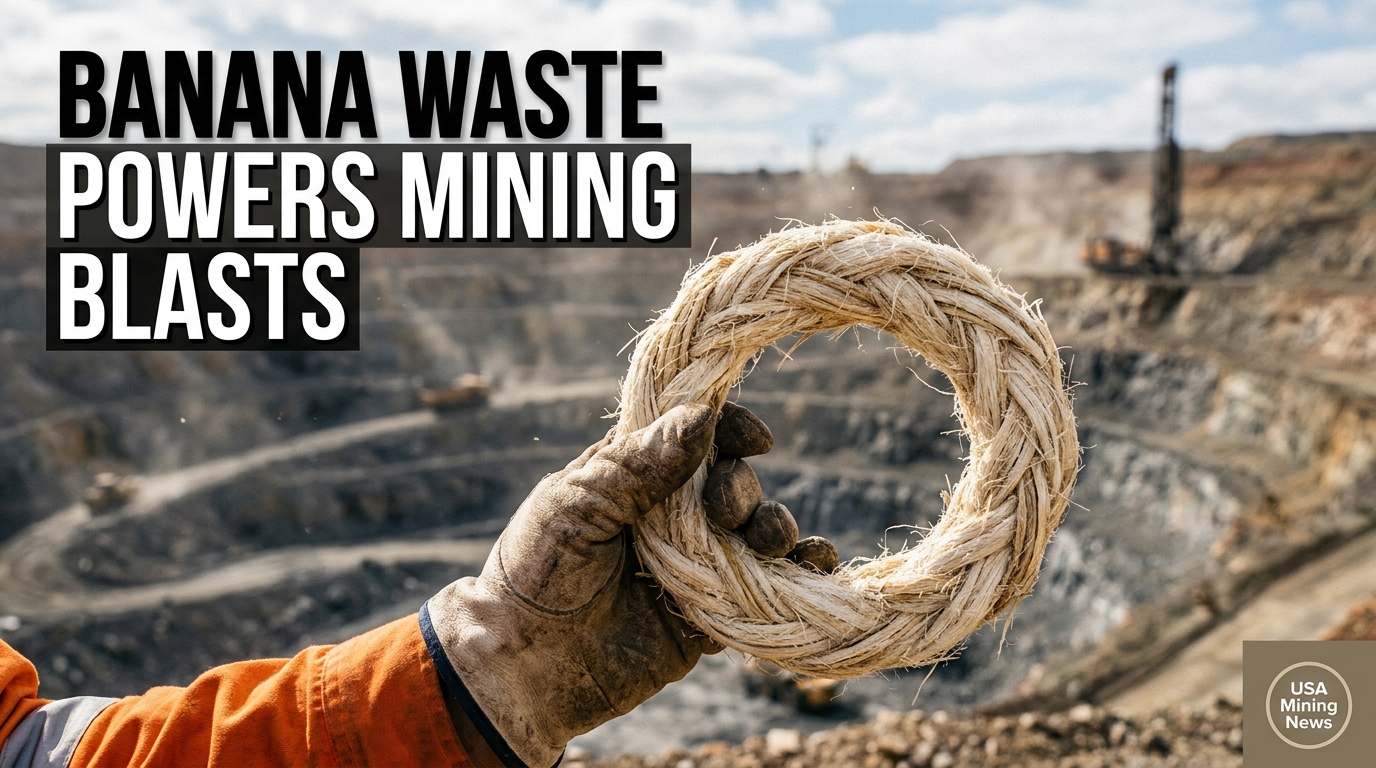
In a significant stride towards greater sustainability within the global mining industry, Australian innovator Papyrus Australia has engineered a groundbreaking solution that transforms agricultural waste into a vital operational component. The company has developed a proprietary process to convert byproducts from banana plantations—specifically stems, stalks, and leaves—into high-performance, biodegradable blast collars for open-cut mining. This pioneering effort not only introduces an environmentally conscious alternative for a critical mining consumable but also addresses a substantial agricultural waste issue, exemplifying the principles of a circular economy.
The development has rapidly moved from trials to commercial application, marked by a multi-million-dollar supply agreement and initial product deliveries to support expanded field evaluations. This initiative, spearheaded by Papyrus Australia and supported by government funding, signals a promising direction for resource management, demonstrating how cross-industry innovation can deliver tangible environmental and operational benefits for the mining sector.
Pioneering Sustainable Blasting: The Banana Fibre Innovation
Blast collars are an indispensable element of drilling and blasting operations in open-cut mines, playing a crucial role in maintaining the integrity of drill-holes prior to firing. These collars help to prevent hole collapse, ensuring that explosives are accurately placed and contained, which is vital for achieving consistent and predictable blasting outcomes. Effective blasting is fundamental to efficient fragmentation, ore recovery, and overall operational safety and cost-effectiveness in mining.
Papyrus Australia's innovation lies in its ability to produce these essential components from an unexpected, yet abundant, source: waste from banana plantations. The company’s patented technology efficiently converts unused banana stems, stalks, and leaves—materials traditionally left to decompose and often posing an environmental challenge—into a robust, biodegradable fibre suitable for industrial applications. This process developed by Papyrus is designed for low-impact conversion, minimizing the environmental footprint of production itself. Unlike conventional blast collars, which may contribute to landfill waste or persist in the environment, the Papyrus solution offers a product designed to naturally break down after use, aligning with the mining industry's increasing focus on environmental stewardship.
Strategic Collaborations and Market Entry
The transition from research and development to commercial viability has been swift and decisive for Papyrus Australia. Following a series of successful joint laboratory and on-site trials conducted in collaboration with industry partners, the company secured a significant supply deal in November. This agreement, valued at A$4.2 million (approximately $3 million USD), is with TBS Mining Solutions, which operates as part of the prominent Australian diversified mining services group, Aquirian. This commercial milestone underscores the industry's readiness to adopt innovative, sustainable solutions that have undergone rigorous performance validation.
Since signing the deal, Papyrus Australia has been actively manufacturing these biodegradable collars. The company has already produced and supplied "several hundred units" to TBS, which are now being deployed for expanded field evaluations. This phase of "final in-field acceptance testing" is critical, allowing mining operators to evaluate the product’s performance under real-world conditions, thereby confirming its operational efficacy and reliability before widespread adoption. Daniel Schmidt, CEO of Papyrus Australia, articulated the dual benefit of this innovation, stating, “The Biodegradable Collar Keeper will be manufactured using our proprietary technology, which is designed for low-impact conversion of the plantation waste material into a valuable fibre resource. For the banana industry, Papyrus Australia also represents a viable opportunity to help the industry utilise its plantation waste.”
Leveraging Waste for Environmental Stewardship
The environmental benefits of Papyrus Australia's innovation extend beyond simply providing a biodegradable product. The Australian banana industry, renowned for its significant agricultural output, concurrently generates substantial volumes of organic byproducts each year. These include vast quantities of unused stems, stalks, and leaves after harvesting. Historically, much of this material has been left within the plantations to naturally decompose. While seemingly innocuous, this decomposition process in anaerobic conditions releases methane, a potent greenhouse gas. These emissions are estimated to be equivalent to thousands of tonnes of CO₂, contributing significantly to the agricultural sector's overall carbon footprint.
This situation makes the Australian banana industry an ideal candidate for circular economy investments. By transforming what was once an environmental liability into a valuable input for another industry—mining—Papyrus Australia demonstrates a powerful model for waste valorization. This approach not only diverts organic waste from decomposition, thereby mitigating methane emissions, but also provides a sustainable source of raw material, reducing reliance on virgin resources. For the mining sector, sourcing such consumables represents a tangible step towards achieving ambitious environmental, social, and governance (ESG) targets and enhancing its social license to operate by integrating more sustainable practices throughout its supply chain.
Government Support and Future Trajectory
Recognizing the transformative potential of this technology, the Australian Government has provided strategic support to accelerate its commercialization. Papyrus Australia, under the leadership of South Australian innovator and commercialisation specialist Al Jawhari, successfully secured a A$250,000 matched-funding grant. This grant was awarded under the Australian Government’s Industry Growth Programme, an initiative designed to foster innovation and help promising technologies bridge the gap from proof-of-concept to scalable production.
The matched-funding grant is instrumental in de-risking the early commercialization phase for Papyrus Australia. Crucially, it also facilitates access to the state-of-the-art Rapid Prototyping and R&D Facility at the University of Adelaide. This collaboration with a leading academic institution provides Papyrus Australia with access to advanced equipment, expertise, and research capabilities, which are vital for optimizing its proprietary banana-fibre processing technology and scaling up manufacturing operations efficiently. This integrated approach, combining governmental support, private sector innovation, and academic research, positions Papyrus Australia to significantly expand its production capacity and market reach. The programme aims to propel the company from its current stage of limited production to a capacity that can meet broader industry demand, illustrating a robust pathway for the commercial scale-up of sustainable technologies.
Broader Implications for Mining and Sustainable Innovation
The adoption of biodegradable blast collars represents more than just a product substitution; it signifies a broader paradigm shift within the mining industry towards genuine sustainability and circular economy principles. As global demand for minerals continues to grow, so does the imperative for mining companies to minimize their environmental footprint and reduce waste across all operational aspects. Papyrus Australia's innovation showcases how seemingly disparate industries can collaborate to create synergistic solutions that deliver mutual benefits.
For mining professionals and investors, this development highlights several critical trends: the increasing viability of bio-based materials in demanding industrial applications, the economic potential of agricultural waste valorization, and the growing importance of ESG factors in operational decision-making and investment strategies. The success of this venture could motivate further research and investment into similar cross-sector innovations, exploring other biomass waste streams for industrial applications globally. Ultimately, Papyrus Australia’s biodegradable blast collars are a testament to the power of ingenuity in tackling complex environmental challenges, offering a blueprint for how the mining industry can evolve towards a more sustainable and resource-efficient future.