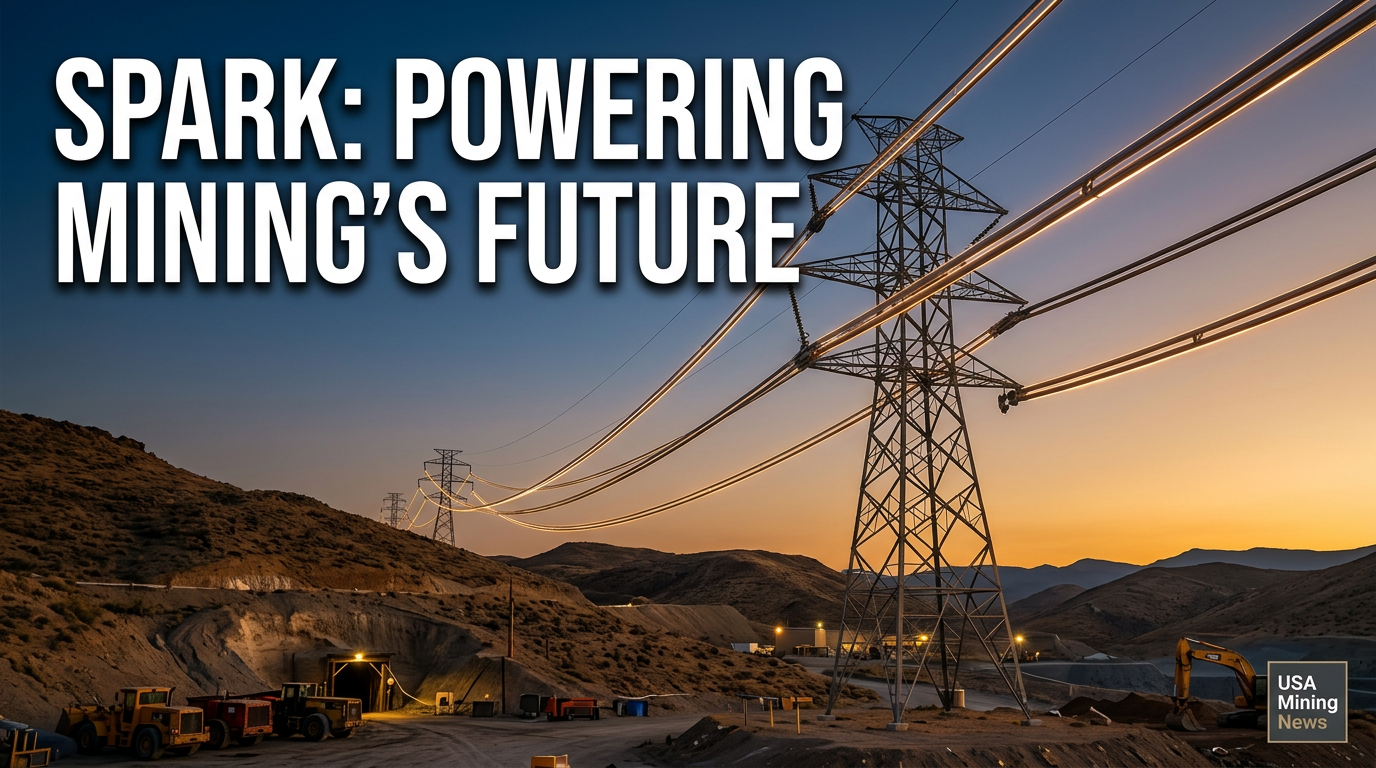
The U.S. Department of Energy's Office of Electricity has announced the approximately $1.9 billion SPARK funding opportunity, a targeted initiative to rapidly upgrade critical grid infrastructure through reconductoring and Advanced Transmission Technologies by August 2026. This investment aims to meet rising electricity demand, enhance grid reliability, and significantly reduce electricity costs for American households and businesses. For the mining sector, this represents a crucial development, promising improved operational efficiencies, support for electrification initiatives, and a more stable power supply vital for continuous operations and the expansion of critical mineral extraction.
U.S. DOE Unveils $1.9 Billion SPARK Initiative for Critical Grid Modernization
**Washington, D.C.** – On March 12, 2026, the U.S. Department of Energy’s Office of Electricity (OE) announced a substantial funding opportunity totaling approximately $1.9 billion, earmarked for urgent upgrades to the nation's power grid. This pivotal investment, part of the "Speed to Power through Accelerated Reconductoring and other Key Advanced Transmission Technology Upgrades" (SPARK) initiative, is designed to enhance grid capacity and reliability, ultimately aiming to lower electricity costs for American consumers and businesses, including the energy-intensive mining sector.
The announcement, made from Washington, underscores a renewed federal commitment to infrastructure essential for robust economic activity and energy security. For an industry as fundamentally reliant on consistent, affordable power as mining, these developments are not merely national news but direct factors influencing operational viability, expansion plans, and overall competitiveness.
Addressing Rising Demand and Enhancing Reliability
The primary impetus behind the SPARK funding opportunity is the pressing need to meet escalating electricity demand across the United States while bolstering resource adequacy. The nation's aging grid infrastructure has struggled to keep pace with both burgeoning industrial requirements and evolving consumption patterns. According to U.S. Secretary of Energy Chris Wright, "For too long, important grid modernization and energy addition efforts were not prioritized by past leaders. Thanks to President Trump, we are doing the important work of modernizing our grid so electricity costs will be lowered for American families and businesses."
This sentiment was echoed by OE Assistant Secretary Katie Jereza, who highlighted the strategic imperative: "The United States must increase grid capacity to meet demand, and ensure the grid provides reliable power—day-in and day-out. Through this SPARK funding opportunity, we will stabilize and optimize grid operations to strengthen it for rapid growth." This focus on stabilization and optimization is particularly relevant for the mining industry, where power interruptions can cascade from lost production into significant safety and environmental risks—making grid stability paramount.
The initiative aligns with President Trump’s Executive Order, *Unleashing American Energy*, which seeks to maximize domestic energy resources and infrastructure. By targeting transmission upgrades, the SPARK program directly supports the broader federal objective of achieving energy independence and economic strength through a modernized energy landscape.
The SPARK Program: Reconductoring and Advanced Transmission Technologies
At the core of the SPARK initiative is a dual-pronged technical strategy: accelerated reconductoring and the deployment of Advanced Transmission Technologies (ATTs).
* **Reconductoring:** This involves replacing existing power lines with higher-capacity conductors. Modern conductors, often made with advanced materials like composite cores, can carry significantly more power both thermally and electrically without increasing line sag or requiring entirely new transmission towers. This process leverages existing rights-of-way, dramatically speeding up project timelines compared to building entirely new transmission lines, which often face lengthy permitting and siting challenges. By utilizing existing routes, the SPARK program prioritizes swift deployment and tangible, rapid results.
* **Advanced Transmission Technologies (ATTs):** These encompass a range of innovations designed to enhance grid performance beyond mere conductor replacement. ATTs can include:
* **Dynamic Line Rating (DLR) systems:** These use real-time weather and line conditions to determine maximum power transfer capability, allowing operators to safely push more power through lines when conditions permit.
* **Advanced sensors and monitoring equipment:** Providing critical data for proactive maintenance and fault detection, improving reliability, and reducing downtime.
* **Power flow controllers:** Devices that optimize electricity flow across the grid, preventing congestion and maximizing transfer efficiency.
* **Grid-enhancing technologies (GETs):** A broader category that includes intelligent software and hardware solutions to improve grid utilization and resilience.
Combined, these technologies are expected to expand grid capacity, increase operational efficiency, lower prices for consumers by reducing congestion and enabling the efficient dispatch of power, and significantly improve the overall system reliability and security of the nation’s electric grid.
A Strategic Continuation of Grid Modernization Efforts
The SPARK opportunity does not emerge in isolation; it strategically builds upon prior federal investments in grid infrastructure. Specifically, it continues the mission of the Grid Resilience and Innovation Partnerships (GRIP) Program, established to provide up to $10.5 billion in competitive funding over five years. The GRIP program, covering fiscal years 2022-2023 and 2023-2024 funding rounds, aimed broadly at strengthening grid resilience and fostering innovation across states, tribes, electric utilities, and other eligible entities.
While GRIP had a broader scope, SPARK represents a focused, rapid deployment effort within the larger grid modernization agenda. It zeroes in on technologies like reconductoring and other ATTs that offer immediate, tangible benefits in expanding transfer capability, strengthening reliability and resource adequacy, and reducing costs. This targeted approach is indicative of a shift towards accelerating deployments that can immediately impact energy costs and grid stability, especially utilizing existing rights-of-way to minimize execution delays.
Crucial Timelines for Industry Participation
For electric utilities and other eligible entities considering participation, the U.S. Department of Energy has outlined clear deadlines:
* **Concept Papers Due:** April 2, 2026
* **Full Applications Due:** May 20, 2026
* **Selections Anticipated:** August 2026
An informational webinar detailing the application process and program specifics is slated to be posted on the OE website by March 19, 2026, providing crucial guidance for potential applicants. This compressed timeline from announcement to selection underscores the urgency the DOE places on rapidly deploying these grid upgrades.
Profound Implications for the U.S. Mining Sector
For the U.S. mining industry, this $1.9 billion investment in grid infrastructure is not merely a technical upgrade but a strategic enabler with far-reaching implications. Mining operations are inherently energy-intensive, from drilling and blasting to crushing, grinding, and refining. Consequently, any federal initiative that promises lower electricity costs, enhanced grid reliability, and increased capacity directly impacts the sector's bottom line and future growth.
* **Operational Cost Efficiencies:** Electricity often constitutes one of the largest operating expenses for mining companies. Reductions in electricity costs, whether through increased grid efficiency or reduced peak demand charges resulting from better grid management, directly translate into improved profitability. A more efficient national grid can also reduce transmission losses, leading to a net saving that can be passed on to industrial consumers. The SPARK program’s explicit goal of "lowering electricity costs for American households and businesses" is a direct benefit to mines.
* **Unlocking Electrification and Decarbonization:** The global mining industry is increasingly moving towards electrification of its fleets and operations to reduce carbon emissions and reliance on fossil fuels. This transition, involving the deployment of electric haul trucks, loaders, and other heavy machinery, necessitates robust, reliable, and high-capacity electrical infrastructure. Upgraded transmission lines facilitated by SPARK can provide the stable and ample power supply required for large-scale charging infrastructure and electric-powered processing plants, accelerating the industry's decarbonization efforts.
* **Bolstering Critical Mineral Production:** The United States is actively working to onshore the supply chains for critical minerals essential for renewable energy technologies, electric vehicles, and national security. Many of these critical mineral deposits are located in remote areas, and their extraction and processing require significant, reliable power. By expanding grid capacity and ensuring resource adequacy, the SPARK program can facilitate the development of new mines and the expansion of existing ones that produce lithium, nickel, copper, rare earth elements, and other vital commodities, aligning with national strategic objectives for domestic mineral supply.
* **Supporting New Mine Project Development:** The availability of adequate power is a fundamental prerequisite for any new mining project. Developers often face significant challenges and costs associated with building out new transmission lines or establishing independent power generation for remote sites. A well-connected, high-capacity national grid reduces this burden, potentially making more deposits economically viable and shortening project development timelines. The emphasis on utilizing "existing rights of way" further implies that new developments might benefit from enhanced power access with less associated infrastructure build-out.
Future Outlook: A Stronger Foundation for Energy Independence
The SPARK funding opportunity represents a targeted, significant federal investment aimed at rapidly addressing critical deficiencies in the U.S. power grid. By focusing on proven technologies like reconductoring and integrating advanced transmission solutions, the DOE is setting a course for a more resilient, efficient, and cost-effective electricity infrastructure.
For the mining industry, this initiative offers a tangible pathway to reduced operating costs, enhanced operational reliability, and crucial support for the ongoing electrification and decarbonization mandates. As the nation pushes to secure its supply chains for critical minerals and transition to a cleaner energy future, a robust and modernized grid is not merely beneficial—it is foundational. The SPARK program, with its expedited timelines and strategic focus, promises to lay a stronger electrical foundation for American industry, ultimately contributing to greater energy independence and economic competitiveness within the global mining landscape.