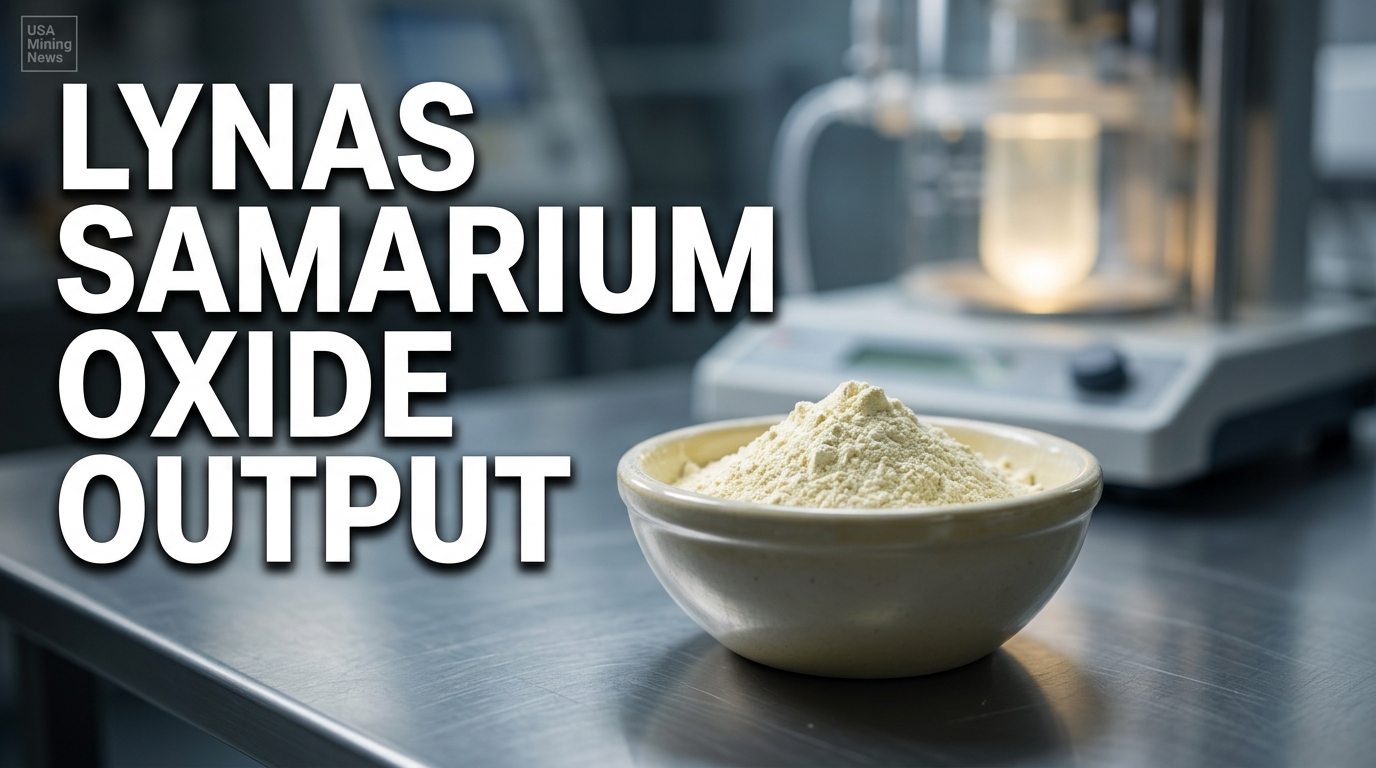
Kuala Lumpur, Malaysia – Lynas Rare Earths, a pivotal player in the global critical minerals sector, has announced a significant operational milestone: the successful initial production of samarium oxide at its state-of-the-art Lynas Malaysia facility. This achievement, confirmed on March 20, 2026, not only marks the first output of this crucial heavy rare earth oxide but also comes ahead of the company's ambitious April 2026 forecast, underscoring Lynas' robust project execution capabilities and technical expertise.
A Strategic Expansion and Timely Delivery
The commencement of samarium oxide production is a testament to Lynas' commitment to enhancing its diverse portfolio of rare earth products. The company initially projected the first output from its expanded heavy rare earth (HRE) separation facility in Malaysia for April 2026. Delivering this key product "on spec and ahead of schedule" is a notable accomplishment in the complex world of rare earth processing, an industry characterized by intricate chemistry and demanding quality controls. Amanda Lacaze, CEO and managing director of Lynas Rare Earths, highlighted the importance of this timely delivery, stating, “The achievement of first samarium oxide, on spec and ahead of schedule, is a significant milestone for Lynas and demonstrates the expertise and capability of our in-house team, which is unique outside China.”
This early success underscores not only efficient project management but also the advanced technical capabilities inherent in Lynas' operations. For an industry heavily reliant on precise chemical separation, the ability to produce a new product meeting stringent specifications ahead of schedule speaks volumes about the company’s operational excellence and its ability to innovate and scale its production sustainably.
The Critical Role of Samarium Oxide
Samarium oxide is far from an obscure industrial chemical; it is a critical ingredient in the production of high-performance permanent magnets, which are indispensable across a wide array of advanced technologies and industries. These specialized magnets are vital components in sectors such as:
- Electronics: Enabling the miniaturization and efficiency of consumer devices and specialized electronics.
- Aerospace and Defense: Used in navigation systems, actuators, and sensor technologies where reliability and performance in extreme conditions are paramount.
- Optics: Crucial for precision optical components and laser systems.
- Catalysts: Employed in various catalytic converters and industrial chemical processes.
- Medical Devices: Integral to advanced diagnostic equipment like MRI machines and precision surgical tools.
The demand for these high-performance magnets is continuously growing, driven by global trends towards electrification, renewable energy, and digital transformation. Samarium-cobalt (SmCo) magnets, in particular, offer superior performance at higher temperatures and greater resistance to demagnetization compared to other magnet types, making samarium oxide an indispensable rare earth for critical applications where stability and durability are non-negotiable.
Lynas' Expanding Heavy Rare Earth Portfolio
With this announcement, Lynas has expanded its offering of separated heavy rare earth oxides to three distinct products, adding samarium to its existing commercial output of dysprosium and terbium oxides. This diversified portfolio solidifies Lynas' status as the sole commercial producer of such separated heavy rare earth oxides outside of the People's Republic of China. This distinction is critically important in the broader context of global supply chain diversification and mineral security, particularly amidst increasing geopolitical focus on reliable access to critical minerals.
Heavy rare earths (HREs) are generally scarcer and more challenging to extract and separate than light rare earths (LREs). Their unique magnetic and electronic properties make them essential for high-tech applications, often commanding higher market prices due to their limited supply. Lynas’ expansion into a broader range of HREs positions it as an even more strategic supplier to multinational manufacturers seeking resilient and geographically diverse sources for these crucial materials.
The "Towards 2030" Growth Strategy: A Roadmap for Expansion
The initial production of samarium oxide is not an isolated event but a foundational step within Lynas’ comprehensive "Towards 2030" growth strategy, which was unveiled in October 2025. This ambitious roadmap outlines the company's plans for significant expansion of its production capabilities to meet escalating global demand for rare earths. A key component of this strategy involves the gradual increase of HRE processing capacity, with an initial suite of separated HREs expected to be fully operational within the next two years.
This initial line-up of separated heavy rare earths includes a range of vital elements:
- Samarium
- Dysprosium
- Gadolinium
- Lutetium
- Terbium
- Yttrium
Beyond this immediate expansion, Lynas is also considering potential enhancements to produce additional products such as europium, holmium, ytterbium, and erbium. However, these further investments are contingent upon securing "favourable commercial agreements" that provide the necessary justification for their development. This pragmatic approach reflects a strategic alignment of production capacity with market demand and securing long-term supply commitments from customers, a common practice in the capital-intensive mining and processing sectors.
Amanda Lacaze emphasized the strategic value of this expanded product range: “The addition of samarium oxide means that we can provide an expanded suite of light and heavy rare earths that customers will use to produce high-performance permanent magnets.” This underscores Lynas' commitment to being a comprehensive supplier to the magnet manufacturing industry, offering a broader palette of essential elements.
Broader Market Implications and Geopolitical Significance
The global mining industry and its downstream consumers have been keenly focused on diversifying rare earth supply chains away from a heavy reliance on a single nation. China currently dominates the rare earth mining, processing, and magnet manufacturing landscape, creating significant supply chain vulnerabilities. Against this backdrop, Lynas Rare Earths has emerged as a cornerstone of the non-Chinese rare earth supply, playing a critical role in fostering global supply chain resilience, particularly for Western economies and industries.
The expansion of Lynas' HRE processing capabilities in Malaysia provides a vital alternative source for these critical materials. Governments in the United States, Europe, Australia, and Japan have all recognized the strategic imperative of securing diversified access to rare earths, often implementing policies and financial incentives to support projects like Lynas'. This development mitigates supply risks for industries reliant on high-performance magnets, from electric vehicles and wind turbines to defense systems, ensuring greater stability and predictability in critical material procurement.
For investors, this expansion signals Lynas' robust growth trajectory and its strengthening market position. Consistent operational achievements, such as early-stage production and capacity expansion, can de-risk future projects and enhance the company’s long-term value proposition by demonstrating reliable execution in a highly specialized field.
Operational Excellence and In-house Expertise
The technical complexity of rare earth separation, particularly for heavy rare earths, cannot be overstated. It involves intricate hydrometallurgical processes requiring specialized knowledge, advanced infrastructure, and stringent environmental controls. The fact that Lynas achieved "on spec" production of samarium oxide ahead of schedule speaks volumes about the company's internal capabilities. This includes its dedicated research and development teams, experienced engineers, and operational staff who possess unique expertise in rare earth processing outside the dominant Chinese industry.
This "in-house team" is a competitive advantage, enabling Lynas to innovate, optimize processes, and swiftly bring new products to market, thereby reinforcing its leadership in sustainable and responsible rare earth production.
Future Outlook and Investment Landscape
Looking ahead, the successful launch of samarium oxide production is merely the beginning of Lynas' journey to significantly scale its HRE operations. The planned gradual increase in HRE processing capacity over the next two years, coupled with the potential for further product diversification, indicates a sustained period of growth and investment. The company’s ability to secure favorable commercial agreements will be critical in determining the scope and speed of future expansions, particularly for more niche heavy rare earth elements like europium and ytterbium.
The continued success of Lynas in expanding its high-value HRE portfolio will undoubtedly attract further attention from global manufacturers and investors. It reinforces the narrative that a viable, diversified, and ethically sourced rare earth supply chain is not only possible but actively growing. As the world continues its trajectory towards advanced technologies and green energy, the demand for these critical minerals will only intensify, positioning Lynas Rare Earths as an indispensable component in the global industrial framework for decades to come.