USA Mining News
Published: April 24, 2026
By: Shree Mishra
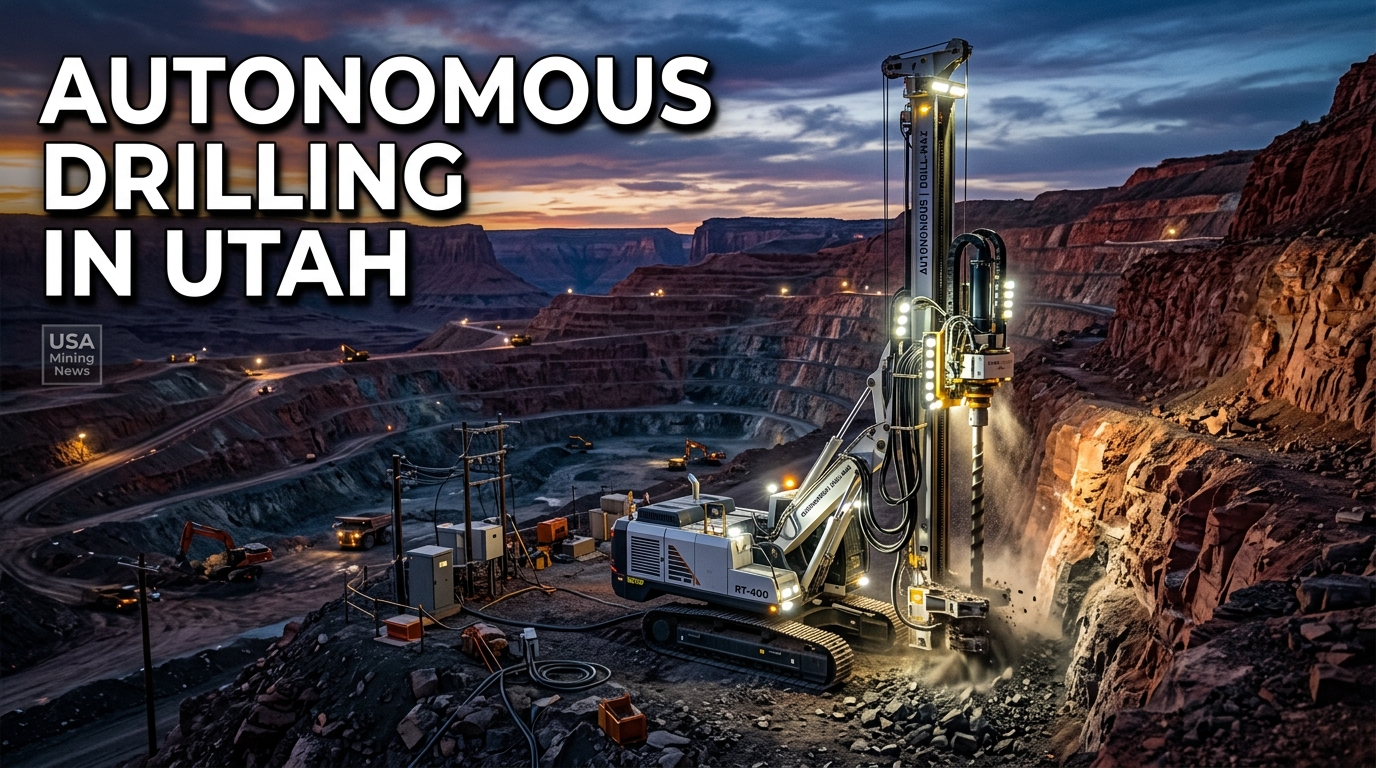
Mariana Minerals and Sandvik Spearhead Autonomous Drilling Revolution in Utah
The global mining industry is on the cusp of a technological transformation, with autonomy emerging as a central pillar for future operations. In a significant development announced on April 24, 2026, Mariana Minerals and Sandvik have embarked on a strategic partnership to implement cutting-edge autonomous drilling technology at Mariana’s Copper One mine, situated in the resource-rich region of south-eastern Utah, US. This collaboration is poised to redefine operational paradigms, transitioning from traditional automation to a more sophisticated, learning-based autonomy that promises to unlock unprecedented efficiencies and safety standards.
Pioneering Autonomous Drilling at Copper One
The Copper One mine, an integral asset for Mariana Minerals, is set to become a proving ground for one of the mining sector's most advanced integrated autonomous systems. The essence of this partnership lies in the seamless integration of Sandvik’s proven AutoMine Surface Drilling platform directly into MarianaOS, Mariana’s proprietary operational software. This synergy moves beyond merely automating individual tasks, aiming instead for a holistic, unified system where drilling activities are intrinsically linked with the overall mining operation. The objective is clear: to foster an intelligent environment where every drill stroke contributes invaluable data, informing and optimizing every subsequent step in the mining value chain.
Sandvik, a global leader in mining and construction equipment and technology, brings to the table its robust AutoMine platform. This system is engineered to execute essential drilling functions with precision and power, including full-power drilling and sophisticated pipe handling. These capabilities are foundational to efficient surface drilling operations, ensuring consistency and accuracy in boreholes, which are critical for effective blasting and material fragmentation.
Seamless Integration: AutoMine into MarianaOS
The true innovation of this partnership lies in the deep integration between Sandvik’s hardware and control systems and Mariana’s software ecosystem. By embedding AutoMine directly into MarianaOS, the systems function as a cohesive unit rather than disparate components. This unified approach facilitates a continuous, bidirectional flow of critical data. Real-time streams of drill activity, comprehensive machine telemetry, and precise geological data are fed directly into MarianaOS. This constant influx of information serves as the lifeblood of Mariana's system, empowering site management and operational teams with dynamic insights that significantly aid decision-making across the entire mining complex.
Mariana Minerals' stated goal for its US operations is to establish a fully autonomous, technology-focused mining environment. The integration with Sandvik’s AutoMine platform is a monumental stride towards achieving this vision. The comprehensive data flow enables MarianaOS to not only monitor operations but also to analyze performance, identify patterns, and ultimately, adapt and optimize processes dynamically. This sophisticated level of integration highlights an accelerating trend toward 'smart mining,' where interconnected systems and data analytics drive continuous improvement.
The Shift from Automation to Autonomy
Turner Caldwell, CEO of Mariana Minerals, articulated the profound implications of this integration, stating, “The drill is where the mine begins. When you integrate it into your operating system, it doesn’t just execute a plan – it informs and improves everything that follows. That is the shift from automation to autonomy. Sandvik gives us the platform, and MarianaOS turns it into a system that learns. That is what we are building at Copper One.”
This statement encapsulates a fundamental paradigm shift in mining. Traditional automation handles repetitive tasks, executing predefined plans with efficiency. True autonomy, however, introduces a layer of intelligence and adaptability. In the context of the Copper One mine, while AutoMine flawlessly performs critical tasks like drilling and pipe handling, MarianaOS elevates this capability by leveraging detailed operational and subsurface data. This data transforms raw information into actionable intelligence, enabling the system to refine and improve downstream decision-making continuously.
For instance, real-time information on drill performance metadata – such as penetration rates, bit wear, and power consumption – combined with geological signals captured during drilling operations (e.g., changes in rock hardness or composition) are fed into advanced models. These models actively refine subsequent operational parameters, including:
- Blast Design: Optimizing fragmentation based on geology and drill performance to improve crusher throughput and reduce energy consumption.
- Material Routing: Directing excavated material more effectively based on grade control refined by drilling data, minimizing waste handling.
- Maintenance Planning: Proactive scheduling of equipment maintenance based on telemetry-driven predictive analytics, reducing unplanned downtime.
- Production Planning: Adapting overall mine planning in real-time to maximize output and efficiency, responding to actual ground conditions rather than static models.
This creates a powerful feedback loop where drilling outcomes consistently enhance subsequent actions, embodying the true spirit of a learning system.
Operational Transformation and Workforce Evolution
The transition to autonomous drilling at Copper One is not merely a technological upgrade but a fundamental reimagining of on-site practices and the workforce structure. Operators, traditionally engaged in the manual manipulation of heavy machinery, will now transition to new roles involving the management and oversight of coordinated, software-led fleets. This shift necessitates a different skill set, moving focus from joystick controls to data analysis, system monitoring, and strategic intervention.
Moreover, the implementation of such advanced technology introduces a demand for new technical roles. These positions will be crucial for maintaining system performance, ensuring the integrity and quality of the vast data streams, and continuously optimizing operations. Teams will be empowered to concentrate on higher-value strategic decisions, fostering a more intellectual and less physically demanding work environment, all while retaining comprehensive oversight of the autonomous processes. This evolution contributes to enhanced safety, as fewer personnel are exposed to hazardous environments, and machines operate with controlled precision, reducing human error.
Strategic Importance for Domestic Copper Production
Beyond the immediate operational benefits, the autonomous initiative at Copper One carries significant strategic importance for the broader US economy and its burgeoning demand for critical minerals. The United States currently imports approximately 50% of its refined copper, a reliance that presents both economic and national security vulnerabilities. Projections indicate that domestic demand for copper is expected to double by 2035, primarily driven by rapid technological advancements.
This surging demand is fueled by the accelerating global transition to green energy and electric vehicles (EVs). Copper is a fundamental component in:
- Electric Vehicles: Used extensively in motors, batteries, and wiring.
- Renewable Energy Infrastructure: Essential for solar panels, wind turbines, and grid modernization projects.
- Data Centers and Electronics: Critical for high-speed connectivity and power transmission.
- Modern Infrastructure: Integral to smart cities and advanced manufacturing sector.
In this context, initiatives like the Mariana-Sandvik partnership are vital for fast-tracking domestic copper operations, reducing import dependency, and securing a reliable supply chain for critical industries. Mats Eriksson, President of Sandvik Mining, underscored this significance: “Sandvik AutoMine transforms the mining process, delivering safer, more productive and insightful drilling operations. Pairing AutoMine with MarianaOS will unlock new levels of efficiency and safety for the Copper One mine, and we are delighted to support Mariana Minerals as they develop this important site.” The project directly contributes to the nation's energy independence and technological competitiveness.
Sandvik's Broader Autonomy Play
This partnership at Copper One is also indicative of Sandvik’s broader, aggressive strategy in advancing autonomous mining solutions across various operational fronts. Earlier in April 2026, Sandvik further demonstrated its commitment to innovation by launching the DD423i, a next-generation automated development drill rig. While the Copper One project focuses on surface drilling, the DD423i represents a significant advancement in underground mining technology, showcasing Sandvik's comprehensive approach to delivering intelligent, automated solutions across the full spectrum of mining operations. This dual focus highlights the industry's rapid adoption of advanced robotics and AI to optimize both surface and subsurface extraction methods.
The Future of Data-Driven Mining
The collaboration between Mariana Minerals and Sandvik at the Copper One mine serves as a powerful testament to the future trajectory of the mining industry. It showcases how integrating intelligent systems can lead to a more efficient, safer, and environmentally responsible mining operation. The continuous feedback loop from the drill bit to the executive decision-making desk fundamentally changes how resources are extracted and managed. By embracing learning systems and data-driven insights, the mining sector can navigate the complexities of mineral extraction with unprecedented precision and adaptability.
The ability to refine blast designs, optimize material flow, predict maintenance needs, and adjust production plans based on real-time sub-surface conditions promises not only to reduce operational costs but also to minimize environmental impact through more precise and efficient resource utilization. This project in Utah is more than just an technological deployment; it is a blueprint for the mines of tomorrow, pushing the boundaries of what is possible in resource extraction and contributing significantly to the stability of critical mineral supply chains in the United States.