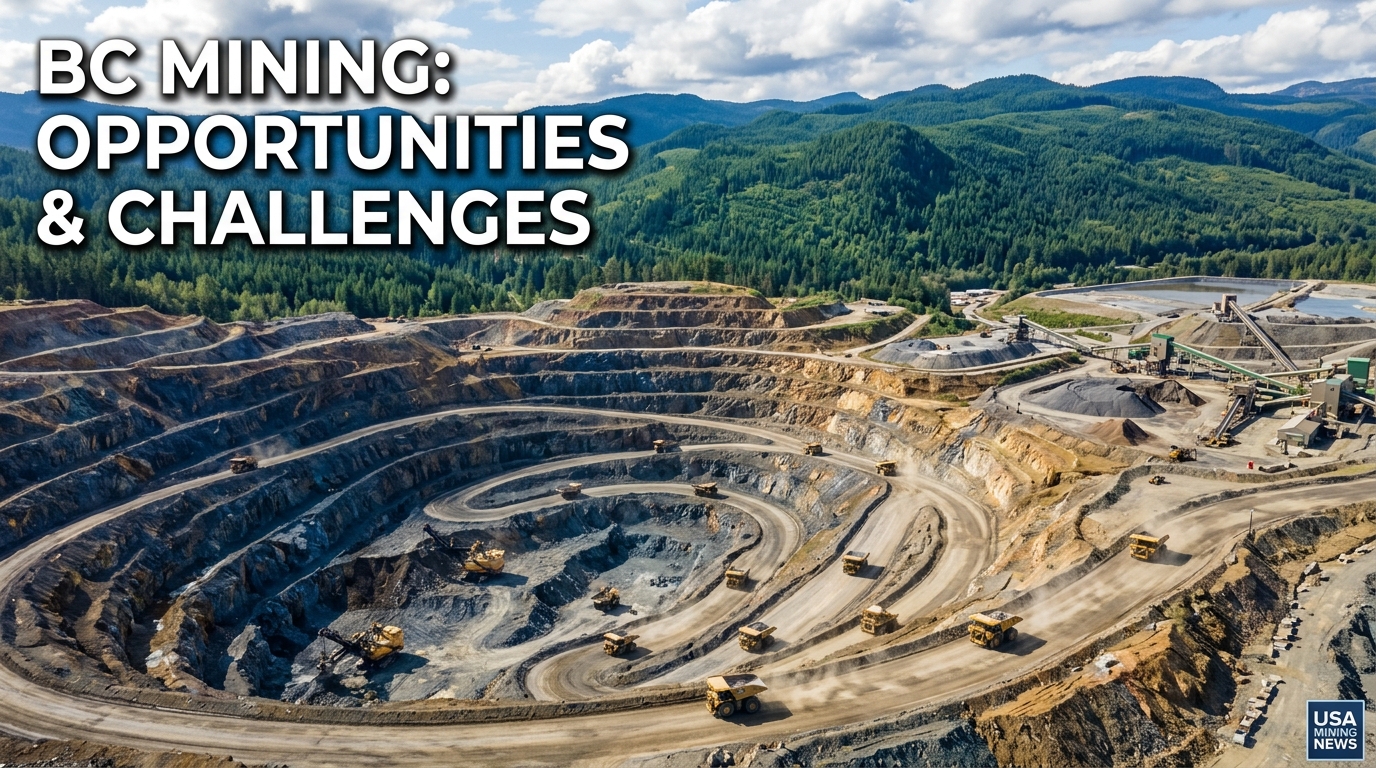
VANCOUVER, B.C. – British Columbia’s mining industry stands as a formidable economic pillar, contributing significantly to the provincial coffers and job markets while positioning itself at the forefront of the global demand for critical minerals. However, this promising outlook is tempered by critical policy and cost challenges, according to the Mining Association of B.C. (MABC). Speaking at a Greater Vancouver Board of Trade event at the Fairmont Hotel Vancouver on Tuesday, May 6, 2026, MABC CEO Michael Goehring underscored the sector’s substantial impact but cautioned that prevailing regulatory uncertainties could jeopardize future investment in the province.
British Columbia's Mining Sector: A Strategic Economic Engine
The MABC's new Economic Impact Study, released concurrently with Goehring’s address, paints a compelling picture of a sector that, despite its relatively small physical footprint, exerts a powerful economic influence. In 2024 alone, British Columbia’s mining industry generated an impressive C$19.6 billion (approximately $14.4 billion USD) in economic output. This robust activity supported a staggering 56,000 jobs across the province and contributed nearly C$6 billion in revenues to government treasuries. Goehring emphasized the efficiency of this output, stating, “All of that from 18 mines and two smelters.” He added, “Mining has a small physical presence, but a large economic impact in B.C. Our mines punch well above their weight.”
These operations include the Rio Tinto BC Works aluminium smelter in Kitimat and Teck Resources’ zinc-lead smelting and refining complex in Trail, facilities crucial to processing raw materials and adding downstream value. While British Columbia is a major producer of copper, Goehring noted a critical gap in the processing chain: there are currently no operational copper smelters within the province, primarily due to the unviable economics of establishing such facilities under current market conditions. This highlights a strategic vulnerability and a potential opportunity if economic factors shift.
Momentum in Project Development and Northern British Columbia's Potential
Despite the challenges, there are tangible signs of progress, signaling a period of revived mining activity within British Columbia. The provincial government, in conjunction with the federal Major Projects Office, has actively fast-tracked key developments. Out of 18 priority developments identified by the province, four are mining projects. Three of these four have now successfully received their requisite permits, with two already transitioning into the construction phase.
Notable projects that exemplify this forward momentum include:
- Teck Resources’ Highland Valley Copper extension near Logan Lake, which will prolong the life of one of North America's largest copper-molybdenum mines.
- Skeena Gold and Silver’s Eskay Creek project in northwestern B.C., an advanced high-grade gold-silver development poised to reopen a historic mine.
- Centerra Gold’s Mount Milligan mine life extension near Prince George, aimed at maximizing the value and longevity of its significant copper-gold asset.
This surge in activity extends particularly to northern B.C., where an additional 24 proposed projects are progressing through various stages of development. The scale of potential investment tied to these northern projects is immense, with the construction phase alone estimated to generate more than $67 billion in economic output, according to figures cited in the MABC report. This influx of large-scale capital, if realized, promises to transform regional economies and bolster British Columbia's position as a prominent global supplier of essential minerals.
Metro Vancouver: A Global Mining Hub
Goehring also highlighted the often-underestimated yet profound connection between the province’s remote mining operations and its urban economic centers. Metro Vancouver, in particular, serves as a vital corporate and financial hub for the industry. In 2024, British Columbia’s operating mines and smelters were responsible for supporting over 12,300 jobs in Metro Vancouver and contributed more than C$3.5 billion in annual economic output for the combined Metro Vancouver and Vancouver Island regions.
The MABC report further revealed Metro Vancouver’s unique standing as home to nearly 1,000 mining and exploration companies, boasting a collective market capitalization of approximately C$449 billion. This concentration of corporate and financial expertise firmly establishes the city as a major international center for mining. Goehring drew a clear parallel: “While Calgary has oil and gas, Vancouver has mining. Metro Vancouver is a global mining centre.” This status holds even greater significance given the proposed $53-billion mega-merger between Anglo American and Teck Resources, which, if finalized, would create a global copper giant with its headquarters firmly planted in Vancouver. Such a development would not only solidify Vancouver's role but also amplify its influence in global commodity markets.
Navigating Regulatory Hurdles: The DRIPA Imperative
While the underlying assets and economic potential are clear, the industry’s optimism remains tempered by persistent concerns over regulatory delays and policy uncertainty. Goehring identified lengthy regulatory processes as the “primary barrier” to new mine development in British Columbia, even acknowledging recent improvements. “There’s more work to do to build on this momentum and drive systemic change and durable improvements to accelerate our province’s mine permitting process,” he stated.
A significant contributor to this uncertainty is the evolving interpretation and application of British Columbia’s Declaration on the Rights of Indigenous Peoples Act, or DRIPA. The mining sector is closely monitoring recent court decisions tied to this act. In a December 2025 ruling, the British Columbia Court of Appeal definitively determined that DRIPA incorporates the United Nations Declaration on the Rights of Indigenous Peoples (UNDRIP) and, crucially, establishes legally enforceable obligations within the province. This ruling has intensified pressure on Premier David Eby, who has faced criticism for what some perceive as “flip-flopping” on plans to amend or suspend portions of the act.
During a panel discussion that followed his remarks, Goehring reiterated the industry’s plea: “We need clarity, we need certainty. Investment hates uncertainty.” While mining companies continue to forge strong relationships with First Nations communities through partnership agreements, Indigenous employment initiatives, and equity participation opportunities—recognizing the indispensable role of Indigenous consent and collaboration—the MABC CEO stressed the critical need for clearer policy direction from governmental bodies. The legal enforceability of DRIPA, while a step towards reconciliation, introduces complexities that, without clear guidelines, can prolong project timelines and escalate investment risk, making British Columbia less competitive for global capital.
Cost Pressures and Labor Challenges
Adding to the regulatory landscape, the mining industry is also pushing back against recent provincial tax changes. The expansion of the provincial sales tax (PST) to encompass some professional services is projected to increase operational costs for mining projects already contending with significant financing pressures. According to Goehring, one advanced-stage mining company estimates that these changes alone could add between C$2 million and C$3 million in costs between 2027 and 2030, a substantial burden on projects with already tight margins.
Simultaneously, the sector faces a looming challenge in workforce recruitment. The Mining Industry Human Resources Council predicts that British Columbia will require an additional 5,000 net new workers over the next decade to meet the anticipated demand stemming from new projects and ongoing operations. Addressing this labor shortage will be crucial for the province to fully capitalize on its mineral wealth, requiring concerted efforts in training, education, and talent attraction.
Outlook: Seizing the Critical Minerals Opportunity
Despite these compounding challenges, mining executives remain convinced that British Columbia is exceptionally well-positioned to capitalize on the rising global demand for critical minerals and metals. These commodities are indispensable for the ongoing electrification of the economy, the transition to green energy, and the development of high-tech industries. The province’s diverse mineral endowment, coupled with its established infrastructure and skilled workforce, presents a potent combination.
“It’s a once-in-a-lifetime opportunity,” Goehring stated, encapsulating the immense potential for British Columbia to become a pivotal player in the global energy transition. However, he cautioned that realizing this potential demands unwavering commitment and strategic focus. “But now more than ever, we need to remain focused, committed and determined.” The ability of the provincial government and industry stakeholders to provide regulatory clarity, manage escalating costs, and proactively address labor shortages will ultimately determine whether British Columbia can fully unlock its mineral wealth and solidify its position as a leading global supplier of the essential materials driving the future.