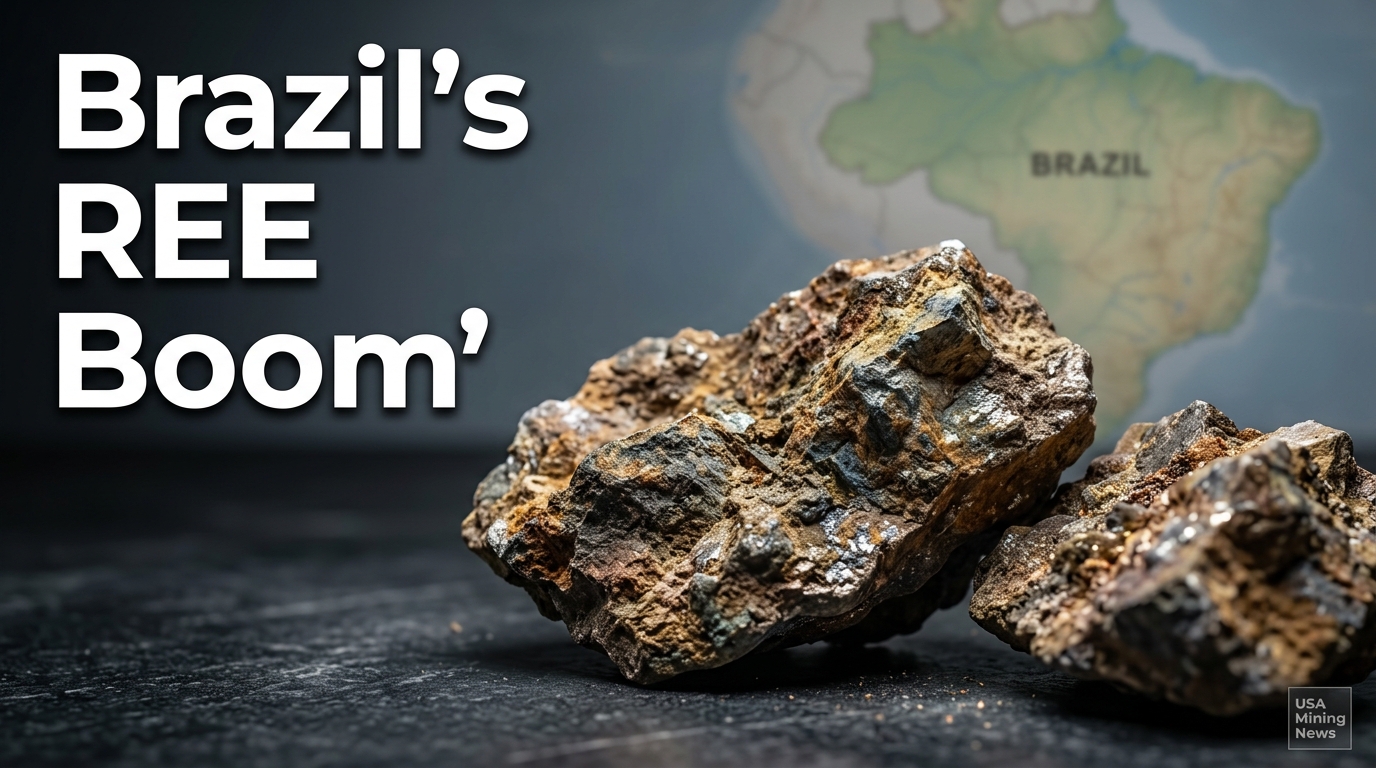
In a significant move poised to reshape its strategic focus and expand its presence in the critical minerals sector, Origen Resources has signed a letter of intent (LoI) to acquire an extensive rare earth elements (REEs) project in north-eastern Brazil. Announced on April 17, 2026, this acquisition targets a property spanning more than 33,000 hectares within Piauí and Bahia states, representing a proactive step by Origen to solidify its position in an increasingly vital commodity market.
Origen Targets Brazilian REE Potential with Strategic Acquisition
The acquisition, if finalized, will see Origen Resources gain a substantial footprint in an area identified as an emerging hub for rare earth deposits. The LoI is with Incorporadora e Mineração Santa Rosa, the current vendor of the Brazilian project. This property not only adds significant acreage but also strategically expands Origen’s existing exploration presence in the region, particularly within Piauí State, and includes claims extending into Bahia State.
This move is indicative of a broader industry trend where companies are actively seeking to secure supply chains for critical minerals outside of traditional sources. Rare earth elements are indispensable for numerous high-tech applications, including electric vehicles, wind turbines, advanced electronics, and defense systems. Brazil, with its vast geological potential, is increasingly being recognized as a key player in the future diversification of REE supply.
Initial Exploration Unveils Promising Anomalies
Prior to Origen’s involvement, Incorporadora e Mineração Santa Rosa conducted initial exploration work, including a soil sampling program, which has revealed encouraging prospects. This sampling identified an anomalous REE area measuring approximately 4km by 6km, suggesting significant mineralization potential within the vast land package.
A total of 33 soil samples were collected at intervals of approximately 1.5km across the property. Of these, seven samples returned elevated values, with a notable peak of 282 parts per million (ppm) total rare earth oxide plus yttrium (TREO+Y). While 282 ppm might appear modest in some geological contexts, it is a significant indicator for early exploration, particularly when targeting certain types of REE deposits. TREO+Y refers to the combined concentration of the 15 lanthanide elements along with yttrium, a transition metal often grouped with REEs due to its similar geochemical properties and co-occurrence in many rare earth deposits. The identification of an anomalous zone of this scale and grade at such an early stage provides a strong basis for further, more detailed exploratory work.
The Strategic Importance of Ion Adsorption Clay-Hosted REE Deposits
Origen’s strategic interest in this project is specifically geared towards identifying ion adsorption clay-hosted (IAC) REE deposits. This particular style of mineralization is of increasing significance in the global rare earth market for several compelling reasons:
- Economic Extraction: IAC deposits are typically found at or near the surface, allowing for simpler and less expensive mining methods compared to hard rock deposits. The rare earths are adsorbed onto clay minerals, making them amenable to relatively straightforward and low-cost leaching processes, often without the need for complex and energy-intensive comminution (crushing and grinding).
- Heavy Rare Earth Enrichment: A key advantage of many IAC deposits is their propensity to contain a higher proportion of heavy rare earth elements (HREEs). HREEs, such as dysprosium (Dy) and terbium (Tb), are particularly critical for high-performance magnets used in electric vehicle motors and wind turbines, and their supply is often more constrained and strategically important than that of light rare earth elements (LREEs).
- Environmental Considerations: Unlike some hard rock REE deposits, IACs typically have lower associated radioactivity, which can simplify processing and reduce environmental management challenges.
Brazil has already demonstrated its potential for hosting commercially viable IAC deposits, with projects such as Serra Verde in Goiás and Caldeira in Minas Gerais serving as important examples. Serra Verde, in particular, represents a significant non-Chinese source of rare earths. By targeting this mineralization style, Origen aims to leverage established geological analogues within Brazil and potentially contribute to the Western world's efforts to diversify its critical mineral supply chains, traditionally dominated by Chinese IAC production.
Deal Structure and Due Diligence Framework
The terms outlined in the LoI provide a clear framework for Origen’s potential acquisition and subsequent development of the project. Origen has secured a 150-day exclusivity period, during which it will conduct its comprehensive due diligence. This exclusivity ensures that Origen has ample time to thoroughly evaluate the project’s technical, legal, and financial aspects without competition.
Upon satisfactory completion of due diligence and the execution of a definitive agreement, Origen may acquire a 70% ownership stake in the project. The proposed consideration for this stake includes an upfront payment to the vendor of $100,000 USD (equivalent to C$136,826 at the time of the announcement) and the issuance of two million Origen shares. A further payment of $100,000 USD and the issuance of an additional four million shares are scheduled for the second anniversary of the definitive agreement.
Beyond these payments, Origen has committed to significant exploration expenditure, pledging to spend $1.5 million USD on exploration activities within two years of finalizing due diligence. This commitment underscores the company's intent to rapidly advance the project through the early exploration phases. After this initial two-year period, Origen and Santa Rosa will operate the project as a 70/30 joint venture (JV), with Origen holding the majority stake. Incorporadora e Mineração Santa Rosa will also retain a 2% royalty on future production, a common mechanism to provide ongoing benefit to the original property holders. Origen does retain an option to buy back 1% of this royalty for $1.5 million USD prior to the commencement of production, providing a pathway to consolidate a larger share of future revenues if deemed strategically beneficial.
To support the due diligence process and forthcoming fieldwork, Incorporadora e Mineração Santa Rosa will collaborate with a local Brazilian consultant. Overseeing the entire technical due diligence will be Coast Mountain Geological, a reputable geological consulting firm based in Vancouver, Canada, which will bring independent expertise to the evaluation.
Origen's Expanding Footprint and Corporate Strategy
The acquisition aligns perfectly with Origen Resources’ articulated corporate strategy, as highlighted by CEO and Director Gary Schellenberg. He stated, “With this acquisition, Origen will be one of the largest claim holders in this emerging rare earth belt, controlling over 68,000ha.” This extensive land package positions Origen to explore a district-scale area, increasing the potential for significant discoveries and future resource expansion.
Schellenberg further emphasized the importance of this approach, noting, “Early-stage, impactful acquisitions have been key to our success in the past, and being among the first to identify the significance of this belt has allowed our team to acquire this district-scale land package.” This statement reflects a strategic philosophy of securing prospective ground ahead of broader industry recognition, aiming to maximize shareholder value through early-mover advantage. The aggregation of over 68,000 hectares is particularly impactful in an exploration play, as it provides geological continuity and allows for systematic, regional-scale exploration programs.
This focus on Brazilian REEs also signifies a potential strategic shift for Origen. For context, in April 2024, Origen Resources agreed to divest its 100% stake in the Arlington project in British Columbia, Canada, to compatriot Nickelex Resources. This divestiture, alongside the new Brazilian REE focus, suggests a sharpened portfolio strategy, concentrating capital and efforts on opportunities deemed to have higher growth potential or strategic advantage in the current market environment.
Market Implications and the Future of REE Supply
The growing global demand for REEs, driven by electrification and advanced technologies, has put immense pressure on supply chains. Concerns over geopolitical stability and the dominance of a single supplier nation have prompted Western governments and industries to seek diversified and secure sources. Brazil, with its rich geological endowment and supportive regulatory environment, is emerging as a critical alternative for REE supply.
New discoveries and development of IAC deposits, like those targeted by Origen, are particularly important due to their potential to provide cost-effective and environmentally sound production of key heavy rare earths. Should Origen's project advance successfully, it could contribute to addressing the supply deficit for these critical materials, offering a non-Chinese source that is attractive to global manufacturers looking to de-risk their supply chains. For investors in the mining sector, this represents an opportunity to participate in the growth of strategically important commodities with significant long-term demand.
Next Steps and Outlook
The immediate next step for Origen is the diligent execution of its 150-day due diligence period. As CEO Gary Schellenberg indicated, "Due diligence work on this project will commence in the coming weeks to further define the prospectivity of this new claim package." This phase will involve a detailed review of all existing geological data, potentially extending to further field verification, to confirm the initial findings and assess the overall geological and economic potential of the project.
If the due diligence is successful and a definitive agreement is reached, Origen will proceed with the committed $1.5 million exploration program over the subsequent two years. This program will likely involve systematic soil sampling grid infill, ground geophysics, and potentially initial drill programs to delineate mineralized zones and establish a maiden resource estimate. The long-term outlook for Origen, assuming a successful exploration and development trajectory, involves establishing a significant rare earth operation within Brazil, further diversifying its portfolio and contributing to the global supply of these indispensable elements.