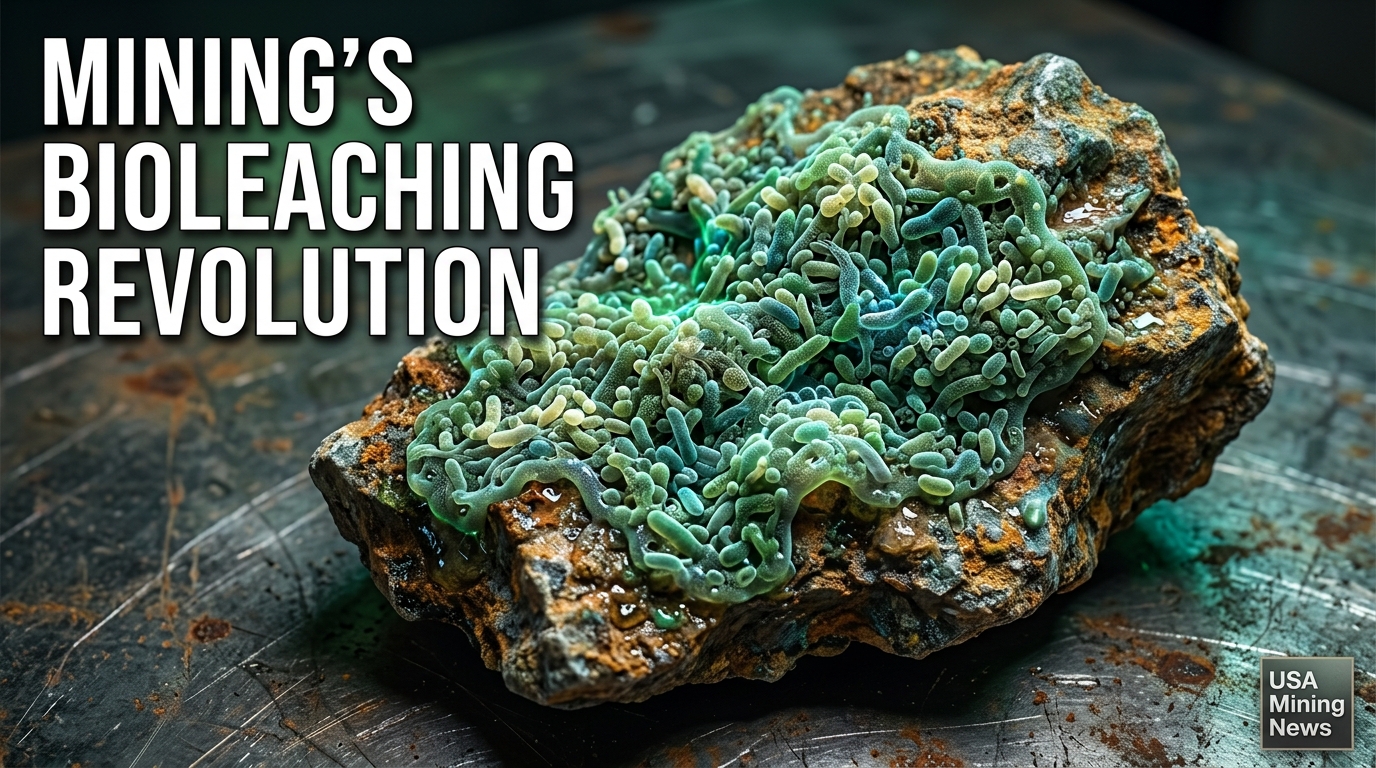
The global mining sector stands at a critical juncture, facing multifaceted challenges that demand innovative solutions. Declining ore grades necessitate more efficient extraction methods, while an unprecedented surge in demand for critical minerals—essential for the accelerating energy transition—places immense pressure on existing supply chains. Simultaneously, the imperative to decarbonize operations and reduce environmental footprints is reshaping corporate strategies across the industry. In this context, bioleaching, a process that harnesses the power of microorganisms to solubilize metals from various feedstocks, is re-emerging not merely as an alternative but as a potentially transformative technology.
An insightful analysis published on June 18, 2026, highlighted how advances in microbiology, coupled with shifting market dynamics and the search for lower-emission processing routes, are bringing bioleaching squarely back into focus. This resurgence is driven by the potential for bioleaching to offer a more sustainable and economically viable pathway for metal recovery, particularly from complex or low-grade resources that conventional methods struggle to process efficiently.
Bioleaching: A Refined Approach to Metal Extraction
While the fundamental concept of bioleaching—employing microorganisms to extract metals from ores, concentrates, and waste materials—is not new, its practical applications have historically been constrained. For decades, industrial bioleaching was largely confined to niche areas, primarily focusing on copper and gold processing, utilizing a relatively narrow spectrum of microorganisms and ore types. However, as noted by Priit Joers, Chief Scientific Officer at BiotaTec, this paradigm is undergoing a significant transformation.
The inherent appeal of bioleaching lies in its ability to offer an alternative to energy-intensive conventional processing routes, which typically involve crushing, grinding, concentration, and smelting. These traditional methods are not only capital-intensive but also carry substantial energy and carbon footprints. Bioleaching, by contrast, operates at lower temperatures and with significantly reduced energy requirements, offering a pathway to lower emissions and enhanced operational sustainability.
The discussion around bioleaching's future, as prominently featured in the analysis, drew insights from leading experts in the field: Priit Joers of BiotaTec, Ross Orr, CEO of BacTech, and Darina Štyriaková, CEO of ekolive. These industry leaders underscored that a confluence of technological advancements and evolving market conditions is creating unprecedented opportunities for bioleaching, opportunities that simply did not exist in previous decades.
Microbiological Breakthroughs and Enhanced Selectivity
A pivotal factor driving the renewed interest in bioleaching is the dramatic expansion of microbiological capabilities. Joers elucidated how advances in molecular biology have broadened the understanding and application of microorganisms for industrial uses. Historically, the mining industry relied primarily on microbes that derive energy from oxidizing iron and sulfur. While effective for certain ore types, this limited the technology's overall versatility. Today, researchers are exploring a much wider array of biological agents capable of interacting with diverse feedstocks.
Crucially, these scientific breakthroughs are leading to improved selectivity in metal extraction. "We can actually tune in to these metals of interest," Joers explained, highlighting the ability to train or engineer microorganisms to target specific metals. This enhanced selectivity is a game-changer, allowing for more precise and efficient recovery of valuable elements, even from complex mineral matrices or mixed waste streams where multiple metals are present. This capability moves bioleaching beyond bulk metal recovery, opening doors to the selective extraction of critical and strategic minerals.
The expanding scope of feedstocks is another significant development. Beyond conventional ores, bioleaching technologies are now being developed and tested for processing mining waste and even end-of-life industrial waste streams. This widens the resource base for metal recovery, aligning with the principles of a circular economy and simultaneously addressing environmental liabilities associated with waste disposal.
Bridging the Gap from Pilot to Commercial Scale
Despite its considerable promise and compelling environmental advantages, bioleaching has yet to achieve widespread commercial deployment across the global mining sector. Darina Štyriaková of ekolive shed light on this persistent challenge. Her company has collaborated with hundreds of mining companies over the years, successfully completing numerous trials and pilot projects. However, the critical hurdle has often been translating this interest and pilot success into full-scale commercial implementation.
One of the primary impediments to broader adoption has been the question of scale and integration. As Ross Orr of BacTech put it, "Can you actually build it?" The mining industry, characterized by large-scale operations and significant capital investments, demands proven, robust, and scalable technologies. BacTech's strategic response to this challenge has been to integrate established bioleaching processes with existing, proven downstream technologies. This approach allows for the creation of new flowsheets that seamlessly incorporate biological extraction without forcing miners to abandon their established and reliable processing infrastructure. Such an integrated model mitigates risk and lowers the barrier to entry for companies considering bioleaching, addressing concerns about operational continuity and capital expenditure.
Transforming Mining Waste into Strategic Resources
The potential for bioleaching to revolutionize tailings management represents one of its strongest selling points. Mining tailings – the residual materials left over after the extraction of target minerals from ore – are often vast depositories of untapped value and significant environmental liabilities. Traditional tailings contain not only residual target metals but also other valuable elements and potentially hazardous substances.
Orr detailed BacTech's pioneering work on Vale's historical nickel mining waste in Sudbury, Canada. This project exemplifies the dual benefits of bioleaching: it seeks not only to recover nickel, copper, and cobalt from sulphide tailings but also to create additional value streams from the remaining material. The successful implementation of such projects could transform legacy waste sites from environmental burdens into economically viable and strategically important sources of metals.
Joers further emphasized that the low operating temperatures, reduced energy requirements, and lower emissions inherent to bioleaching make it particularly attractive for processing historical waste streams that were previously considered uneconomic. As governments worldwide increasingly seek greater supply-chain security for critical raw materials, these legacy materials could become essential future sources. The ability to recover valuable metals from existing waste deposits reduces reliance on new mining operations, with their associated permitting and social license challenges.
Štyriaková reinforced this point by referencing tailings sites in Slovakia where copper concentrations remain higher than grades currently being actively mined by the industry. This stark observation underscores that historic waste deposits are not merely inert liabilities but represent a significant, largely untapped resource that bioleaching technologies are uniquely positioned to unlock.
Strategic Implications and Future Outlook for the Mining Sector
The re-emergence of bioleaching is therefore more than just a technological curiosity; it is a strategic imperative for the mining industry. Policymakers and industry leaders are increasingly recognizing bioleaching’s potential to address several intertwined challenges:
- Unlocking Critical Raw Materials: Accessing metals from historic waste deposits enhances national resource security.
- Addressing Environmental Liabilities: Processing tailings not only recovers value but also mitigates the long-term environmental risks associated with these sites.
- Decarbonization Pathways: Offering a lower-emission alternative to conventional pyrometallurgical processes, aiding the industry’s net-zero ambitions.
- Economic Viability: Making uneconomic low-grade ores and waste materials viable feedstocks through more efficient and selective extraction.
Ultimately, similar to the broader energy transition, the widespread future adoption of bioleaching will hinge on the industry's ability to bridge the gap between technical promise and commercial deployment. The underlying technology has existed for decades. However, the current confluence of significant advances in molecular biology, coupled with an escalating global demand for critical minerals and an urgent need for sustainable practices, presents an unprecedented opportunity for bioleaching to move from a specialized application to a mainstream solution in the global mining sector.
The insights discussed, originating from an episode of Energy Technology, powered by data and analysis from GlobalData and its associated publications like Mining Technology, provide a deep dive into these industry-defining topics. As the mining sector continues its evolution, the quiet power of microorganisms may well prove to be one of its most disruptive and beneficial innovations.