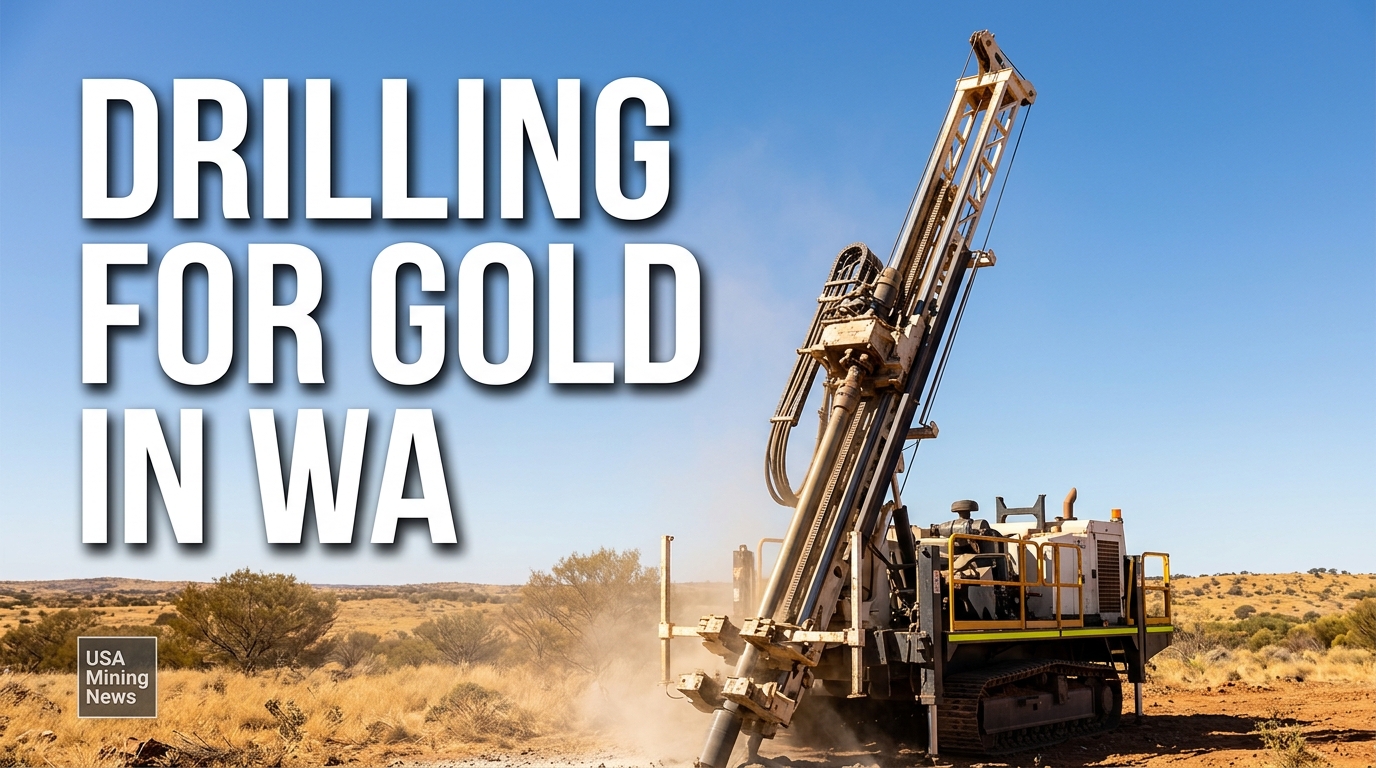
Austin Metals has embarked on a pivotal exploration phase with the commencement of a reverse circulation (RC) drilling program at its Austin Gold Project, strategically located near Cue in Western Australia’s highly prospective Murchison region. This initiative, announced on June 11, 2026, represents a significant step for the company as it systematically tests newly defined gold targets across its 111km² tenement holdings. The program is designed to complete approximately 4,000 meters of drilling, with operations slated to run through June and July 2026, marking a concerted effort to unlock the project's gold potential.
Strategic Exploration Commences in Western Australia's Murchison Region
The Austin Gold Project is situated within the Murchison goldfield, a prolific historical and current gold-producing province of Western Australia. This region is renowned for its Archaean greenstone belts, which host numerous gold deposits, including significant banded iron formation (BIF)-hosted and shear-zone-related gold systems. Austin Metals’ current drilling initiative is focused specifically on the Northern Zone of the Austin Gold Project, where recent exploration efforts have successfully delineated a pipeline of compelling new gold targets.
The selection of RC drilling as the method for this initial campaign is strategic. RC drilling is a cost-effective and efficient technique suitable for early-stage exploration, providing a rapid assessment of lithology, alteration, and mineralisation across significant strike lengths and depths. This method allows Austin Metals to quickly gather critical geological data to evaluate the tenor and geometry of the identified gold zones, which is vital for informing subsequent, more targeted phases of exploration, potentially involving diamond drilling to obtain detailed structural and geotechnical information.
Brunswick Hill: A High-Priority Gold Target
The drilling program commenced in the Brunswick Hill area, identified by Austin Metals as a standout prospect within the Northern Zone. This initial phase of drilling will test five high-priority gold target areas distributed along a substantial 3-kilometer stretch of prospective banded iron formation (BIF) stratigraphy. BIFs are well-known hosts for gold mineralisation in several world-class deposits within Western Australia, including those in the adjacent Cue-Mt Magnet district, a point highlighted by Austin Metals Managing Director, Mike Moore.
The rigorous target definition process at Brunswick Hill employed by Austin Metals leveraged a multi-disciplinary approach, integrating several key geological and geochemical indicators. These indicators include:
- Strong presence of favorable chert-magnetite BIF host rocks, which provide ideal structural and chemical environments for gold deposition.
- Interpretation of structural intersections, where faults and shears create dilation zones that can serve as conduits and traps for mineralising fluids.
- Evidence of oxidised quartz-sulphide veining, a common association with lode gold systems in Archaean greenstone terrains, indicating the passage of gold-bearing hydrothermal fluids.
- Positive geochemical anomalies, which act as direct or pathfinder indicators of underlying gold mineralisation.
The convergence of these geological characteristics provides confidence in the potential for significant gold discoveries at Brunswick Hill, aligning with the geological footprints observed in other major BIF-hosted gold systems throughout the Murchison region.
Expanding Horizons: Mt Sandy and Future Prospects
Following the initial, concentrated efforts at Brunswick Hill, the RC drilling program is scheduled to advance to the Mt Sandy area. This phase of drilling at Mt Sandy is designed to investigate potential extensions to gold mineralisation that was previously identified through earlier exploration activities. Historical work at Mt Sandy revealed gold occurrences associated with quartz-sulphide veining, a geological signature often indicative of robust gold systems. These veins typically occur along a sheared mafic-felsic contact, a geological setting globally recognized for its prospectivity in Archaean gold camps.
Austin Metals' specific objectives for drilling at Mt Sandy include:
- Testing the lateral and depth extensions of the previously delineated gold-mineralised zones.
- Examining areas that have been modelled as prospective for hosting higher-grade gold at greater depths, which could significantly impact the economic viability of any future resource.
Beyond Brunswick Hill and Mt Sandy, Austin Metals is already looking ahead, with planning and assessments currently underway for future drilling programs at other identified prospects within the Austin Gold Project, including Teds and Shadow. This systematic, phased approach underscores the company's long-term commitment to fully exploring and developing the project's potential.
Operational Timelines and Strategic Insights
The drilling operations, spanning June and July 2026, represent a period of intense activity for Austin Metals. The company anticipates receiving crucial assay results approximately four to six weeks after the completion of the drilling campaign. This timeframe is standard for laboratory processing and quality control protocols in the mining industry, and the results will be eagerly awaited by stakeholders and the wider market. Once received, these assay results will be fundamental in allowing Austin Metals to refine and update its existing geological model for the Austin Gold Project. A more accurate and comprehensive geological understanding is critical for optimizing future exploration strategies, including the positioning of subsequent drill holes and the potential allocation of resources towards more advanced studies.
Mike Moore, Managing Director of Austin Metals, articulated the significance of this phase, stating, "The commencement of drilling marks an important milestone for Austin as we begin testing a pipeline of compelling gold targets generated through our recent exploration work. This program is the first meaningful drill test of several newly generated gold targets, and we look forward to delivering regular exploration milestones over the coming months. The Brunswick Hill area is a standout, with more than 3km of prospective BIF stratigraphy and multiple targets exhibiting similar geological characteristics observed at significant BIF-hosted gold systems in the Cue-Mt Magnet district." His comments underscore the company's confidence in the geological potential and the calculated approach being taken.
Industry Implications and Regional Context
For mining industry professionals and investors, the initiation of this drill program by Austin Metals is noteworthy for several reasons. Firstly, it highlights the continuous investment and exploration activity by junior mining companies, which are critical drivers of new discoveries and ultimately, future gold supply. Western Australia remains a premier global jurisdiction for gold exploration and production, supported by robust infrastructure, a skilled workforce, and a generally favorable regulatory environment. Projects like Austin Gold contribute to the ongoing vibrancy of this sector.
The focus on BIF-hosted gold systems is particularly relevant. BIFs are metallogenically important in the Archaean cratons, often hosting large gold deposits due to their brittle nature, which allows for the formation of significant fault-controlled structures during regional deformation events. These structures act as excellent conduits for gold-bearing fluids, and the reactive iron-rich nature of BIF can also promote gold precipitation. Understanding the geological controls, as Austin Metals is demonstrating through its target definition, is key to successful exploration in these terrains.
Moreover, the systematic progression from regional exploration leading to specific drill targets, and then moving from initial high-priority areas to evaluating extensions and deeper potential, is a textbook example of best practices in mineral exploration. This methodical approach minimizes risk and maximizes the probability of successful resource delineation.
The Road Ahead for Austin Metals
The coming months will be crucial for Austin Metals. The receipt and interpretation of assay results from the 4,000m RC drilling program will be the next major catalyst for the company. Should these results demonstrate significant gold intercepts at Brunswick Hill and Mt Sandy, it would not only validate Austin Metals’ exploration strategy but also potentially attract increased investor interest and provide the impetus for accelerated follow-up drilling, possibly including diamond core drilling to better understand structural controls and provide material for metallurgical testing.
Looking further ahead, the planned drilling at prospects such as Teds and Shadow indicates a strong belief in the broader upside of the Austin Gold Project. A sustained pipeline of exploration targets is vital for a junior explorer, demonstrating long-term growth potential. The ultimate success of the Austin Gold Project lies in its transition from promising exploration targets to a defined mineral resource, a journey that begins with impactful drilling programs such as the one currently underway.