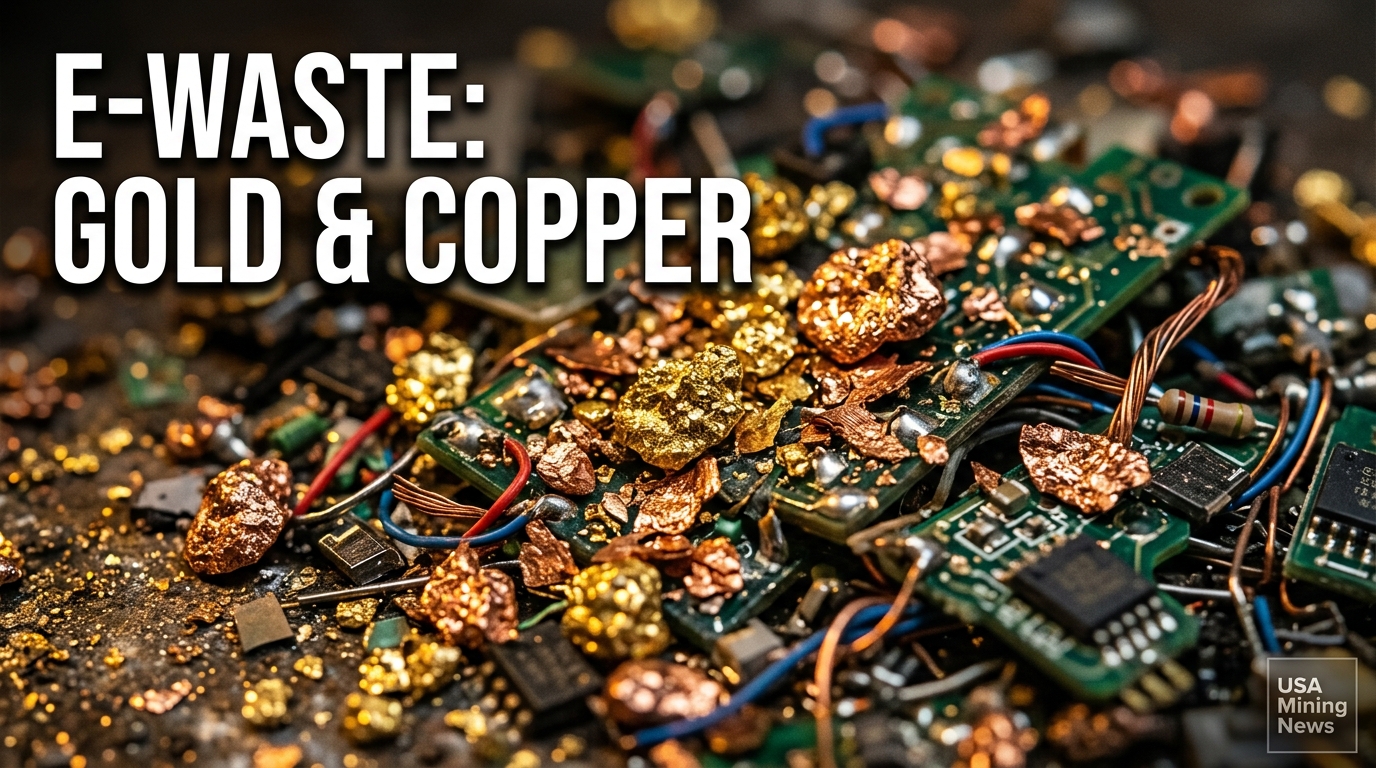
In a notable development poised to redefine urban mining, the University of Edinburgh has announced the licensing of a groundbreaking gold and copper recovery process to Lithium Universe, a prominent mineral processing company. This innovative technology, dubbed the Gold Copper Diamide Extraction (GCDE) process, offers a cleaner and more sustainable method for extracting high-value metals from the rapidly accumulating global stream of electronic waste (e-waste). Announced on May 29, 2026, at 12:06 pm, this agreement positions Lithium Universe to globally deploy and sub-license the GCDE process, signaling a strategic reinforcement of its precious metals recycling capabilities and a tangible step towards mitigating both the environmental and economic challenges posed by discarded electronics.
A New Frontier in Urban Mining: The GCDE Process
Developed by the University of Edinburgh’s School of Chemistry, specifically by Professors Jason Love and Carole Morrison, and commercialized with crucial support from Edinburgh Innovations, the GCDE process represents a significant leap forward in hydrometallurgical extraction. This technology employs specialized organic compounds, referred to as small, reusable organic ligands, that behave like molecular magnets. These ligands are designed to selectively target and extract metals in a precise sequence.
The core innovation lies in its ability to operate under remarkably mild conditions, utilizing low-temperature hydrometallurgy. This stands in stark contrast to conventional e-waste processing methods, which predominantly rely on energy-intensive furnace smelting, often requiring temperatures exceeding 1,200°C, or aggressive chemical leaching techniques. Both traditional approaches are not only energy-intensive but also significant sources of pollution. A critical advantage of the GCDE process is its complete avoidance of highly toxic and environmentally detrimental reagents such as cyanide and mercury, as well as minimizing the use of organic solvents.
Professor Love highlighted the strategic design philosophy behind the GCDE process in a news release, stating, “Electronic waste is effectively a high‑grade ‘urban ore’. Our goal was to design chemistry that can recover those metals selectively and safely, without the energy and environmental cost of smelting.” He further elaborated on the selectivity: “The diamide behaves like a molecular magnet for gold. By following with a selective copper step, we can recover two of the most valuable metals in e-waste with high purity and lower environmental impact.” This dual-metal selectivity ensures a high purity of recovered gold and copper, maximizing the economic yield while significantly reducing the environmental footprint of the recycling operation.
The Growing Imperative of E-Waste Recycling
The licensing of the GCDE process comes at a critical juncture, as electronic waste has emerged as one of the world’s fastest-growing and most complex hazardous waste streams. Projections from the University indicate a staggering increase, with global e-waste volumes expected to reach approximately 93.5 million tonnes by the year 2030. Despite this escalating tide of discarded devices, only about 20% of current e-waste is recycled using methods considered environmentally sound. This leaves an enormous portion either accumulating in landfills or being processed through informal channels, often leading to severe environmental degradation and public health risks.
The economic incentive to address this issue is substantial. E-waste is far from mere rubbish; it is, as Professor Love aptly described, a valuable “urban ore.” Discarded devices, particularly printed circuit boards, are remarkably rich in precious and base metals. At current market prices, a single tonne of typical e-waste is estimated to contain gold worth more than $46,000. Additionally, the copper content within that same tonne can add approximately another $2,000 to its intrinsic value. These figures dwarf the typical metal content of many virgin ore deposits, underscoring the immense economic opportunity in efficient, sustainable e-waste recycling.
For the mining industry, which is globally focused on resource security and sustainable supply chains, e-waste represents an underexploited resource. The ability to recover these metals from urban sources reduces the reliance on traditional, often more environmentally impactful, primary mining activities. Furthermore, it addresses critical questions of geopolitical supply chain resilience for essential industrial metals.
Lithium Universe's Strategic Expansion into Circular Economy Solutions
Lithium Universe’s acquisition of this exclusive global license for the GCDE technology signifies a strategic expansion of its precious metals recycling division. The company will be responsible for both deploying the technology in its own operations and sub-licensing it to other entities worldwide, effectively becoming a global facilitator for this advanced e-waste recovery solution.
Executive Chair Iggy Tan articulated the company’s vision, stating, “This breakthrough from the University of Edinburgh reinforces the strategic expansion of our precious metals recycling division into high-value recovery technologies.” He emphasized the integration of these capabilities: “By integrating selective metal recovery with sustainable processing, the company would strengthen its competitive position in circular-economy solutions for gold, silver and copper recovery.”
This move is not an isolated venture for Lithium Universe. The company already possesses and deploys silver recovery technologies designed for end-of-life solar panels. The integration of the GCDE process positions Lithium Universe as a diversified leader in sustainable recovery across multiple high-value commodities originating from diverse e-waste streams. This holistic approach aligns perfectly with the growing global emphasis on the circular economy, where resources are kept in use for as long as possible, extracting the maximum value from them, then recovering and regenerating products and materials at the end of their service life.
Market Implications and Future Outlook
The widespread adoption of technologies like GCDE holds profound implications for the global mining and metals industry. Firstly, it offers a tangible pathway to increase the supply of critical metals like gold and copper without the environmental burden associated with opening new mines or expanding existing ones in sensitive areas. As global demand for electronics continues to surge, so too will the need for these metals, and urban mining presents a vital supplementary source.
Secondly, the shift towards cleaner, low-carbon recovery processes resonates strongly with corporate environmental, social, and governance (ESG) mandates that are increasingly influencing investment decisions and corporate strategies across the mining sector. Companies demonstrating leadership in sustainable practices are likely to gain a competitive edge and attract responsible investment capital.
Looking ahead, Lithium Universe's global deployment plan for GCDE represents a significant commitment to scaling this innovative solution. The success of this global rollout will not only enhance the company’s market position in the burgeoning precious metals recycling space but also set a precedent for future academic-industry collaborations in circular economy initiatives. The mining industry, traditionally focused on primary extraction, is increasingly looking towards such partnerships to diversify its resource streams and enhance its sustainability credentials. The GCDE process, therefore, is not merely a technical advancement; it is a blueprint for a more responsible and resource-efficient future for critical metal supply.
In conclusion, the licensing of the University of Edinburgh's GCDE technology to Lithium Universe marks a pivotal moment in the evolution of e-waste recycling. By offering a high-purity, low-impact, and economically viable method for recovering gold and copper from urban ore, this collaboration promises to transform how the mining industry approaches secondary resource utilization. It underscores the growing recognition that the challenges of growing e-waste volumes can be effectively addressed through innovation, turning an environmental burden into a significant economic opportunity within a truly circular economy framework.