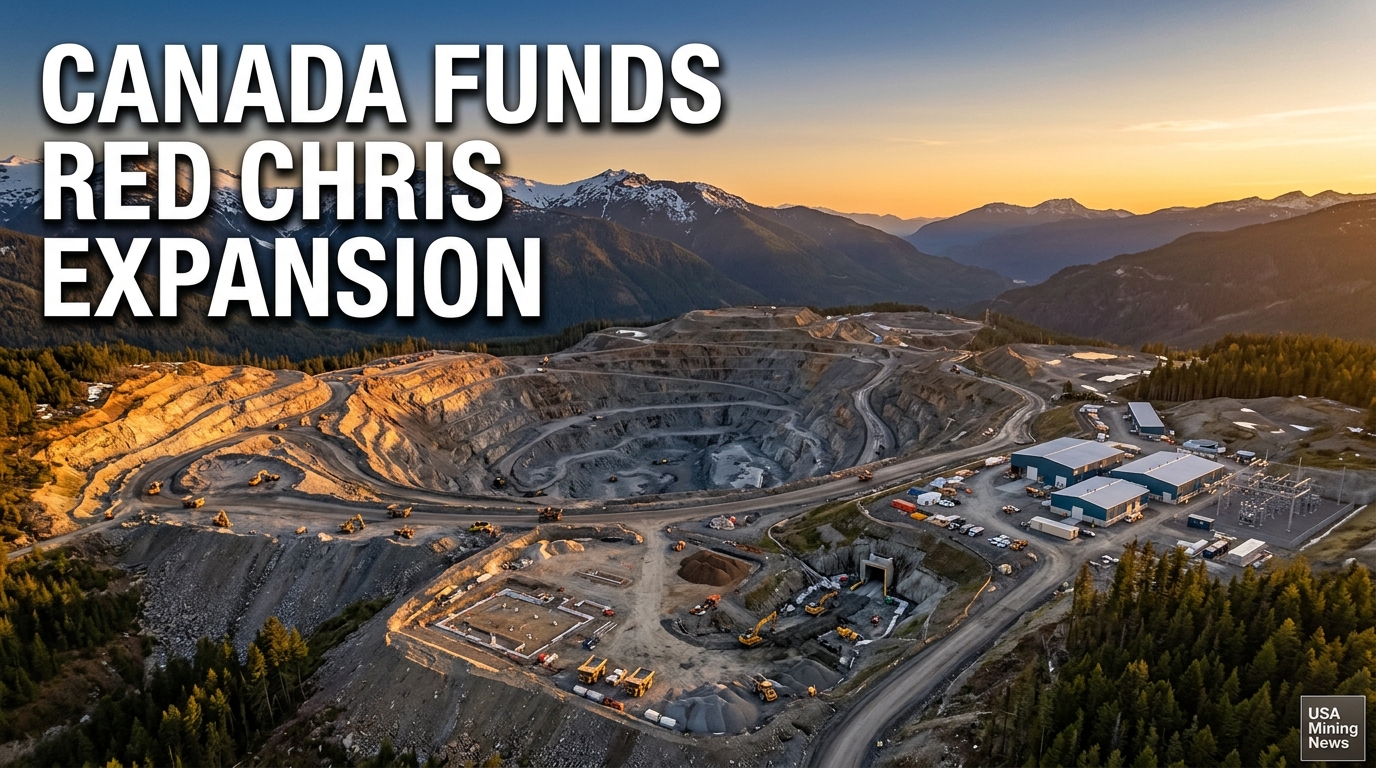
The Canadian government has announced a substantial financial commitment of C$500 million (approximately $352 million USD) to the Red Chris Block Cave expansion project in British Columbia. This investment, confirmed on Thursday, July 3, 2026, underscores Canada's strategic initiative to fast-track pivotal mining developments across the nation, particularly those impacting critical minerals and the green energy transition. The funding is a significant endorsement for the joint venture between Newmont and Imperial Metals, aiming to transform one of British Columbia's most promising copper-gold deposits.
Driving Critical Minerals Supply and Sustainable Mining
The government's commitment to Red Chris is multifaceted, addressing both economic growth and environmental stewardship. In an official statement, the Canadian government highlighted the expected outcomes: "We will invest $500 million to expand Red Chris mine, which will increase Canada’s annual copper production by more than 15%, support critical minerals demand for clean energy and manufacturing, and reduce greenhouse gas emissions by over 70% once operational." These targets align with Canada's broader national strategy to secure its position in the global supply chain for critical minerals, which are indispensable for technologies ranging from electric vehicles to renewable energy infrastructure. Copper, in particular, is witnessing robust demand driven by global electrification trends, making projects like Red Chris strategically vital.
The Red Chris Deposit: A World-Class Copper-Gold Resource
Located within the prolific Golden Triangle region of British Columbia, the Red Chris porphyry deposit is renowned for its immense mineral endowment. Geological surveys and resource estimations indicate a substantial reserve base, comprising an estimated 20 million ounces of gold and 13 billion pounds of copper across its measured, indicated, and inferred resource categories. Such a significant endowment positions Red Chris as a long-life asset with the potential to be a major contributor to both global copper and gold markets for decades. The Golden Triangle itself is a globally recognized mining district, characterized by its rich geological formations that host several world-class precious and base metal deposits, further enhancing the appeal and strategic importance of the Red Chris project.
Key Players: Newmont and Imperial Metals Forge Ahead
The Red Chris mine is a joint venture between two prominent mining entities: Colorado-based Newmont and Canada’s Imperial Metals. Newmont (NYSE: NEM, TSX: NGT), recognized as the world’s largest gold miner, holds a majority ownership stake and serves as the operator of the project. Its involvement signifies a strategic diversification, leveraging its extensive operational expertise in large-scale mining projects to develop a significant copper-gold asset. Imperial Metals (TSX: III) holds a 30% joint venture interest, representing a substantial asset for the Canadian mid-tier miner and underscoring its continued presence in British Columbia's mining landscape.
The collaboration between a global leader like Newmont and a proven Canadian miner like Imperial Metals creates a robust partnership capable of executing a project of this scale and complexity. Newmont’s statement following the government’s announcement reiterated this strength. "Newmont welcomes the government of Canada’s announcement of a C$500 million contribution to support the Red Chris Block Cave project," the company stated. "As we advance through our approval process toward a final investment decision, this commitment strengthens the business case for the development of a world-class copper-gold operation." This endorsement from Newmont highlights the tangible impact of government support in de-risking major capital investments and accelerating project timelines.
Technical Transition: From Open Pit to Block Cave
A cornerstone of the expansion is the planned transition from conventional open-pit mining to an underground block caving operation. This significant technical shift is pivotal for unlocking the deeper, higher-grade sections of the Red Chris porphyry deposit and extending the mine’s operational lifespan into the mid-2040s.
Block caving is an underground mining method suitable for large, deep, relatively uniform ore bodies. It involves undercutting large blocks of ore, which then progressively collapse under gravity, allowing for continuous extraction with relatively low operating costs once the operation is established. While requiring substantial upfront capital investment and a lengthy development period, block caving offers several advantages for deposits like Red Chris, including:
- Access to massive ore bodies at significant depths, which are uneconomical for open-pit mining.
- Potential for high production rates once fully operational.
- Improved safety as mining occurs entirely underground.
- Reduced surface footprint compared to large open-pit operations.
The choice of block caving reflects a strategic decision to maximize the long-term value of the Red Chris deposit, transitioning it into a highly efficient, high-volume underground operation.
Regulatory Hurdles Cleared, Feasibility Study Nearing Completion
In a crucial development last month, the Red Chris Block Cave project received necessary regulatory approvals. This milestone is fundamental, as navigating complex environmental and operational permitting processes is often a significant hurdle for large-scale mining projects. Securing these approvals paves the way for the physical development phase and reinforces the project’s viability.
Newmont is currently finalizing a definitive feasibility study (DFS) for the project. A DFS is a comprehensive technical and economic evaluation that provides a precise estimate of capital and operating costs, production forecasts, and key financial metrics. Its completion is a critical precursor to a Final Investment Decision (FID) by the joint venture partners, which would then unlock the full development of the block cave. The government’s financial commitment arrives at an opportune moment, providing significant confidence as the DFS concludes and an FID looms.
Economic and Social Impact: Jobs and Regional Development
Beyond its contribution to critical mineral supply, the Red Chris expansion is projected to deliver substantial economic benefits to British Columbia and Canada. The project is expected to generate more than 1,800 jobs during its construction phase. Once operational, it will sustain a total approximate workforce of 1,500 peak-season operational roles. These figures represent a significant boost to regional employment in northern British Columbia, providing high-paying jobs and stimulating local economies through procurement and services. Such large-scale employment creation aligns with the government’s objectives for fostering economic growth and opportunity in resource-rich regions.
Future Outlook: A Blueprint for Canadian Mining
The Canadian government's C$500 million pledge to the Red Chris Block Cave expansion sets a notable precedent. It signals a proactive approach to supporting strategic mining initiatives, especially those tied to critical minerals and sustainable development. As global demand for copper and other critical minerals intensifies, driven by the clean energy transition, government intervention in de-risking and accelerating such projects could become a template for future developments across Canada. The Red Chris project, with its robust mineral endowment, advanced mining plan, and strong governmental backing, is poised to become a cornerstone of Canada’s critical mineral strategy and a vital asset in the global pursuit of a greener future. Its success could encourage further public-private partnerships, bolstering Canada's position as a reliable and responsible source of essential raw materials.