Hancock Iron Ore has successfully commenced production at its A$840 million ($579 million) McPhee Creek mine in Western Australia's Pilbara region, overcoming regulatory delays to deliver its first ore after nearly 19 months of development. This significant milestone for the Australian mining giant, led by executive chairman Mrs. Gina Rinehart AO, underscores the continued investment and strategic importance of the Pilbara in the global iron ore market, integrating new production with existing infrastructure at the Roy Hill facility.
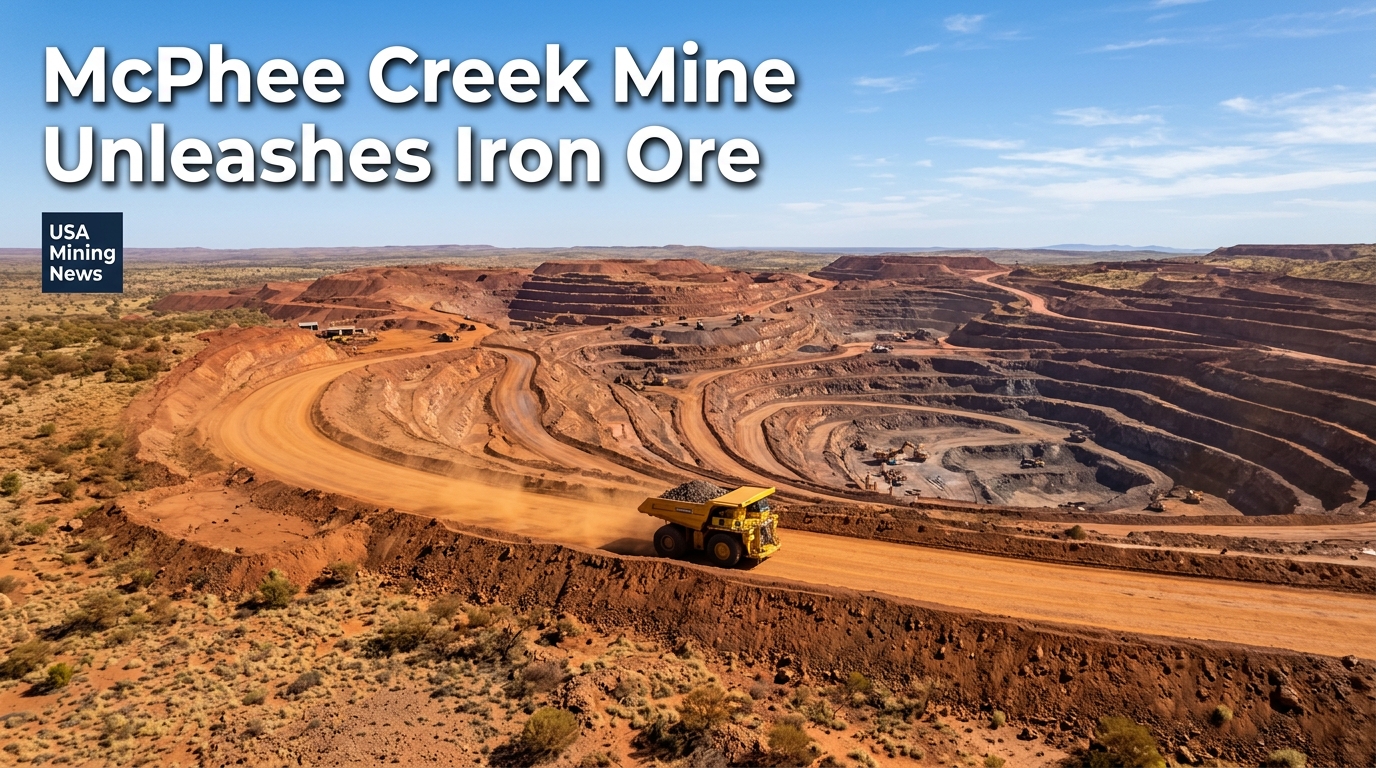
In a material development reinforcing Western Australia's enduring prominence in the global commodity supply chain, Hancock Iron Ore, a subsidiary of Hancock Prospecting, has officially announced the commencement of production at its new McPhee Creek mine. Located in the highly prospective Pilbara region, approximately 100 kilometers north of the operational Roy Hill Mine and 30 kilometers north of Nullagine, this A$840 million (US$579 million) venture marks a significant expansion of Hancock's iron ore operations, delivering its first ore after what the company described as nearly 19 months of intensive development work. The initiation of production at McPhee Creek represents a culmination of years of strategic planning, extensive engineering, and diligent navigation of Australia's complex regulatory landscape, solidifying Hancock's position as a vital player in the international iron ore market.
Hancock Iron Ore Begins Production at McPhee Creek
The news, formally announced on June 29, 2026, by Hancock Iron Ore, details the successful transition from an intensive construction phase to initial ore production. This achievement at McPhee Creek is a testament to large-scale project management and the strategic vision of Hancock Prospecting. The mine's location within the Pilbara, a region synonymous with high-quality iron ore deposits, places it at the heart of Australia's resource sector. The financial outlay for the project, totaling A$840 million (with an approximate US dollar equivalent of $579 million at the time of reporting), highlights the substantial capital investment required to bring a mine of this scale into operation in a remote yet resource-rich environment.
The development timeline itself, spanning nearly 19 months from groundbreaking to the first ore delivery, is indicative of the rapid progress made once all essential approvals were in place. This speed reflects not only robust project execution capabilities but also the urgency in bringing new production to market to capitalize on demand and optimize return on investment. The project's success is a critical addition to Hancock Iron Ore's portfolio, enhancing its operational flexibility and strengthening its overall production capacity within one of the world's most competitive iron ore producing regions.
A Decade in the Making: Project Genesis and Development Timeline
The journey to first ore at McPhee Creek has been a protracted one, reflecting the meticulous planning and regulatory compliance inherent in developing major mining projects in Australia. The initial groundwork for McPhee Creek began in early 2019, following Hancock Prospecting’s strategic acquisition of Atlas Iron. This acquisition provided Hancock with a substantial pipeline of iron ore assets and further cemented its presence in the Pilbara. The feasibility work undertaken from 2019 onwards laid the technical and economic foundations for the project, evaluating resource estimates, operational methodologies, and infrastructure requirements.
Following comprehensive studies and an assessment of its viability, Hancock Prospecting’s board granted formal approval for the development of McPhee Creek in 2021. This go-ahead signaled the commencement of detailed engineering and preparatory site works. The project had an initial target for opening in 2023, a timeline that proved ambitious due to the unforeseen complexities of securing necessary regulatory clearances. Mining operations in Australia, particularly those affecting significant environmental or cultural heritage areas, are subject to rigorous environmental impact assessments and aboriginal heritage consultations. These processes, while crucial for sustainable development, often extend project timelines. In the case of McPhee Creek, progress was specifically delayed by environmental and regulatory approvals, with the federal government granting final clearance in September 2024. Despite these challenges, the company successfully transitioned from the construction phase to operational readiness without disruption, a testament to effective planning and management.
Key Infrastructure and Operational Synergy
The development of the McPhee Creek mine involved a significant capital expenditure not only on mine-site facilities but also on critical supporting infrastructure. Hancock Iron Ore, in partnership with the state government, undertook substantial upgrades to regional transportation networks. This collaboration was particularly evident in the upgrading and sealing of 100 kilometers of roads, a vital component for enabling efficient and safe haulage operations in the Pilbara's challenging terrain. Such infrastructure investments are often shared between mining companies and government entities, recognizing the broader economic benefits they bring to regional development and logistics.
On the mine site itself, the development included extensive earthmoving activities, with approximately one million cubic meters of earth moved to prepare the site for operation. This monumental effort paved the way for the construction of essential mine facilities, modern workshops for equipment maintenance, and a comprehensive 220-room accommodation camp designed to house the operational workforce. The establishment of integrated housing and support services is critical for attracting and retaining skilled labor in remote mining locations.
A key operational aspect of the McPhee Creek project is its synergistic relationship with Hancock's existing infrastructure. Once fully operational, primary crushed ore from McPhee Creek will be hauled by purpose-built road trains to the Roy Hill facility. This strategic integration allows McPhee Creek to leverage the established processing capabilities and export logistics of the Roy Hill operation, rather than constructing entirely new processing plants and port facilities. After processing at the Roy Hill facility, the refined iron ore product will then be transported for export via existing port facilities, streamlining the supply chain and optimizing cost efficiencies. This hub-and-spoke model is common in major mining regions, where new deposits can feed into established processing and export arteries, maximizing infrastructure utilization.
Strategic Importance in the Pilbara Iron Ore Landscape
The Pilbara region of Western Australia is globally recognized as the heartland of premium iron ore production, contributing a substantial portion of the world's seaborne iron ore supply. The successful commissioning of McPhee Creek reinforces Australia's position as a dominant force in this critical commodity market. For Hancock Iron Ore, the addition of McPhee Creek augments its existing production base, providing diversification and enhancing its long-term output capabilities. This expansion is particularly relevant in a global market characterized by fluctuating demand, where reliable, high-quality supply chains are paramount.
The executive chairman of Hancock Prospecting, Mrs. Gina Rinehart AO, has consistently been a visionary and driving force behind the company's growth and Australia's broader resources sector. In a statement released by Hancock Iron Ore regarding McPhee Creek, her leadership was specifically acknowledged: “The vision and drive of our executive chairman, Mrs Gina Rinehart AO, continues to shape Australia’s resources sector. Her leadership has been instrumental in bringing McPhee from concept to reality.” This sentiment underscores the strategic importance of such projects in maintaining Australia’s economic prosperity and its competitive edge in the global mining arena.
The new mine’s production will primarily feed into the global steelmaking industry, with Asian markets, particularly China, remaining the primary destination for Australian iron ore. By bringing new capacity online, Hancock is positioning itself to capitalize on sustained demand for high-quality iron ore, crucial for crude steel production globally. The integration with Roy Hill's infrastructure also solidifies the operational efficiency and reliability of Hancock's entire Pilbara network.
Overcoming Hurdles: Environmental Approvals and Project Management
The delay from an initial 2023 projected opening to a federal clearance in September 2024 for McPhee Creek highlights a recurring theme in modern mining development: the increasing complexity of environmental and regulatory approvals. Australia has some of the most stringent environmental protection and indigenous heritage laws globally. Large-scale mining projects are subject to rigorous multi-tiered assessment processes, involving both state and federal governments, as well as extensive consultation with traditional owners and environmental stakeholders. These processes are designed to mitigate potential environmental impacts, ensure ecological sustainability, and protect cultural heritage, but they inevitably add significant time and resources to project timelines.
Hancock Iron Ore's statement emphasizes the collaborative effort required to navigate these challenges: “McPhee Creek is a testament to the collaboration across engineering, construction, approvals, safety, environment and stakeholder teams – all working with a relentless ‘solve it’ mindset.” This collaborative and proactive approach is essential for any major mining company operating under such stringent regulatory frameworks. The successful clearance in September 2024, nearly two years after the initial target opening, demonstrates the company's persistence and commitment to fulfilling all environmental and regulatory obligations, ensuring the project adheres to the highest standards of responsible resource development.
Future Outlook and Economic Contributions
With production now underway, the immediate focus for Hancock Iron Ore and McPhee Creek will be on ramping up to full operational capacity. This involves optimizing mining processes, ensuring consistent ore haulage to Roy Hill, and fine-tuning the integration with processing and export logistics. As McPhee Creek reaches its full potential, it is expected to contribute positively to employment in the region, both directly at the mine site and indirectly through the supply chain and service industries that support such a large-scale operation. The 220-room accommodation camp is a clear indicator of the substantial workforce required for ongoing operations.
Economically, McPhee Creek represents a continued commitment to regional development within Western Australia. The revenue generated from iron ore sales will contribute to state royalties and taxes, underpinning public services and infrastructure within Australia. For Hancock Prospecting, this new mine solidifies its growth trajectory and its ability to continually identify, develop, and operate world-class iron ore assets. The longevity of mining operations in the Pilbara, supported by new projects like McPhee Creek, ensures Australia remains a consistent and reliable supplier of essential raw materials to global industries for decades to come, providing stability for commodity markets and continued economic prosperity for the nation.
The commencement of production at McPhee Creek is more than just another mine opening; it is an affirmation of the resilience, innovation, and strategic foresight required to operate successfully in the modern global mining industry. It showcases how significant investments, coupled with diligent project management and effective stakeholder engagement, can overcome complex challenges to bring vital resources to market.