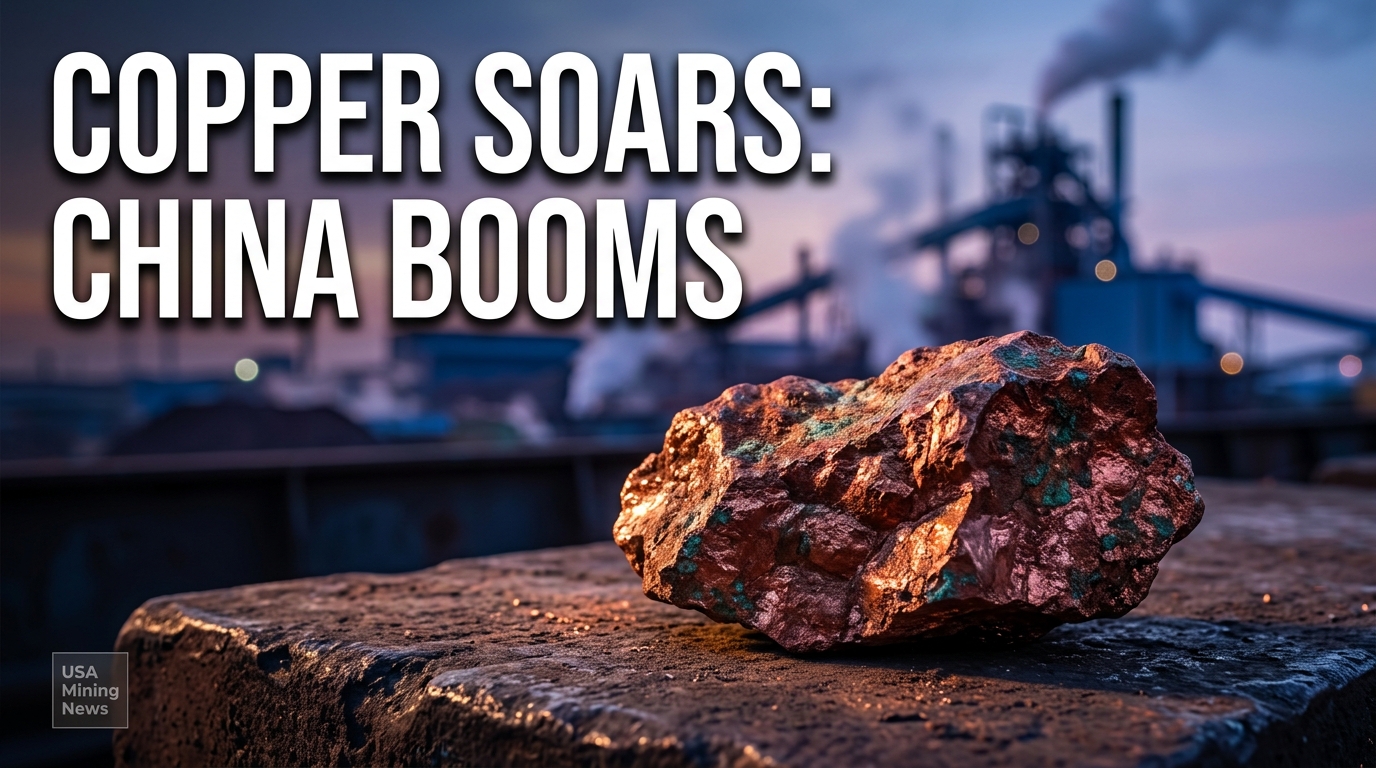
USA Mining News | April 18, 2026 – The global copper market is experiencing a significant surge, with prices soaring to a 10-week high, positioning the vital industrial metal within sight of its all-time peak recorded just before the onset of the Iran war in late January. This robust recovery in prices, reaching $6.11 per pound ($13,480 a tonne) for May futures in New York, is largely underpinned by a dramatic rebound in smelting activity within China, a critical bellwether for global industrial demand.
The recent positive trend has been confirmed by cutting-edge satellite monitoring data from London-based Earth-i’s SAVANT Global Copper Smelting Index. This data indicates a marked improvement in global smelter utilization throughout March, notably reversing a trend that saw activity plunge to its lowest recorded level in nearly a decade this past January. For mining industry stakeholders, understanding these shifts in smelter activity is paramount, as they directly reflect the health of the downstream demand for refined copper and exert immense pressure on the commodity’s pricing dynamics and the economics of concentrate supply.
China's Unprecedented Smelting Resurgence
Earth-i’s sophisticated satellite monitoring, which encompasses approximately 95% of the world’s copper smelting capacity, provided crucial insights into this resurgence. In March 2026, global inactive smelting capacity fell to 11.7%, a notable improvement from the 14.3% recorded in January when activity reached its nadir. The driving force behind this global recovery was unequivocally China.
Within China, the country-level inactive capacity sub-index experienced a sharp decline of 1.1%, settling at an exceptionally low 3.9%. This heightened operational efficiency, coupled with the ongoing build-out of new smelting capacity across the mainland, culminated in an all-time high active capacity reading of 10.73 million tonnes. This figure represents a substantial increase of more than 775,000 tonnes compared to one year ago and stands an impressive 1.49 million tonnes above the three-year average.
Earth-i analysts attribute this surge to an improvement in downstream manufacturing and construction activity in recent weeks, signifying a recovery in demand following a period that industry insiders termed a “buyer’s strike.” This strike occurred in response to the record-high copper prices observed in January, which also led to a slump in imports from international markets as buyers resisted elevated costs. The rapid return of Chinese demand underscores the nation's pivotal role in global copper consumption and its immediate impact on commodity markets.
A Mixed Picture Beyond the Mainland
While China’s copper smelting sector powered ahead, the global landscape presented a more varied picture. Outside of China, smelting activity generally declined, with a few notable exceptions and several critical disruptions impacting regional supply chains.
- Africa: The central copper belt exhibited strong operating performance, signaling robust production from key mining regions despite broader global instability. This consistent output from countries like the Democratic Republic of Congo (DRC) and Zambia remains a vital component of global concentrate supply.
- Iran: Geopolitical tensions, specifically the ongoing Iran war, have severely impacted the nation’s smelting capabilities. Two significant smelters, with a combined annual capacity of 400,000 tonnes, are currently offline outside their routine maintenance schedules, directly impacting regional supply dynamics and contributing to global tightening.
- Australia: The ongoing outage at the 300,000-tpa Mount Isa smelter in Queensland continues to constrain regional production. These combined disruptions in Iran and Australia helped keep the Asia & Oceania regional inactivity sub-index elevated at 18.7%, significantly above its three-year average of only 5.7%.
- Europe: The continent observed a modest uptick in inactivity, rising by 2.1%. However, Europe still boasts the lowest average percentage of idled capacity globally at 6.2%, reflecting a relatively stable operational environment despite various economic headwinds.
- Western Hemisphere: Smelting activity in the Americas continued to be the weakest. North America’s inactive capacity sub-index rose by 10.3% in March to a concerning 32.3%. South America, while also showing significant idle capacity at 27.4%, experienced a comparatively better month, with its inactivity figure falling below that of North America. This regional weakness in the Western Hemisphere highlights ongoing operational challenges, regulatory hurdles, and potentially higher energy costs impacting competitiveness.
The Acid Test: Margins and Treatment Charges Under Pressure
The intricate balance of the copper market is further complicated by the dynamics of by-products and processing costs. Chinese smelters' increased willingness to purchase copper concentrate has been influenced by a dramatic surge in sulfuric acid prices. Sulfuric acid, a key by-product of the smelting process, saw its FOB China price reach $210 per tonne in April, a staggering 74% increase since January. This price spike, largely attributed to disruptions stemming from the Iran war, has provided a critical revenue stream for Chinese operators, enabling them to secure short-term margins despite other cost pressures.
However, this advantage comes with a significant caveat: immense pressure on Treatment and Refining Charges (TC/RCs). These charges, paid by miners to smelters for processing copper concentrate into refined metal, are a crucial negotiation point. According to Platts, a unit of S&P Global Energy, spot TC/RCs have plunged into unprecedented negative territory, with recent spot market tenders closing near –$78.50 per tonne and –7.85¢ per pound. This represents a dramatic swing from a positive $50 per tonne as recently as January 2024. Negative TC/RCs mean that smelters are effectively paying miners to receive their concentrate, a stark indicator of an extremely tight concentrate supply market.
Structural Shifts Intensify TC/RC Squeeze
S&P Global projects that this downward pressure on TC/RCs is set to persist, driven by several significant structural shifts in the global copper concentrate market. Two key developments are particularly impactful:
- Indonesia’s Batu Hijau Mine: The export permit for Indonesia’s Batu Hijau mine, a substantial source of copper concentrate, is scheduled to expire at the end of April. Should this permit not be renewed or if new regulations mandate increased domestic processing, it will significantly curb the availability of concentrate for export to global markets, including China. This aligns with a broader trend in resource-rich nations seeking to add value domestically.
- DRC’s Kamoa-Kakula Smelter: The Democratic Republic of Congo (DRC) welcomed the commencement of anode production at the Kamoa-Kakula 500,000-tpa capacity smelter at the end of 2025. This state-of-the-art facility will consume domestically produced copper concentrate, thereby reducing concentrate exports from the DRC. Kamoa-Kakula is one of the world's largest and highest-grade copper mines, and its decision to process locally represents a significant shift in global concentrate flows.
These fundamental shifts in concentrate supply have sent ripples through the benchmark annual contract market. In a historic development, Antofagasta’s 2026 benchmark agreement with a Chinese smelter settled at zero dollars. This unprecedented annual TC/RC term underscores the dire supply situation for concentrate and signals a profound recalibration of bargaining power between miners and refiners, tilting heavily in favor of the former.
Market Implications and Future Outlook
For mining industry professionals and investors, the current copper market presents a complex but potentially lucrative scenario. The surge in copper prices is a clear positive for miners, particularly those with strong operational efficiencies and lower production costs, who stand to benefit from increased revenue. However, the preceding "buyer's strike" serves as a cautionary tale, indicating that demand can be sensitive to rapid price escalations.
The unprecedented negative TC/RCs create a challenging environment for smelters globally. While Chinese smelters may find some relief in surging sulfuric acid prices, the squeeze on processing margins is undeniable. This situation will likely accelerate consolidation or strategic partnerships within the smelting sector and could incentivize further investment in integrated mining and smelting operations.
Looking ahead, the resilience of Chinese demand, the resolution of geopolitical conflicts affecting supply chains (like the Iran war), and the ongoing impact of resource nationalism and domestic processing mandates in countries like Indonesia and the DRC will be critical factors to monitor. The copper market remains a dynamic arena, reflecting both global industrial health and the intricate interplay of supply, demand, and geopolitical forces. As copper continues to be a cornerstone of global electrification and decarbonization efforts, these market dynamics will only intensify in significance.