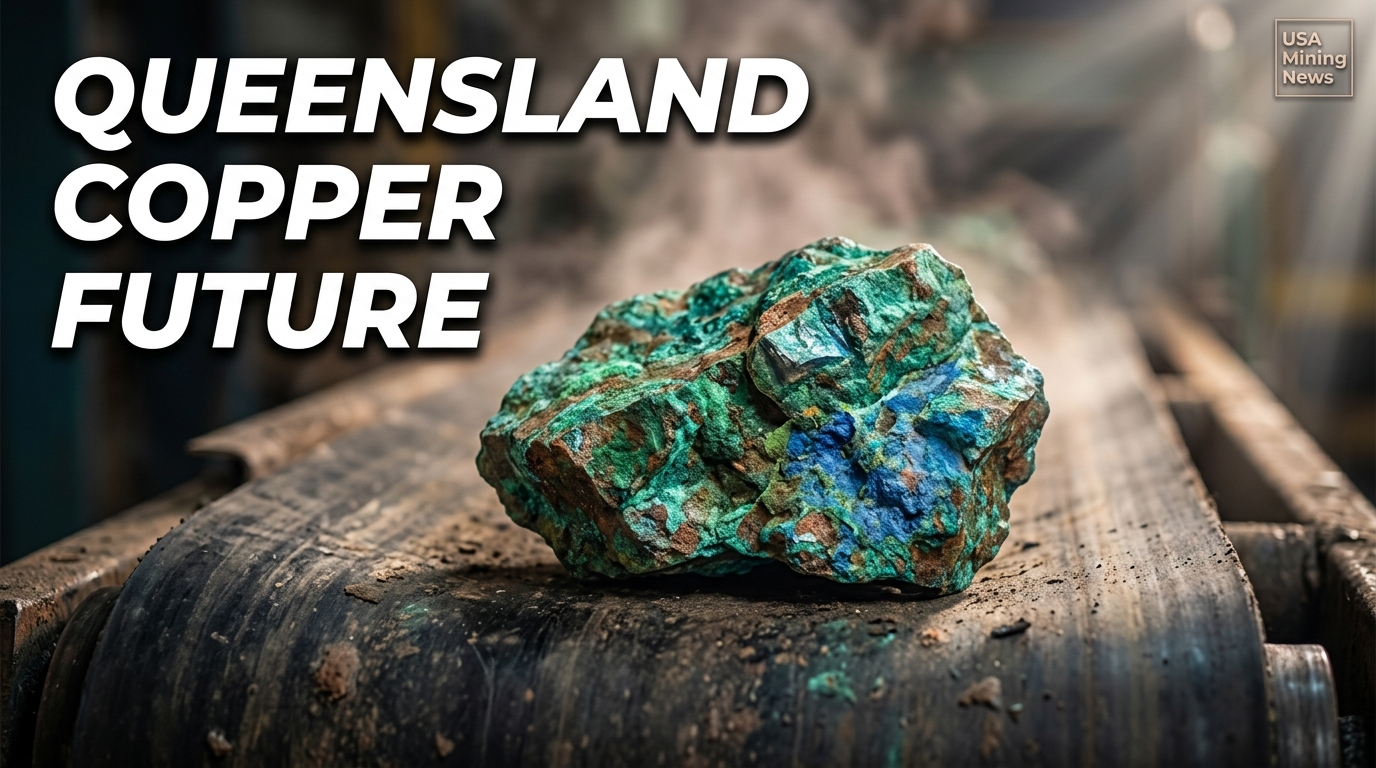
Mount Isa, Queensland, Australia – On June 5, 2026, a significant joint initiative by the Australian Federal and Queensland State governments was unveiled, signaling a concerted effort to secure the long-term viability and global competitiveness of Queensland’s crucial copper industry. UK-based business consultancy CRU, a globally recognized authority in commodity market intelligence, has been selected to spearhead a comprehensive, government-backed study focused on the future of north-west Queensland’s copper value chain. This strategic endeavor seeks to chart a sustainable course for a region pivotal to Australia's mineral output and increasingly vital to the world's energy transition.
The study, formally announced by Australian Federal Industry and Innovation Minister Senator Tim Ayres and Queensland Natural Resources and Mines Minister Dale Last, comes at a time of unprecedented global demand for copper, driven by the accelerating needs of electrification, renewable energy infrastructure, and electric vehicle manufacturing. The deep dive into Queensland’s copper sector is not merely an academic exercise; it represents a commitment to supporting the region’s long-term industrial development, safeguarding jobs, and consolidating Australia’s position as a key supplier of critical minerals.
A Deep Dive into Queensland's Copper Value Chain
CRU, leveraging its extensive expertise and working alongside unnamed consortium partners, will undertake an exhaustive assessment of the copper value chain specifically across Queensland’s North West Minerals Province. This comprehensive mandate covers the entire spectrum of operations, from the initial stages of mining in the resource-rich Mount Isa region through to the processing carried out at facilities such as the Mount Isa Copper Smelter and extending to the refining activities at the Townsville Copper Refinery.
According to CRU, the study’s methodology is designed to provide an end-to-end evaluation, integrating multiple layers of analysis:
- Market Intelligence: This component will analyze global and regional copper supply and demand dynamics, pricing trends, competitive landscapes, and future market forecasts. Understanding where Queensland’s copper fits into the global context is crucial for long-term planning.
- Cost Analysis: A detailed examination of operational costs across mining, smelting, and refining activities will be undertaken. This includes assessing energy consumption, labor expenses, logistics, capital expenditure, and environmental compliance costs. Such analysis will identify areas for efficiency improvements and cost reduction, crucial for maintaining competitiveness.
- Facility-Level Data: The study will draw upon specific data from individual mines, smelters, and refineries. This granular approach will allow for precise evaluations of operational efficiency, technological adoption, production capacities, and environmental performance at each stage of the value chain.
Beyond these immediate operational and market assessments, the scope of the work extends to examining long-term opportunities. This includes industrial facilities, the workforce supporting them, and the broader copper sector, particularly as it looks beyond the current period of government financial support. This forward-looking element underscores the need to build a self-sustaining and robust industry capable of thriving without ongoing subsidies, a common challenge for mature mining regions globally.
Key Players and Government Initiative
The selection of CRU to lead this pivotal study highlights the governments' commitment to robust, independent analysis. CRU, a UK-based business consultancy, is renowned for its authoritative market intelligence, independent analysis, and consulting services specific to the global metals, mining, and fertilizers industries. Their deep understanding of commodity markets and operational intricacies makes them a fitting choice for such a critical assessment.
The joint nature of this Commonwealth-Queensland initiative underscores a unified governmental approach to regional economic development and critical minerals strategy. Senator Tim Ayres, as the Federal Industry and Innovation Minister, brings the national strategic imperative, particularly concerning Australia's role in global supply chains and advanced manufacturing. Queensland Natural Resources and Mines Minister Dale Last represents the state’s direct vested interest in one of its most economically significant regions. This collaborative framework ensures that the study’s recommendations will be considered at both federal and state policymaking levels, increasing the likelihood of coordinated implementation.
Hugh Greene, global head of consulting at CRU, expressed the company’s honor at being selected for such a vital undertaking. Greene emphasized the historical importance of north-west Queensland in Australia’s copper value chain and articulated the project’s objective: to identify “practical pathways” that will strengthen the region’s industrial capability, resilience, and competitiveness over the long term. This statement encapsulates the multifaceted goals of the study, aiming to not just analyze but also to provide actionable strategies for future growth and stability.
The North West Minerals Province: A Critical Hub
The North West Minerals Province is unequivocally one of Australia’s key mineral-producing regions. Its geological endowment has supported extensive mining operations for over a century, contributing significantly to both state and national economies. Copper mining and processing have historically formed, and continue to form, a substantial part of the local economy. The region is characterized by world-class deposits that have sustained major operations, creating thousands of jobs and supporting numerous ancillary industries and communities.
However, like many mature mining regions, the North West Minerals Province faces challenges that necessitate strategic planning. These can include aging infrastructure, declining ore grades in some long-standing operations, the need for continuous technological innovation, managing environmental impacts, and ensuring a skilled workforce for future demands. The study’s focus on long-term opportunities is particularly relevant in this context, aiming to identify new avenues for growth and diversification that will sustain the region well into the future, potentially through exploration for new deposits, processing innovations, or integration into emerging industries such as battery manufacturing.
Strategic Imperatives: Industrial Capability, Resilience, and Competitiveness
The three pillars identified by Hugh Greene – industrial capability, resilience, and competitiveness – are fundamental to the sustainability of any major mining region. Strengthening industrial capability involves not just maintaining current operational standards but also investing in new technologies, improving processing efficiencies, and potentially expanding into higher-value downstream activities. This could involve exploring opportunities for further processing of copper beyond current refining stages, such as producing copper foils or specialized alloys, if economically viable.
Resilience in the context of the copper industry refers to the ability to withstand market volatility, supply chain disruptions, and changing regulatory landscapes. This might entail diversifying energy sources for operations, optimizing logistics to reduce dependency on single routes, or implementing robust risk management strategies to hedge against commodity price swings. For a region like north-west Queensland, resilience also includes climate change adaptation and ensuring water security for mining operations.
Finally, competitiveness is paramount in a global market. This involves benchmarking Queensland’s copper production costs and environmental performance against other major producers worldwide. Initiatives to reduce greenhouse gas emissions, improve water usage efficiency, and adopt leading-edge automation and digitalization technologies can all contribute to enhancing the region’s competitive edge. The study's focus on identifying "practical pathways" implies a pragmatic, action-oriented approach to meeting these strategic imperatives.
The Broader Copper Market Context
The timing of this study is particularly pertinent given the global copper market outlook. Copper is often referred to as "Dr. Copper" due to its accurate prognostication of economic health, but its role has evolved beyond simple economic indicator. It is now a cornerstone of the global energy transition. Projections from various industry analyses indicate a significant supply deficit in the coming decade, driven by exponential demand from electric vehicles (EVs), charging infrastructure, renewable energy generation (solar panels, wind turbines), and smart grid development. Australia, with its rich mineral endowments, is strategically positioned to play a critical role in meeting this demand.
However, developing new copper mines and expanding existing operations is a capital-intensive and time-consuming process, often constrained by permitting challenges, community engagement, and infrastructure limitations. For an established region like north-west Queensland, optimizing existing assets, improving extraction and processing efficiencies, and extending mine life become paramount. The study, therefore, is not just about local economic development but also about Australia’s contribution to global clean energy supply chains.
Operational Details and Timeline
CRU has outlined a diligent process for the study, emphasizing extensive stakeholder engagement throughout 2026. This engagement will be critical, involving various parties from mining companies and processing facility operators to local communities, Indigenous groups, labor unions, environmental organizations, and local businesses. Gathering diverse perspectives and data from these stakeholders is essential for developing recommendations that are not only economically sound but also socially acceptable and environmentally responsible.
The culmination of this extensive work will be the submission of a final report to both the Commonwealth and Queensland governments by the end of 2026. This timeline suggests a focused and intensive period of data gathering, analysis, and report generation, aiming to provide policymakers with a robust framework for decision-making in the near future.
Looking Ahead: Future Outlook and Implications
The outcomes of CRU’s study are poised to have significant implications for the future direction of Queensland’s copper industry and potentially for Australia’s broader critical minerals strategy. The "practical pathways" identified could lead to substantial government and private sector investments in:
- New exploration initiatives and resource definitions to extend the life of mining operations.
- Upgrades and modernization of existing smelting and refining facilities to improve efficiency and reduce environmental footprints.
- Development of new infrastructure, such as dedicated rail lines or green energy projects, to support mining operations and reduce production costs.
- Workforce development and training programs to ensure a skilled labor pool equipped for future industry demands, including automation and digitalization.
- Policy adjustments to streamline regulatory processes, incentivize investment, and support sustainable mining practices.
Ultimately, this study represents a proactive stance from the Australian and Queensland governments to ensure that the North West Minerals Province not only continues its legacy as a key copper producer but also evolves to meet the demands of a rapidly changing global economy. By securing its industrial capability, boosting resilience, and enhancing competitiveness, Queensland aims to solidify its position as an indispensable player in the future of critical mineral supply, contributing significantly to both its own prosperity and the global energy transition.