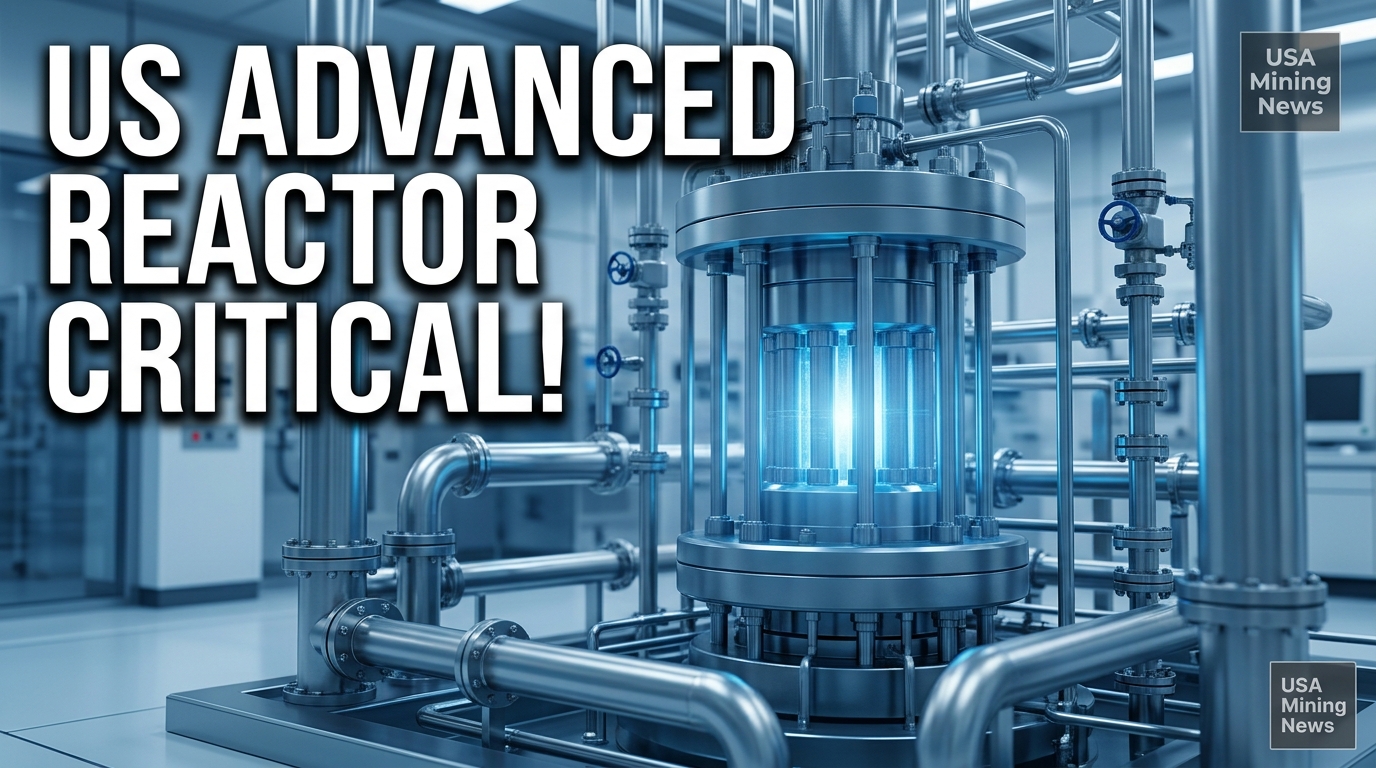
WASHINGTON D.C. - June 18, 2026 - The United States is witnessing a significant resurgence in its commitment to nuclear energy, a development with profound implications for energy security, decarbonization efforts, and particularly, the global mining industry. Today, the U.S. Department of Energy (DOE) heralded a pivotal achievement, announcing that Valar Atomics’ advanced reactor design, the Ward 250, successfully completed a zero-power fueled criticality demonstration. This event, which took place at the Utah San Rafael Energy Lab in Emery County, Utah, underscores the rapid progress being made under the DOE’s Reactor Pilot Program and marks a critical step towards the commercial deployment of advanced nuclear technologies. For mining sector stakeholders, this accelerating pace points directly to a projected increase in demand for uranium and other associated materials, reinforcing the strategic importance of a robust supply chain.
Valar Atomics' Ward 250 Achieves Criticality in Utah
The successful criticality demonstration of the Ward 250 reactor on June 18, 2026, is not merely a technical accomplishment but a symbolic moment for the U.S. nuclear landscape. According to the DOE, this marks the first time a DOE-authorized reactor has been built and operated outside of a national laboratory setting, a testament to the program's innovative approach to deployment. The Utah San Rafael Energy Lab, a new focal point for energy innovation, provided the independent backdrop for this historic event.
U.S. Energy Secretary Chris Wright emphasized the broader context of this success. "Today marks another historic moment for America's nuclear renaissance," Secretary Wright stated. "From the first-ever airlift of a small reactor aboard a U.S. military C-17 to successful zero-power criticality testing, Valar Atomics is delivering achievements that mark a revolutionary moment for advanced nuclear in this country. The Trump administration is proud to support the rebirth of America’s nuclear industry, ensuring Americans have access to affordable, reliable and secure energy for generations to come.” His comments highlight the strong governmental backing and the clear strategic intent behind these initiatives.
Isaiah Taylor, Founder & CEO of Valar Atomics, acknowledged the collaborative effort behind this swift progress. "Nine months ago, this was an empty site. Today, there's a critical reactor on it, built and operated by the Valar team," Taylor remarked. "We met the milestone the executive order set. This reactor was built to make power, and that's exactly where we're headed. I'm grateful to the Department of Energy, the State of Utah, the local community, and the many people who got us here.” Taylor's sentiment reflects the commitment to rapid execution and the multi-stakeholder support critical for such ambitious projects.
The Broader Context: America's Nuclear Renaissance
The Ward 250’s achievement is part of a larger, coordinated effort to re-establish U.S. leadership in nuclear energy. It is the second of multiple advanced reactors anticipated to go critical by a stringent deadline: July 4th, as set by President Trump in an executive order issued in May 2025. This ambitious timeline underscores the urgency and strategic importance placed on accelerating advanced nuclear deployment.
Just earlier this month, another significant milestone was reached when Antares Nuclear’s Mark-0 reactor achieved criticality at the Idaho National Laboratory. The success of both Antares Nuclear and Valar Atomics within such a tight timeframe demonstrates the efficacy of the DOE’s Reactor Pilot Program. This program is designed to leverage DOE authorization to expeditiously certify and construct first-of-a-kind advanced reactor designs for demonstration, streamlining processes that have historically been bottlenecks for nuclear innovation. The "zero-power fueled criticality demonstration" itself is a crucial preliminary step. It confirms that the reactor core, loaded with nuclear fuel, can sustain a controlled, self-propagating nuclear chain reaction—a prerequisite for safe and effective power generation. While not producing electricity, it validates the fundamental physics and engineering of the reactor design.
Technical Nuances of Advanced Reactor Designs
The term "advanced reactor" encompasses a diverse range of nuclear technologies that move beyond the conventional light-water reactors dominant in the existing global fleet. These designs often prioritize enhanced safety features, greater fuel efficiency, reduced physical footprints, and potential for diverse applications beyond just electricity generation, such as industrial heat or hydrogen production. Many advanced reactor concepts are designed to be modular, meaning they can be factory-produced and assembled on-site, potentially reducing construction times and costs significantly compared to traditional large-scale nuclear plants. The Ward 250, by demonstrating criticality, moves closer to validating its specific design parameters and proving its ability to operate safely and effectively.
The significance of achieving criticality at zero power is multi-faceted. It allows engineers to gather critical data on the reactor's neutronics—how neutrons behave within the core—without the complexities introduced by high temperatures and pressures associated with power generation. This data is essential for validating computational models, informing operational procedures, and ensuring robust safety margins before the reactor is transitioned to power-producing modes. It's a foundational step that must be completed accurately and safely before power scaling can commence.
Catalyzing Innovation: The DOE's Strategic Initiatives
The DOE's Reactor Pilot Program has proven to be an effective catalyst for rapid innovation and progress in developing American advanced reactor designs. By providing authorization and support, the program has enabled companies like Valar Atomics to move from concept to demonstration at an unprecedented pace. Building on this success, the DOE recently established the Nuclear Energy Launch Pad, an initiative designed to further accelerate the deployment of advanced nuclear technologies. This complementary program aims to solidify the U.S. lead in nuclear innovation, creating a pipeline for next-generation nuclear solutions from research and development through to commercialization and deployment.
These initiatives are not merely about technology; they are about fostering an ecosystem where private industry can thrive alongside governmental support. They address critical challenges such as regulatory pathways, financing mechanisms, and supply chain development, all of which are essential for bringing new nuclear power plants online. By systematically removing barriers, the DOE aims to ensure that America remains at the forefront of this crucial energy sector.
Implications for the Mining Industry: Fueling the Renaissance
For the mining industry, the resurgence of advanced nuclear power in the United States carries substantial weight, primarily translating into an anticipated increase in demand for uranium, the fundamental fuel for nuclear reactors. The current U.S. nuclear fleet, while robust, relies heavily on imported uranium. According to recent data, domestic uranium production has been minimal for years, with the majority of fuel sourced from countries like Canada, Australia, Kazakhstan, and Russia. This reliance on foreign supply presents both energy security vulnerabilities and significant opportunities for domestic mining companies.
The widespread deployment of advanced reactors, whether they are small modular reactors (SMRs) or microreactors like the Ward 250, will require a steady and secure supply of uranium. While the exact fuel requirements may vary slightly between advanced designs—some might utilize different enrichment levels or even alternative fuel cycles—the overarching trend will be upward pressure on the uranium market. This increased demand is expected to:
- Incentivize Domestic Exploration and Production: Renewed interest and potential long-term contracts from U.S. utilities and reactor developers could stimulate investment in domestic uranium exploration, development, and mining operations. This would be a significant shift for a U.S. industry that has seen limited activity for decades.
- Boost Processing and Conversion Capabilities: Beyond mining, the entire nuclear fuel cycle—including milling, conversion, enrichment, and fuel fabrication—will need to expand or be re-established domestically to support a full-scale nuclear renaissance. This offers opportunities for specialized metallurgical processing facilities.
- Impact Global Uranium Markets: A substantial increase in demand from the world's largest consumer of nuclear power, the United States, would inevitably tighten global uranium supplies, potentially leading to higher spot and long-term contract prices. This would benefit uranium producers globally and make previously uneconomical projects viable.
- Support Strategic Metals Demand: While uranium is paramount, the construction and operation of advanced reactors also require other strategic metals. Materials like zirconium (for fuel cladding), specialized alloys (for reactor vessels), and rare earth elements (in some advanced control systems) could see secondary demand surges, leading to further mining opportunities.
- Bolster Energy-Intensive Mining Operations: Crucially for the broader mining sector, the expansion of nuclear power offers a stable, carbon-free source of electricity. Mining operations, particularly those involved in processing raw materials, are incredibly energy-intensive. Access to affordable, reliable, and consistent clean nuclear power can lower operating costs, enhance environmental credentials, and improve logistical stability for mining companies, making U.S. operations more competitive.
Looking Ahead: The Future of U.S. Advanced Nuclear
The criticality of Ward 250 represents a critical juncture, moving from theoretical design and experimental validation to tangible hardware. The next steps for Valar Atomics will involve further testing and, crucially, scaling up to power generation. This will involve stringent regulatory reviews, more extensive operational demonstrations, and a careful ramp-up to commercial operation. The lessons learned from the Ward 250 and Antares Nuclear’s Mark-0 will be invaluable for future advanced reactor deployments.
The overarching vision outlined by the DOE, supported by the swift execution under programs like the Reactor Pilot Program and the Nuclear Energy Launch Pad, points to a future where advanced nuclear technology plays a central role in America's energy mix. This path promises enhanced energy independence, significant reductions in carbon emissions, and a reinvigorated high-tech manufacturing sector. For mining professionals and investors, tracking these developments is paramount, as the unfolding nuclear renaissance is set to redefine the demand landscape for critical minerals and potentially spark a new era of domestic resource development.
The U.S. Department of Energy’s commitment, coupled with the innovation of private companies like Valar Atomics, signals a transformative period for both the energy and mining sectors, charting a course towards a more secure, sustainable, and nuclear-powered future.