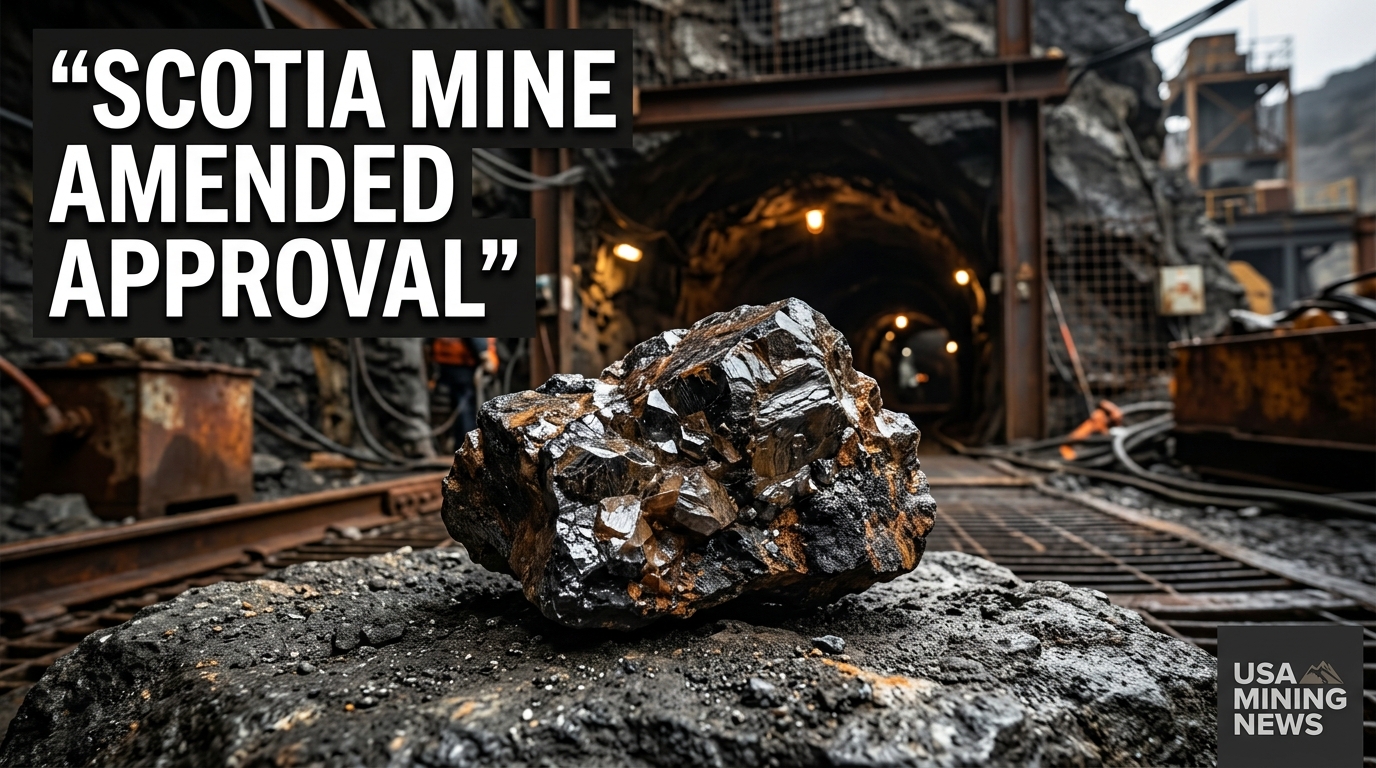
Halifax, Nova Scotia – EDM Resources Inc. has achieved a pivotal regulatory milestone, receiving an amended industrial approval (IA) from the Nova Scotia Department of Environment and Climate Change for the planned restart of its Scotia Mine. This critical endorsement, issued on July 21, 2026, marks a significant step forward for the project, which is poised to become Nova Scotia's sole primary zinc producer and a key contributor to North America's burgeoning critical minerals supply chain.
A Significant Regulatory Milestone for Scotia Mine
The amended industrial approval (IA) granted by provincial authorities is a comprehensive update that permits substantial modifications to the Scotia Mine's operational and infrastructure design. Specifically, the approval covers vital changes to the mine plan and processing facility, and formally authorizes revisions to the overall mine layout, detailed processing infrastructure, waste rock and tailings management systems, and associated environmental protection measures. This update is a direct outcome of extensive engineering, environmental, and permitting work undertaken by EDM Resources over the past two years, ensuring the project aligns with contemporary mining best practices and stringent environmental standards.
According to EDM Resources president and CEO Mark Haywood, the receipt of the amended IA represents one of the most significant regulatory achievements for the company since its acquisition of the Scotia Mine. This approval is foundational to the company's updated pre-feasibility study (PFS), providing the necessary regulatory backing for the technical and economic assessments. The alignment between the regulatory approval and the company's internal planning underscores a cohesive strategy towards project execution and de-risking.
Strategic Alignment with Nova Scotia's Critical Minerals Strategy
The Scotia Mine project is not merely a commercial venture but also holds strategic importance for regional and national resource security. Upon commencing operations, the mine is projected to create approximately 150 direct jobs, offering a substantial economic boost to Halifax County and the broader Nova Scotia region. Beyond job creation, the project is a fundamental component of Nova Scotia's Critical Minerals Strategy.
Zinc, the primary commodity to be produced at Scotia Mine, has been officially listed as a critical mineral under this provincial strategy. Its designation is driven by its indispensable role in the development of renewable energy infrastructure and advanced manufacturing applications globally. Zinc's corrosion-resistant properties are vital for galvanizing steel used in wind turbines, solar panel frames, and electric vehicle components, while its use in advanced battery technologies and high-strength alloys further underscores its strategic importance. As governments and industries worldwide pivot towards decarbonization and electrification, securing a stable and ethical supply of critical minerals like zinc has become a top priority.
The Updated Project Blueprint: Technical and Operational Enhancements
The amended industrial approval specifically supports a modernised mining operation, incorporating revised processing systems and enhanced environmental management protocols. These updates are expected to lead to a more efficient and environmentally responsible mining process, crucial for gaining and maintaining social license in today's mining landscape. The technical review conducted by provincial authorities prior to issuing the IA ensures that the proposed modifications meet all regulatory requirements and best available technologies.
While the amended IA is a major hurdle overcome, EDM Resources is concurrently progressing on several other fronts essential for restarting the mine. The company is actively working on an updated mineral resource estimate, which will refine the understanding of the deposit's size and grade, providing critical data for detailed mine planning and financial modeling. The completion of the PFS remains a near-term objective, which will provide a more detailed economic and technical analysis of the project. Furthermore, EDM Resources is advancing its financing initiatives, engaging with potential investors and lenders to secure the capital required for construction. Discussions with prospective concentrate offtake partners are also underway, aiming to establish secure sales agreements for the future zinc production, a crucial aspect for project financing and long-term stability.
From Past Production to Future Potential: The Scotia Mine's History and Location
The Scotia Mine is a brownfield project, meaning it is a past-producing operation with existing infrastructure and geological understanding. Situated approximately 60 kilometers north-east of Halifax, its location in Atlantic Canada provides logistical advantages regarding port access for concentrate shipments and access to a skilled labor force. While the history of past production offers valuable insights into the orebody and geological conditions, the restart plan leverages modern mining techniques and environmental safeguards that far exceed those employed during its previous operational periods.
Reviving a past-producing mine often presents a unique set of challenges and opportunities. While existing infrastructure can be a cost-saver, it frequently requires extensive upgrades to meet current standards. The comprehensive nature of the amended IA, covering mine layout, processing, and waste management, indicates a thorough modernization strategy rather than a simple re-opening, reflecting a forward-looking approach to mining in the 21st century.
Pathway to Restart: Permitting, Financing, and Construction
The target resumption of mining operations for the Scotia Mine is in 2027. This timeline is contingent upon the successful completion of several remaining critical steps: securing additional permitting, finalizing financing, and undertaking the necessary construction activities. One of the most significant outstanding regulatory requirements is the federal Fisheries Act Authorisation. EDM Resources submitted its application for this authorization earlier in the year (2026), indicating a proactive approach to parallel permitting processes. The Fisheries Act Authorisation is crucial as it addresses potential impacts on fish habitats and outlines mitigation strategies, a common federal requirement for projects near water bodies in Canada.
Mark Haywood reiterated the strong progress being made, stating that the amended IA, combined with the federal Fisheries Act Authorisation application and the ongoing PFS update, positions the Scotia Mine to become one of Atlantic Canada’s premier critical minerals projects. The sequential nature of these approvals and studies is typical for mining project development, where each successful step de-risks the project and paves the way for the next phase of investment and development.
Beyond Zinc: Diversified Revenue Streams with Gypsum Offtake
Adding another dimension to its operational strategy, EDM Resources has also diversified its potential revenue streams through an offtake agreement for gypsum, a byproduct of the Scotia Mine's operations. In June 2025, the company signed a definitive supply agreement valued at $58 million (C$79.39 million) with a Canadian gypsum producer and wallboard manufacturer. This agreement provides a stable market for a significant byproduct, enhancing the project's overall economics and reducing waste. Leveraging byproducts not only adds to a project's financial viability but also aligns with principles of a circular economy, minimizing waste and maximizing resource utilization – an increasingly important aspect of sustainable mining practices sought by investors and communities alike.
Broader Implications for Atlantic Canada and Critical Minerals Supply
The successful restart of the Scotia Mine would have substantial ripple effects beyond the immediate vicinity. For Atlantic Canada, it signifies a rejuvenation of the region's mining sector and a strategic pivot towards critical minerals. The project will contribute to the diversification of the regional economy, providing high-value jobs and stimulating local businesses through supply chain demands.
On a national and international scale, the Scotia Mine represents an important step towards enhancing North American critical minerals independence. As global geopolitical dynamics continue to shift, industrial nations are increasingly keen to secure domestic or near-shore supplies of essential raw materials. Zinc, being crucial for green technologies, places the Scotia Mine at the forefront of this strategic imperative, contributing to energy transition efforts and bolstering supply chain resilience against global disruptions.
Outlook and Next Steps
The amended industrial approval for the Scotia Mine is a testament to EDM Resources' diligent and systematic approach to project development. With this provincial regulatory hurdle largely cleared, the company can intensify its focus on securing the federal Fisheries Act Authorisation, completing its updated PFS, and finalizing financing arrangements. The successful execution of these remaining steps will be critical in transforming the past-producing Scotia Mine into a modern, operating zinc facility by 2027.
Ultimately, the Scotia Mine project embodies the dual objectives of economic development and sustainable resource extraction in the context of critical minerals. Its progression signals a positive outlook for the mining industry in Atlantic Canada and underscores the region's potential to contribute significantly to the global supply of materials vital for a low-carbon future.