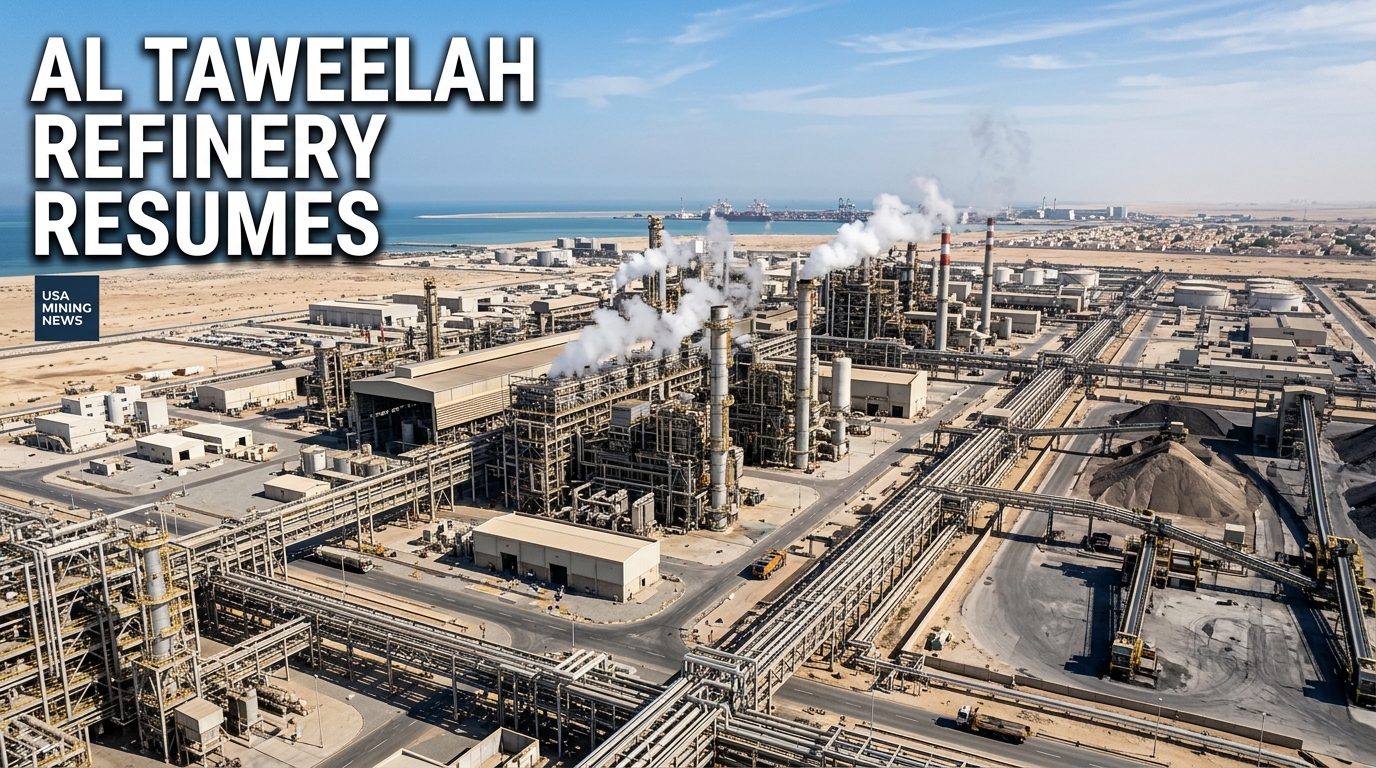
Abu Dhabi, UAE – Emirates Global Aluminium (EGA), one of the world's leading primary aluminium producers, announced today the successful restart of alumina production at its Al Taweelah refinery. This crucial facility in Abu Dhabi had been idled since March 2026 following security incidents attributed to Iranian attacks on the Khalifa Economic Zone Abu Dhabi. The resumption of operations signals a significant step towards restoring full production capabilities at one of the most important industrial complexes in the Middle East and reinforces the resilience of global supply chains for critical metals.
The restart follows an intense period of assessment and repairs, with the company confirming that initial production of hydrate, the precursor to alumina, recommenced on June 24, 2026. Now, just weeks later, the fully operational refinery is expected to achieve 50% of its plant capacity within days. This rapid turnaround is a testament to the operational agility and strategic importance of the Al Taweelah complex to EGA’s integrated value chain.
EGA Restarts Alumina Production at Al Taweelah
The Al Taweelah alumina refinery, which originally began operations in 2019, represents a cornerstone of EGA's backward integration strategy. It was established to reduce the company's reliance on imported alumina and enhance the security of supply for its smelting operations. The decision to suspend operations in March 2026 was a direct consequence of security events in the Khalifa Economic Zone, illustrating the increasing geopolitical risks that can impact critical infrastructure in key industrial hubs. Such attacks underscore the imperative for mining and metals companies to build robust risk mitigation strategies and enhance supply chain resilience.
Abdulnasser Bin Kalban, CEO of EGA, highlighted the significance of this milestone, stating, “First alumina production from Al Taweelah alumina refinery is another big milestone in our journey to restore EGA’s Al Taweelah site to its position as one of the most important aluminium production complexes in the world. The dedication and agility of the team at Al Taweelah alumina refinery has enabled us to reach this milestone safely and quickly.” His statement reflects the strategic importance of the facility not just to EGA, but to the broader global aluminium industry, particularly as producers navigate an increasingly fragmented and risk-prone global landscape.
Operational Capabilities and Production Targets
The Al Taweelah alumina refinery is an advanced facility designed to process bauxite ore into alumina, the primary feedstock for aluminium smelters. In 2025, a full year of undisturbed operations, the refinery produced an impressive 2.4 million tonnes of alumina. This volume accounted for approximately 46% of EGA’s total alumina requirements for its integrated smelting operations. The strategic proximity of the refinery, located adjacent to the Al Taweelah smelter, allows for efficient and cost-effective transfer of alumina directly via conveyor belts to storage facilities and then into the smelter, minimizing logistical complexities and costs that often plague global supply chains.
Looking ahead, EGA has set ambitious targets for the refinery’s ramp-up. The company aims to have the technical capability to achieve full alumina production by the end of 2026. However, this full ramp-up is subject to broader market and operational considerations. EGA noted that further increases in production at the Al Taweelah alumina refinery would depend on evolving supply chain factors and the ongoing optimization of its alumina sourcing strategy. This cautious approach acknowledges the complexities of securing raw materials and managing logistics in a dynamic global environment.
It is important to note that the ramp-up in aluminium production at the neighboring Al Taweelah smelter is not entirely contingent on a full ramp-up at the refinery. This indicates EGA’s diverse sourcing strategy for alumina, enabling the smelter to maintain operations even if the refinery’s output does not immediately reach full capacity. Such flexibility is a critical component of modern industrial operations, particularly in sectors prone to supply disruptions.
Strategic Resilience in a Volatile Geopolitical Landscape
The suspension and subsequent restart of operations at Al Taweelah underscore the critical need for supply chain resilience in the global mining and metals industry. The incident of Iranian attacks on the Khalifa Economic Zone highlights how geopolitical tensions can directly impact industrial output and subsequently, global commodity markets. For a major player like EGA, ensuring stable access to key raw materials such as alumina is paramount to maintaining its market position and fulfilling its commitments to customers.
In a proactive move to bolster its supply chain robustness, EGA signed a significant high-level agreement in May 2026 with ADNOC Logistics & Services. This collaboration aims to explore cooperative efforts designed to enhance supply chain resilience specifically within the aluminium sector. ADNOC Logistics & Services, a prominent logistics and shipping provider in the region, bringing expertise in managing complex logistical operations, including maritime transport, port services, and integrated logistics solutions. Such partnerships are increasingly vital as companies seek to mitigate risks ranging from geopolitical instability to natural disasters and economic downturns. By collaborating with established logistics providers, EGA is fortifying its ability to manage disruptions, optimize inventory, and ensure the timely delivery of raw materials and finished products.
The Al Taweelah project itself is a prime example of vertical integration, a strategy widely adopted in the mining and metals industries to gain greater control over the entire production process, from raw material extraction to finished product. For EGA, investing in its own alumina refinery reduces exposure to volatile global alumina prices and ensures a stable, quality-controlled feedstock supply. This internal capacity significantly de-risks its smelting operations, which are capital-intensive and require vast quantities of alumina.
The Broader Aluminium Market Implications
The resumption of production at Al Taweelah holds significant implications for both the regional and global aluminium markets. Alumina is the crucial intermediary product between bauxite ore and primary aluminium. Any disruption to alumina supply from a major producer like EGA can ripple through the market, potentially leading to price volatility and supply shortages for smelters that rely on external sourcing.
EGA is one of the world's largest 'premium aluminium' producers, and its integrated operations in the UAE contribute substantially to global supply. A stable and efficient production flow from Al Taweelah minimizes market uncertainty and supports a more predictable pricing environment for alumina and, by extension, primary aluminium. The restoration of this capacity will help to offset potential future supply deficits and may exert a stabilizing influence on global spot prices for alumina, which can be highly sensitive to supply and demand imbalances.
Furthermore, the incident and its resolution serve as a case study for the industry regarding operational continuity in challenging geopolitical environments. It highlights the importance of diversified sourcing, robust contingency planning, and strategic partnerships for companies operating in regions with elevated risk profiles. For investors in the mining and metals sector, such events underscore the need to assess not only economic factors but also geopolitical risks associated with key assets.
Future Outlook and Strategic Vision
With hydrate production successfully restarted and alumina output ramping up, EGA is firmly focused on achieving full operational capacity by the close of 2026. This objective, while technically feasible, will continue to be monitored against supply chain dynamics and the ongoing refinement of its alumina sourcing strategy, suggesting a pragmatic approach to navigating market complexities.
EGA’s long-term vision, as articulated by CEO Abdulnasser Bin Kalban, is to reaffirm the Al Taweelah site's standing as one of the world’s most important aluminium production complexes. This strategic emphasis not only reinforces the company's commitment to the UAE's industrial development but also its ambition to maintain a leading role in the global aluminium sector. Continued investment in advanced technologies, optimization of operational efficiencies, and the pursuit of strategic partnerships, such as that with ADNOC Logistics & Services, will be key to realizing this vision.
The incident surrounding the Al Taweelah refinery provides valuable lessons for the entire mining and metals industry. It underscores that while technological advancements and resource endowments are critical, the ability to build and maintain resilient supply chains, backed by strong corporate leadership and agile operational teams, is equally vital for sustained success in a complex and often unpredictable global economy. EGA’s swift response and systematic approach to restoring production will likely be studied as a model for crisis management and operational recovery in the industrial sector.