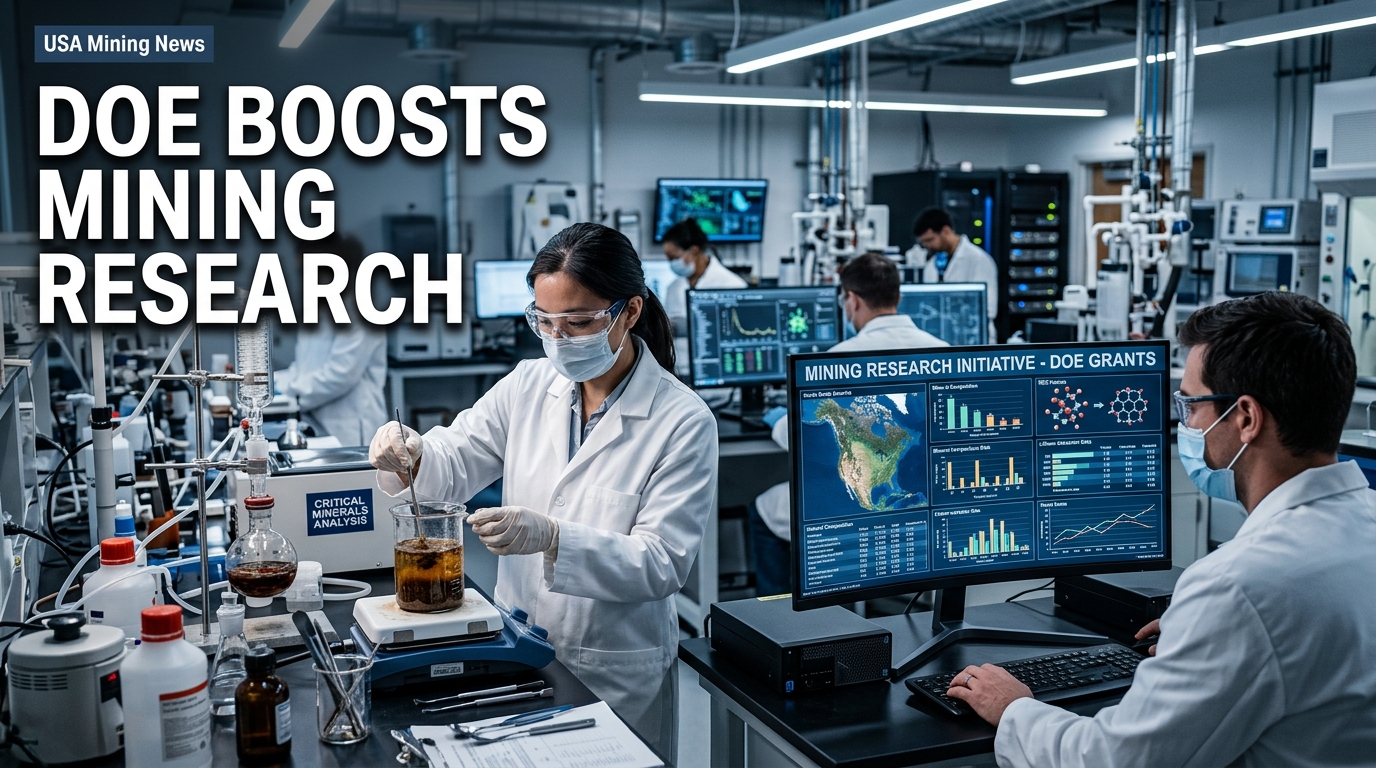
WASHINGTON – On October 1, 2026, the U.S. Department of Energy (DOE) unveiled a substantial annual funding opportunity, committing up to $400 million towards foundational scientific research. This pivotal investment, announced in Washington, is designed to advance the frontiers of scientific knowledge and lay crucial groundwork for future technologies and innovation across the nation. For an industry as fundamentally reliant on scientific progress as mining, this "Open Call" for research support represents a significant, albeit often indirect, boost to future operational capabilities and strategic positioning.
The funding initiative directly supports President Trump’s Executive Order, Restoring Gold Standard Science, emphasizing rigorous, transparent, and mission-driven research. The DOE’s Office of Science, recognized as the largest supporter of basic research in the physical sciences nationwide, is the primary conduit for this investment, channeling funds to hundreds of universities and stewarding 10 of the DOE’s National Laboratories. This comprehensive approach underscores a national commitment to fortifying America's scientific and technological leadership on the global stage, a leadership that is increasingly intertwined with secure and sustainable mineral resource supply chains.
DOE Unveils Significant Basic Research Investment
The annual funding opportunity, formally known as a Notice of Funding Opportunity (NOFO) and informally as the “Open Call,” was issued at the beginning of Fiscal Year 2027. This mechanism allows the DOE’s Office of Science to solicit applications from institutions for research support in areas not covered by more specific, topical NOFOs. Under Secretary for Science Darío Gil articulated the strategic importance of this investment, stating, “Foundational research is where the breakthroughs that shape America’s future begin. Through this investment, we are empowering our nation’s researchers to pursue bold ideas, push the boundaries of discovery, and build the scientific foundations for tomorrow’s technologies—strengthening America’s global leadership in science and innovation.”
This statement resonates deeply within the mining community, where continuous innovation is paramount for addressing complex challenges ranging from declining ore grades and increasing energy costs to stringent environmental regulations and the urgent need for critical mineral independence. While the immediate beneficiaries are research institutions and scientists, the long-term impact cascades through sectors like mining, which stand to gain from enhanced technologies, improved resource utilization, and more sustainable operational practices.
Targeted Scientific Frontiers for Future Innovation
The allocated funds will support research across a broad spectrum of scientific disciplines under the DOE’s Office of Science. These areas are critical to tackling some of the nation’s greatest scientific challenges and accelerating discoveries in fields vital to America’s future competitiveness. The key research areas identified include:
- Advanced Scientific Computing Research: Focused on developing advanced computational models, algorithms, and high-performance computing capabilities.
- Basic Energy Sciences: Encompassing fundamental research in materials sciences, chemistry, geosciences, and biosciences that underpins energy technologies.
- Biological and Environmental Research: Exploring complex biological systems and their interactions with the environment, including climate and ecosystem studies.
- Fusion Energy Sciences: Pursuing the development of fusion as a clean, virtually limitless energy source.
- High Energy Physics: Investigating the fundamental constituents of matter and energy, and the forces that govern them.
- Nuclear Physics: Studying the properties and interactions of atomic nuclei and nuclear matter.
- Isotope R&D and Production: Developing and producing stable and radioactive isotopes for various applications in medicine, industry, and national security.
Each of these disciplines, while seemingly disparate from day-to-day mining operations, offers a foundational layer of scientific inquiry that can yield transformative applications within the mining sector. For instance, breakthroughs in materials science under Basic Energy Sciences can lead to more durable and efficient mining equipment, while advancements in computing can revolutionize exploration and operational planning.
The "Open Call" Mechanism: Fueling University and National Lab Research
The annual "Open Call" NOFO is a cornerstone of the DOE's strategy to maintain a vibrant and innovative research ecosystem. By providing a flexible funding mechanism, it ensures that promising, unsolicited research proposals in critical areas can receive support. This approach leverages the intellectual capital of hundreds of universities nationwide and the cutting-edge facilities and expertise residing within the 10 National Laboratories stewarded by the DOE’s Office of Science. This broad engagement fosters a diverse portfolio of research, increasing the likelihood of serendipitous discoveries and interdisciplinary breakthroughs that can have unforeseen yet profound impacts.
For the mining industry, this distributed research model is highly beneficial. Universities and National Laboratories often serve as incubators for radical new ideas and technologies that may be too nascent or high-risk for direct corporate investment. Collaborative efforts and technology transfer programs stemming from these institutions are crucial for bringing new tools and techniques to market, ultimately benefiting mining companies seeking competitive advantages.
The Mining Sector's Stake in Foundational Science
The direct links between these broad scientific endeavors and the mining industry, while not always immediately apparent, are fundamental to long-term progress and sustainability. Mining is an increasingly high-tech industry, relying on advanced science to extract resources safely, efficiently, and with minimal environmental impact. This $400 million investment underpins future capabilities in several key areas:
- Advanced Scientific Computing Research: Breakthroughs here directly feed into the development of Artificial Intelligence (AI) and Machine Learning (ML) algorithms for geological modeling, predictive maintenance of heavy machinery, optimization of mine planning and scheduling, and autonomous mining systems. Improved computing power and algorithms can transform how exploration data is processed, how ore bodies are understood, and how operations are managed in real-time.
- Basic Energy Sciences (Materials Science & Chemistry): This is perhaps one of the most impactful areas. Research in new materials can lead to the creation of ultra-hard, corrosion-resistant alloys for drilling and crushing equipment, extending lifespan and reducing downtime. Advances in chemistry can develop more selective and environmentally friendly reagents for mineral processing, reducing chemical consumption and waste. Furthermore, innovations in energy storage materials are vital for the electrification of mine fleets, reducing reliance on fossil fuels and lowering operational costs and emissions.
- Biological and Environmental Research: This field is critical for modern mining's environmental stewardship. Research into bioremediation techniques can offer novel solutions for mine site reclamation and water treatment, addressing legacies of past operations and improving current practices. Understanding complex biogeochemical cycles can inform strategies for managing tailings and mitigating environmental risks, ensuring compliance with increasingly stringent regulations.
- Isotope R&D and Production: Isotopes have diverse applications in mining. Stable isotopes are invaluable for geochronology and tracing geological processes, aiding in more precise mineral exploration. Radioactive isotopes are used in process control, such as density gauges in slurry lines, and in elemental analysis instruments (e.g., Portable X-ray Fluorescence – pXRF) for rapid on-site analysis of ore grades, optimizing resource recovery and reducing waste. Advanced isotope research can lead to more accurate and cost-effective tools for resource characterization and environmental monitoring.
Strategic Implications for America's Resource Security
Beyond direct operational benefits, this federal investment in basic science carries significant strategic implications for America’s resource security. The ability to innovate at the fundamental scientific level is crucial for maintaining a competitive domestic mining industry capable of supplying critical minerals essential for national defense, clean energy technologies, and advanced manufacturing. By fostering cutting-edge research, the U.S. aims to:
- Enhance Domestic Resource Discovery and Extraction: More sophisticated exploration techniques and efficient extraction methods can unlock previously uneconomic deposits, reducing reliance on foreign supply chains for vital commodities.
- Improve Processing Efficiency and Reduce Waste: Innovations in mineral processing, driven by basic chemical and materials science, can lead to higher recovery rates from lower-grade ores and more effective utilization of mine waste, transforming it into valuable co-products.
- Lower Environmental Footprint and Increase Sustainability: Research in environmental sciences and new materials contributes to cleaner mining practices, which are essential for securing social license to operate and meeting environmental, social, and governance (ESG) expectations from investors and communities.
- Foster a Skilled Workforce: Investments in university research not only produce scientific breakthroughs but also train the next generation of engineers, scientists, and technicians who will staff the mining industry and its supporting sectors.
This long-term vision of scientific investment supports a robust and resilient domestic supply chain, which is a key priority for the Trump Administration as outlined by the Executive Order. For mining companies and investors, understanding these foundational research trends is essential for identifying future opportunities and anticipating technological shifts that could redefine the industry.
Future Outlook: A Long-Term Vision for Industry Advancement
While the direct commercialization of basic scientific research can take years, even decades, the $400 million annual funding from the DOE is a vital injection into the pipeline of innovation. The breakthroughs fostered today in DOE-funded laboratories and universities will eventually translate into the advanced tools, technologies, and methodologies that will define the mining industry of tomorrow. From autonomous electric vehicles navigating smart mines, to novel hydrometallurgical processes extracting metals from unconventional sources, to sophisticated environmental monitoring systems, the seeds of these advancements are being sown through initiatives like the "Open Call."
Mining industry professionals and investors should view this investment not as a distant academic exercise, but as a critical enabler for future competitiveness. Tracking the outcomes of research in areas like materials science, advanced computing, and isotope technologies will provide leading indicators for where the next wave of innovation will emerge. This sustained commitment to foundational science ensures that the United States remains at the forefront of technological progress, benefiting critical industries such as mining that are indispensable to the nation’s economic strength and strategic autonomy.