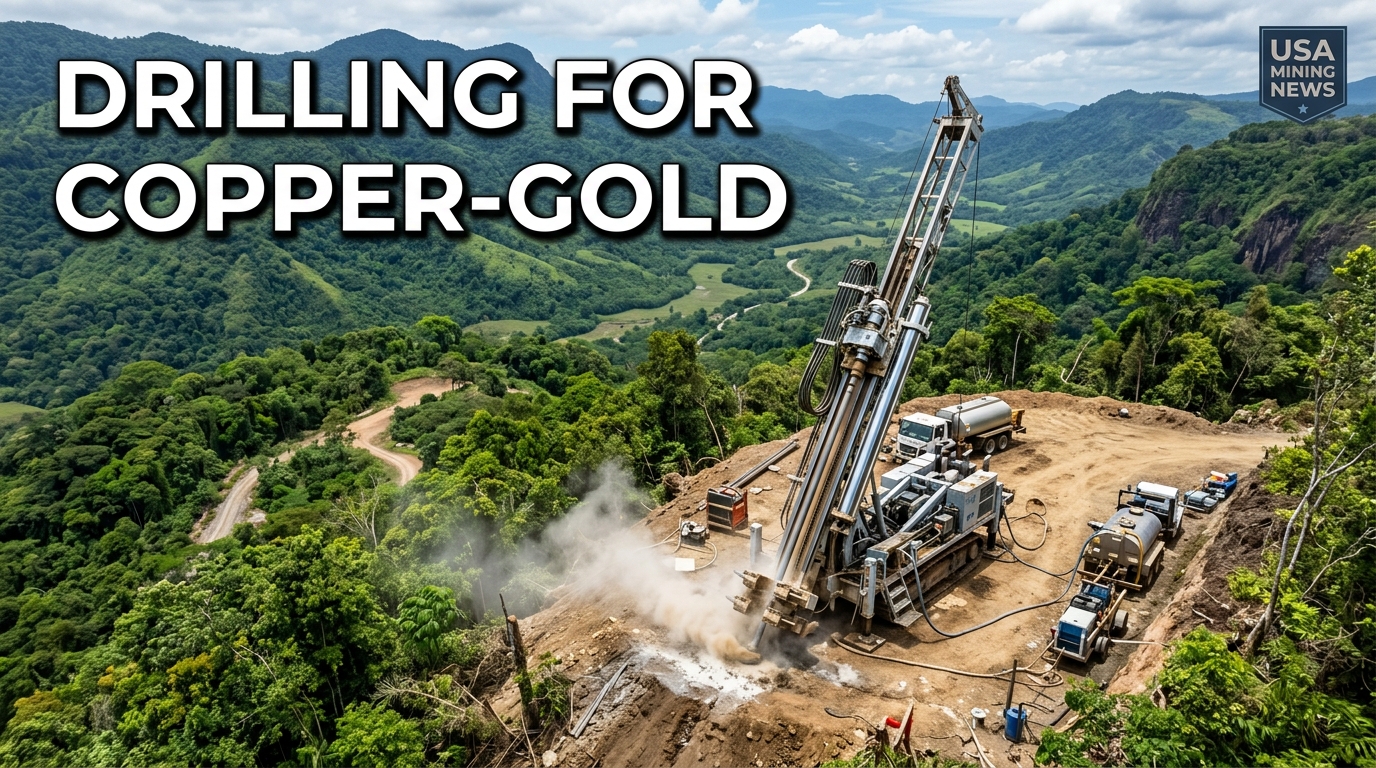
Estrella Resources Kicks Off Maiden Drilling at Laleno Dome, Timor-Leste, Targeting Porphyry Copper-Gold
DILI, TIMOR-LESTE – In a significant development for the global mining sector and an emerging frontier market, Estrella Resources has officially received approval from the Autoridade Nacional dos Minerais Timor-Leste (ANM) to initiate its maiden drilling campaign at the highly prospective Laleno Dome. This crucial regulatory clearance, announced on October 16, 2026, paves the way for immediate ground preparations, with drilling operations slated to commence early next week. The program aims to explore targets considered highly prospective for porphyry-style copper-gold mineralisation, marking a pivotal moment for Estrella Resources and the mining potential of Timor-Leste.
The commencement of drilling at Laleno Dome represents the culmination of extensive preparatory work and geological interpretation. Porphyry deposits are globally significant sources of copper, gold, molybdenum, and silver, characterized by large volumes of disseminated mineralization often associated with intrusive igneous rocks. Discoveries of such deposits can be transformative for companies and nations alike, given their scale and long production lives. The industry will be watching closely as Estrella Resources puts its exploration hypotheses to the test in this previously untested region.
Green Light from ANM: A Regulatory Milestone
Securing formal approval from the Autoridade Nacional dos Minerais Timor-Leste (ANM) is a critical milestone for any exploration company operating in the jurisdiction. It underscores the cooperative framework between Estrella Resources and the Timorese government, highlighting the country's structured approach to developing its mineral resources. The ANM's approval signifies that Estrella Resources has met all necessary environmental, operational, and safety standards required to proceed with intrusive exploration activities.
Following the ANM’s green light, Estrella Resources wasted no time in mobilizing its teams. The company announced that the preparation of drill sites and access tracks would begin immediately. This foundational work is essential for ensuring safe and efficient drilling operations, particularly in potentially rugged or remote terrains. The swift transition from approval to operational readiness demonstrates Estrella’s commitment to advancing its Timor-Leste projects with urgency and professionalism. The expectation for drilling operations to begin "early next week" further emphasizes the accelerated timeline for this high-priority campaign.
Targeting Porphyry-Style Copper-Gold: A Detailed Look at Exploration Strategy
The inaugural drilling program at Laleno Dome is strategically designed to assess targets that exhibit strong indicators for porphyry-style copper-gold mineralisation. These targets were not haphazardly chosen but were identified through a rigorous and systematic exploration methodology, combining advanced geophysical techniques with boots-on-the-ground sampling.
Key indicators and targets for the drilling campaign include:
- High-Conductivity Anomalies: The drilling will specifically focus on areas that registered high-conductivity anomalies. These anomalies often indicate the presence of sulfide minerals, which are commonly associated with copper and gold in porphyry systems.
- "Plumes" on the Flank of Laleno Dome: A particular focus will be on "plumes" detected on the flank of the Laleno Dome. In geophysical interpretation, conductive plumes can represent significant, potentially deep-seated zones of mineralisation or alteration indicative of a large hydrothermal system.
- Shallow Conductivity Targets: The program will also test shallower conductive zones, which could represent near-surface expressions of a larger system or distinct mineralised horizons.
- Shallow-Dipping Conductive Anomaly: Of particular interest is a shallow-dipping conductive anomaly. This anomaly is interpreted to potentially represent a manganese-bearing horizon, but also importantly, a near-surface porphyry outcrop, suggesting the immediate presence of the target rock type at shallow depths.
These targets were primarily defined by results from a Mobile MTd geophysical survey. Mobile MTd (Magnetotelluric) is an electromagnetic geophysical method used to image the electrical resistivity structure of the Earth, capable of detecting conductive mineralisation at significant depths. This advanced technique, combined with detailed copper sampling conducted around the Dome, provided compelling evidence to delineate high-priority drill targets. Further supporting this interpretation are recent petrographic results, which involve the microscopic analysis of rock samples. These results have further strengthened the interpretation of a porphyry-style copper system, with visible copper observed at nine distinct locations around the Laleno Dome. This multi-faceted approach to target generation significantly de-risks the initial drilling phase, directing the drill rigs to areas with the highest probability of success.
Laleno Dome: An Untested Frontier with Significant Potential
The Laleno Dome itself is described as a large geological structure, adding to the excitement surrounding this drilling campaign. Historically, large structures often correlate with large-scale mineral systems. The fact that this extensive prospect has "never been tested" underscores its frontier exploration status and the significant discovery potential it holds. Robert Mencel, Managing Director of Estrella Resources, articulated the company's enthusiasm and the rationale behind the aggressive exploration push.
“This is a significant moment for Estrella,” Mr. Mencel stated. “Laleno Dome is a large structure that has never been tested and we are now approved to put the first holes into this extensive prospect.” His remarks highlight the pioneering nature of this exploration effort. He continued, emphasizing the compelling evidence gathered to date: “The evidence received to date supports the potential for the Dome to host porphyry-style copper-gold mineralisation, but we need to drill this target to truly understand its significance.” This statement perfectly encapsulates the transition from geological inference to direct physical testing, which is the cornerstone of mineral exploration.
Mr. Mencel further reinforced the quality of the targets, noting, “Through our geophysics campaign we have defined some conductive plume targets which represent strong walk-up targets that are supported by encouraging boots-on-the-ground sampling work.” The term "walk-up targets" in exploration parlance refers to high-priority anomalies that are readily accessible and present clear drilling propositions due to strong supporting evidence, minimizing initial exploration risk.
Estrella Resources' Strategic Shift and Timor-Leste Portfolio
While Estrella Resources holds exploration projects and mineral rights in Western Australia, a renowned mining jurisdiction, the company has made a strategic decision to prioritize its Timor-Leste portfolio. This shift indicates a high degree of confidence in the geological potential of the relatively underexplored Southeast Asian nation. Such strategic reorientations are common in the junior mining sector, where companies often chase the highest potential for significant discovery.
Estrella Resources is not new to Timor-Leste; its presence there is well-established, particularly with previous success in manganese exploration. To date, the company has discovered manganese mineralisation at several sites within the country, including the prominent Ira Miri deposit. At Ira Miri, Estrella demonstrated its operational capability by extracting a bulk sample of approximately 27,000 tonnes. This substantial sample was taken for "market appraisal," a crucial step in understanding the economic viability and specific market applications for the manganese ore. Manganese is a vital industrial metal primarily used in steel production and increasingly in battery technologies, making the Ira Miri development an important asset for the company.
The company's exploration efforts in Timor-Leste are ongoing, encompassing both manganese and the intensified pursuit of copper and gold occurrences across the region. This multi-commodity approach leverages the diverse geological endowment of Timor-Leste and positions Estrella Resources to capitalize on different commodity market dynamics.
The Broader Industry Context: Timor-Leste's Emerging Mining Landscape
The unfolding developments at Laleno Dome are highly relevant to the broader mining industry, particularly given Timor-Leste’s status as an emerging mining jurisdiction. For investors and industry professionals, a potential major copper-gold discovery in a new frontier region holds significant implications. Global demand for copper is projected to surge dramatically due to the accelerating energy transition, driven by electrification, renewable energy infrastructure, and electric vehicles. Gold, meanwhile, continues to hold its value as a safe-haven asset and a critical component in various high-tech applications. A new, large-scale porphyry system could contribute meaningfully to future global supply, diversifying sources away from traditional mining regions.
Operating in emerging markets like Timor-Leste often presents a unique set of challenges and opportunities. While geological prospectivity can be high due to limited historical exploration, companies must navigate developing regulatory frameworks, infrastructure limitations, and socio-economic considerations. Estrella Resources’ successful navigation of the ANM approval process and its prior experience with manganese extraction demonstrate its capacity to operate effectively within this context. A significant discovery at Laleno Dome could catalyze further exploration and investment into Timor-Leste, potentially transforming its economic landscape and establishing it as a recognized player in the global mineral supply chain.
Future Outlook and Implications for Estrella Resources
With drilling scheduled to commence imminently, the immediate future for Estrella Resources at Laleno Dome involves the rigorous execution of the drilling program, followed by core logging, sampling, and assaying. The initial assay results will be eagerly awaited by the market, as they will provide the first direct evidence of copper-gold grades and widths within the targeted zones. These results will be critical in confirming the porphyry model and determining the project’s economic potential.
Should the drilling confirm significant copper-gold mineralization, the implications for Estrella Resources could be substantial. A successful maiden drilling campaign would likely lead to further infill and extensional drilling, aimed at defining a JORC-compliant mineral resource. Such a development would significantly enhance the company’s valuation, attract further investment, and potentially position it as a key player in a major new discovery. For Timor-Leste, a successful project could spur economic development, create employment opportunities, and establish a new revenue stream, diversifying its economy beyond its existing oil and gas sector.
The exploration community will closely monitor Estrella Resources’ progress, as the Laleno Dome campaign represents a compelling test of modern exploration techniques in a previously undrilled, large-scale geological target. The stakes are high, but the potential rewards – a new, large-scale copper-gold porphyry deposit – are considerable for all stakeholders.