Fortescue Achieves Landmark First Hot Metal Production at Christmas Creek, Signaling Green Steel Future
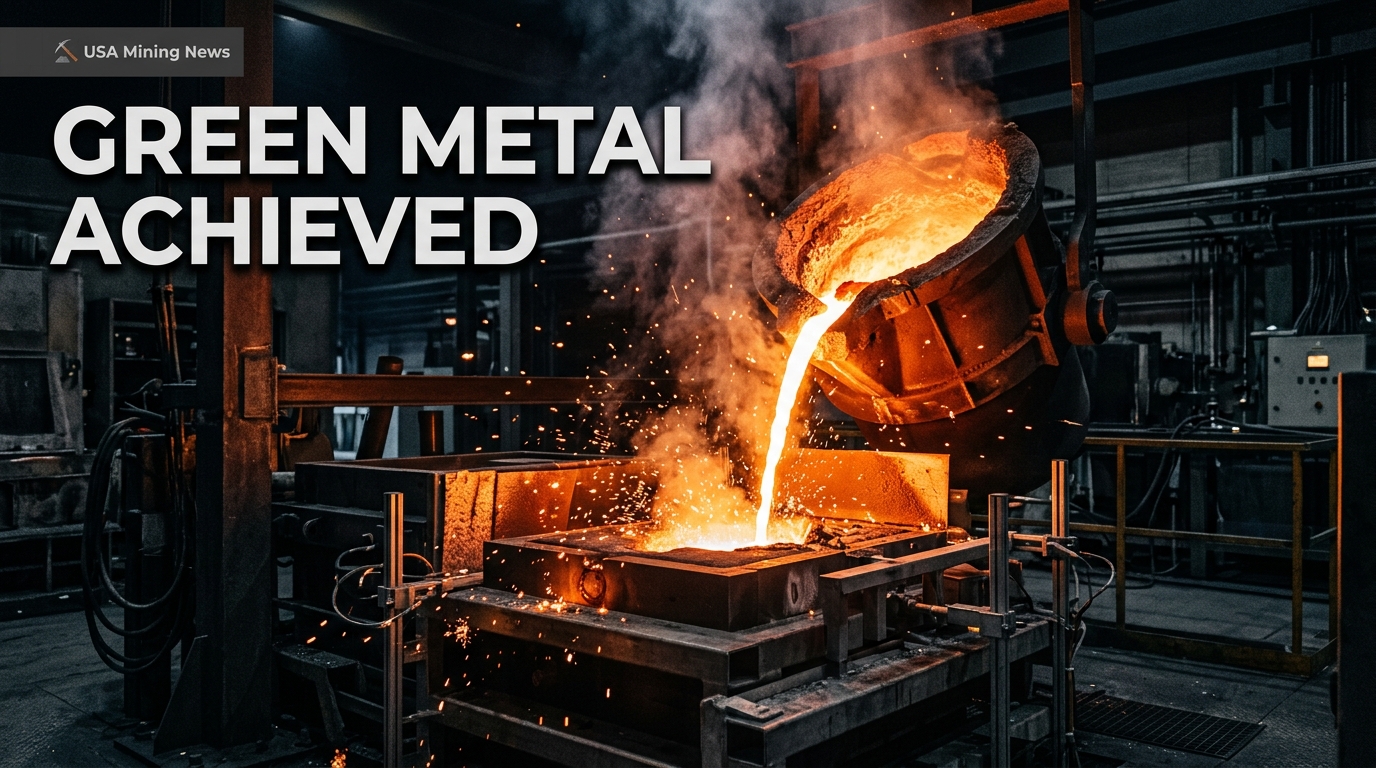
Perth, Western Australia – September 29, 2026 – Fortescue Metals, a global leader in the iron ore industry, has announced a pivotal achievement at its Christmas Creek Green Metal Project in Western Australia: the successful production of its first hot metal. This milestone, made possible by an advanced electric direct reduced iron (DRI) smelting furnace supplied by Finnish technology giant Metso, represents a tangible step forward in the quest for lower-emission iron-making and the broader decarbonization of the global steel sector. Situated in the resource-rich Pilbara region, this project is not merely an operational success but a strategic declaration of intent, positioning Fortescue and Australia at the forefront of green industrial innovation.
The successful initiation of hot metal production at Christmas Creek underscores Fortescue's ambitious commitment to transform its iron ore operations and contribute to a sustainable future. The project is specifically designed to rigorously test and validate new low-emission technologies for processing iron ore, moving decisively away from the energy-intensive and carbon-heavy traditional blast furnace methods that have historically dominated steel production. This shift is crucial for an industry grappling with immense pressure to reduce its environmental footprint, given that steelmaking is one of the largest industrial emitters of carbon dioxide globally. The installation of Metso’s cutting-edge electric DRI smelting furnace commenced in September 2025, culminating in this critical production milestone just over a year later.
The Christmas Creek Green Metal Project: A Pioneering Initiative
The Christmas Creek Green Metal Project is strategically located within Fortescue's established mining operations in the Pilbara region, a geographic area synonymous with the world's highest-quality iron ore deposits. This positioning allows Fortescue to leverage its extensive experience and existing infrastructure while simultaneously pioneering new metallurgical pathways. The primary objective of the project is to thoroughly evaluate the potential of Metso’s advanced technology to process local iron ore fines through innovative, lower-emission iron-making routes.
Fortescue's vision, as articulated by CEO Dino Otranto, extends beyond simply mining and exporting raw materials. "This is a significant milestone for our Green Metal Project and another step towards producing commercial-scale green metal in Australia," Otranto stated. He emphasized the transformative economic opportunity this presents for the nation: "For decades Australia has exported iron ore to the world. The next opportunity is to create more value from that ore by producing green metal here at home." This statement highlights a strategic pivot, aiming to capture greater value within the domestic economy by upgrading raw materials into higher-value, lower-carbon products.
The shift from traditional blast furnace methods, which rely heavily on metallurgical coal and produce substantial CO2 emissions, to DRI processes offers a compelling pathway for decarbonization. DRI technology typically uses natural gas as a reductant, or increasingly, green hydrogen, to remove oxygen from iron ore at lower temperatures, producing a solid iron product known as direct reduced iron. When this DRI is subsequently melted in an electric arc furnace (EAF), especially one powered by renewable electricity, the result is significantly lower-emission steel, or "green steel." The Christmas Creek project, with its electric DRI smelting furnace, directly contributes to proving the viability of this integrated approach on Australian soil.
Metso's Advanced DRI Smelting Furnace Technology
At the heart of the Christmas Creek project's success is the proprietary electric DRI smelting furnace technology supplied by Metso. Known for its extensive range of Outotec-branded solutions, Metso has provided the core design and technological expertise for this pivotal installation. The furnace is engineered to produce high-quality iron units, which are the fundamental building blocks for steel production, while simultaneously achieving significantly lower emissions compared to conventional methods.
A particularly notable advantage of Metso's technology, as highlighted by the company, is its capability to enable iron-making from specific ore reserves in the Pilbara that have historically been considered unsuitable for direct reduction. This unsuitability was primarily due to a higher gangue content – inert materials mixed with the desired ore. Traditional DRI processes often require very high-grade iron ore with minimal impurities. By effectively handling these challenging feedstocks, Metso's technology unlocks new potential for utilizing a broader spectrum of Australia's vast iron ore resources, enhancing resource efficiency and potentially extending the economic life of certain deposits. The technology leverages proprietary equipment designed to process even blast furnace-grade iron ore, making it highly versatile and adaptable to various raw material compositions.
Piia Karhu, Metso Minerals President, expressed the company's enthusiasm for this achievement. "We congratulate Fortescue on this significant step forward. The production of first hot metal at the Christmas Creek Green Metal Project demonstrates the role of Metso’s DRI smelting furnace technology in advancing lower-emission iron-making," Karhu stated. She emphasized the collaborative learning aspect of the project: "The project will provide important learnings as Fortescue works towards developing a pathway for green iron production at scale using Pilbara ore. We are proud to support Fortescue in this pioneering work."
Metso's pilot furnace at Christmas Creek is intended to demonstrate both the equipment's robust performance and the process features that could be directly applied to industrial-scale operations. This real-world validation is critical for de-risking future commercial investments in similar technologies. The Christmas Creek trials are complemented by ongoing research and development at the Metso Research Center in Pori, Finland, where the technology is being rigorously tested alongside circular alternating current (AC) and direct current (DC) electric furnaces. This dual approach of pilot-scale demonstration and advanced R&D ensures the continuous optimization and scalability of Metso’s low-emission solutions for the global metals industry.
Industry Implications and Market Context
The successful production of hot metal at Fortescue's Christmas Creek project carries profound implications for the global mining and steel industries. For Fortescue, it marks a significant step in its corporate strategy to diversify its product portfolio beyond raw iron ore and to future-proof its business in a rapidly decarbonizing world. By investing in value-added green metal production, Fortescue aims to capture a larger share of the value chain, mitigate future carbon taxes or levies, and enhance its appeal to environmentally conscious investors and customers.
For the steel industry as a whole, this development offers tangible hope for achieving ambitious decarbonization targets. Steel production accounts for approximately 7-9% of global anthropogenic CO2 emissions, making it one of the most challenging sectors to abate. The successful implementation and eventual scaling of technologies like Metso's DRI smelting furnace, particularly when coupled with renewable energy sources and green hydrogen, could dramatically alter this emissions profile. This project serves as a practical demonstration of how metallurgical innovations can unlock sustainable production routes, potentially accelerating the transition to a low-carbon economy.
Economically, Australia stands to benefit significantly. By transforming from a primary exporter of unprocessed minerals to a producer of green metal, the nation can create new high-tech manufacturing jobs, foster local expertise, and strengthen its position in global supply chains that increasingly prioritize sustainability. The ability to utilize lower-grade ores, previously deemed uneconomical for direct reduction, further enhances Australia’s resource utilization efficiency and could prolong the operational life of existing mines.
The Path Forward: Scaling Up and Broader Impact
The "important learnings" derived from the Christmas Creek Green Metal Project will be instrumental in informing Fortescue's strategy for developing a comprehensive pathway for green iron production at a truly industrial scale using Pilbara ore. This initial pilot phase is crucial for optimizing process parameters, understanding operational challenges, and refining the economic model for large-scale deployment. The collaboration with Metso, a company at the forefront of sustainable technologies, ensures that these learnings will be systematically integrated into future advancements.
The potential for this technology to be adopted globally is substantial. As steelmakers worldwide seek viable solutions to reduce their carbon footprint, the validated performance of Metso's electric DRI smelting furnace at Christmas Creek could serve as a blueprint for similar projects in other iron ore-producing regions. The flexibility to handle varying ore qualities, particularly those with higher gangue content, broadens its applicability significantly.
Metso’s commitment to advancing green technologies is further evidenced by its recent activities beyond Christmas Creek. Earlier this month, Metso signed an agreement with the Geological Survey of Finland (GTK) to engineer and deliver process technology for GTK Mintec’s new pilot plant in Outokumpu, Finland. This parallel initiative underscores Metso's broader strategy to innovate across the mineral processing value chain, developing solutions that cater to the evolving needs of a resource-efficient and environmentally responsible mining industry.
In conclusion, the production of first hot metal at Fortescue’s Christmas Creek Green Metal Project represents more than just an operational achievement; it is a tangible symbol of the mining industry's transformative journey towards sustainability. With the successful deployment of Metso’s advanced electric DRI smelting furnace, Fortescue has not only taken a significant stride towards its goal of producing commercial-scale green metal in Australia but has also provided a powerful demonstration of how technological innovation can unlock a lower-emission future for one of the world's most critical industrial sectors.