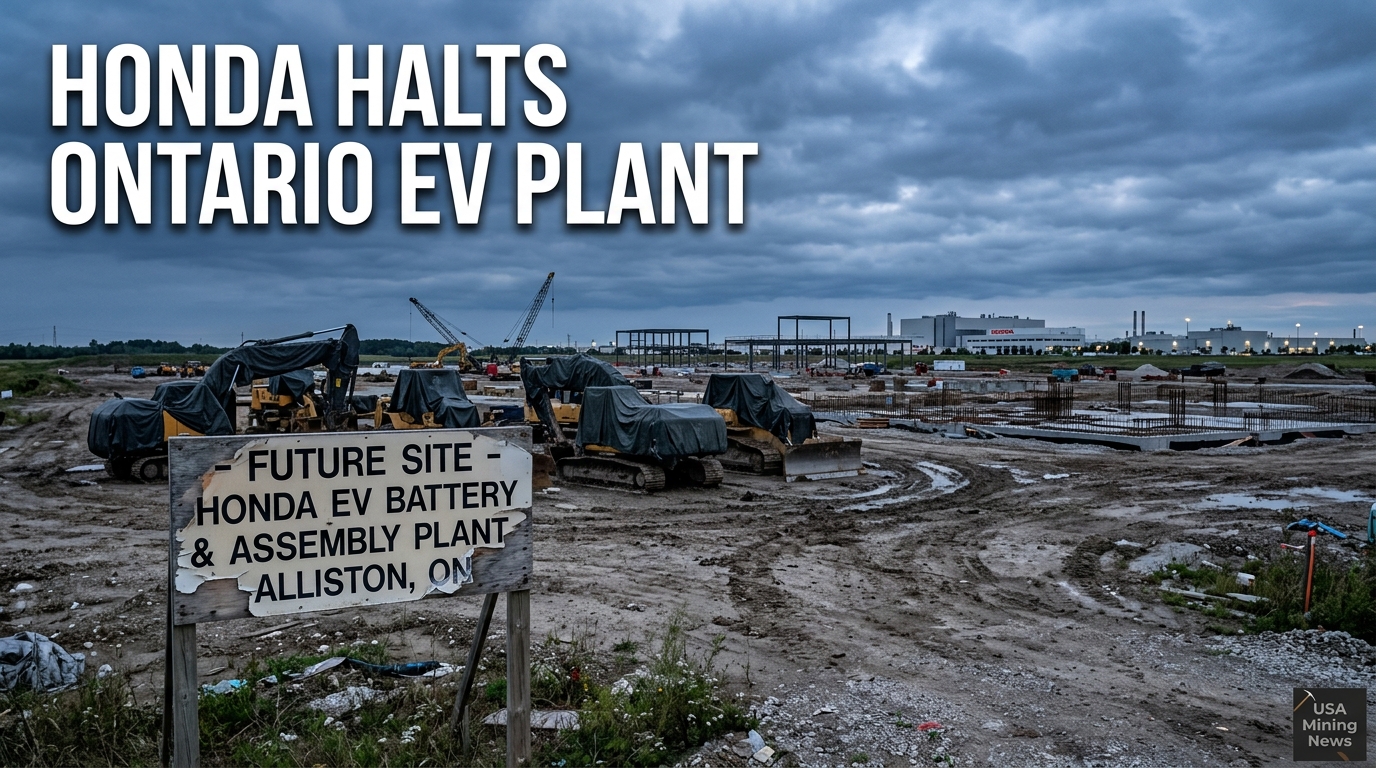
Alliston, Ontario – Honda has formally announced the indefinite suspension of its ambitious C$15 billion ($11 billion USD) electric vehicle (EV) and battery manufacturing complex planned for Alliston, Ontario. This significant decision, communicated on May 15, 2026, marks a considerable setback for Canada’s strategic objectives to establish a comprehensive domestic EV supply chain and sends a reverberation through the global automotive and battery metals industries.
The announcement follows speculation last week in Japanese media regarding a potential postponement. The project, initially slated to be operational by 2028 before an earlier delay pushed it to 2030, will now be put on hold indefinitely, as Honda cited “revised strategic objectives” and the need to “carefully monitor market conditions.” This move, confirmed via a company statement on Thursday, will not, according to Honda, impact existing jobs or current production activities at its Alliston facility.
A Major Reversal for Honda's Canadian Ambitions
The proposed expansion represented a cornerstone of Honda's future manufacturing strategy in North America and a significant investment in Canada. The complex was designed to dramatically augment the company’s existing Alliston operations, encompassing four key components:
- An upgraded assembly plant capable of producing next-generation electric vehicles.
- A standalone, state-of-the-art battery facility to produce EV batteries.
- Two additional component plants to support the integrated manufacturing process.
Upon completion, the site was projected to produce as many as 240,000 electric vehicles annually by the end of the decade. Crucially for the local economy, the project aimed to preserve approximately 4,200 existing jobs while creating an additional 1,000 new positions. The Canadian federal and Ontario provincial governments had previously pledged substantial financial support for the endeavor, announcing in 2024 that up to C$5 billion in funding would be made available. However, Honda confirmed that none of this committed government funding has yet been disbursed for the project.
The indefinite suspension represents a culmination of a series of reconsiderations by the Japanese automaker. In May of last year, Honda had already announced a two-year delay for the project, pushing its target completion date from 2028 to 2030. The current decision to suspend the project altogether highlights a more fundamental shift in the company’s near-term investment strategy.
Economic Headwinds and Shifting Corporate Strategy
Honda’s decision to halt the C$15 billion Ontario project is directly linked to the challenging financial environment the company currently faces. On the same day as the suspension announcement, Honda reported its first-ever full-year loss, amounting to 423.9 billion yen ($2.7 billion USD), for the fiscal period spanning April 1, 2025, to March 31, 2026. This stark financial downturn was attributed by Honda, in a quarterly statement issued in March, to several factors impacting its core automotive sector:
- The adverse effects of U.S. tariff policies on its gasoline and hybrid vehicle business.
- A decline in the competitiveness of Honda products in Asian markets, partly due to the strategic redirection of resources towards electric vehicle development.
Prime Minister Mark Carney, speaking to reporters on Thursday, expressed his disappointment with Honda’s decision, noting its reflection of the automaker’s broader strategic and financial challenges, which are further exacerbated by recent spikes in gasoline prices, as reported by Global News.
Honda’s strategic review is not an isolated incident but rather indicative of broader turbulences within the global EV sector. Automakers worldwide are increasingly tempering their aggressive spending plans for EV manufacturing, grappling with persistently high development and production costs, inconsistent policy signals—particularly from the U.S. Trump administration—and a slower-than-forecasted sales growth rate for electric vehicles. This confluence of factors has prompted a re-evaluation of massive capital commitments across the industry.
Canada's Broader EV Strategy Under Scrutiny
For Canada, and specifically Ontario, Honda’s suspension represents a significant blow to a diligently cultivated strategy aimed at establishing a fully integrated EV supply chain, from critical minerals extraction to final vehicle assembly. The province had been championing the development of a “battery metals corridor” designed to feed directly into domestic EV manufacturing plants.
However, this strategy has experienced several high-profile setbacks and delays. The Ontario government itself has, in the present year, re-evaluated its singular focus on EVs, shifting its emphasis towards “defence metals” after being stung by the complexities and postponements associated with a series of large investment promises:
- In 2023, the C$5 billion NextStar Energy battery plant in Windsor, a joint venture between LG Energy Solution and Stellantis, experienced a brief halt in construction and subsequent restructuring when Stellantis temporarily pulled out.
- Volkswagen’s ambitious C$7 billion PowerCo battery gigafactory in St. Thomas, while progressing, has done so at a pace slower than initially envisioned.
- Ford Motor Company notably opted to produce traditional pickup trucks at its Oakville, Ontario plant instead of proceeding with previously considered EV manufacturing plans.
- General Motors announced last year that it would cease production of its BrightDrop electric delivery van in the province.
Despite these challenges in downstream manufacturing, Ontario continues to back crucial upstream projects within the EV supply chain. The province is notably fast-tracking key mining projects such as Canada Nickel’s (TSXV: CNC) Crawford project, aiming to be a significant producer of nickel for batteries, and Frontier Lithium’s (TSXV: FL) PAK project, which targets high-grade lithium deposits. Additionally, investments in several processing plants, including those for cobalt, highlight a continued governmental commitment to securing raw and processed battery materials, even as vehicle assembly faces headwinds.
The Shadow of Geopolitical Trade Tensions
A crucial underlying factor influencing Honda’s decision, and indeed the broader attractiveness of manufacturing in Canada for global automakers, is the prevailing trade relationship between Washington and Ottawa. Honda’s primary market for vehicles produced in North America is emphatically the much larger United States, not Canada. This critical dependence means that uncertainties surrounding cross-border trade policies carry significant weight.
Both the U.S. and Canada, along with Mexico, are currently engaged in a review of their foundational free trade agreement, the CUSMA (Canada-United States-Mexico Agreement). A key area of scrutiny within this review is how the agreement’s rules of origin exempt autos, a vital component for integrated North American manufacturing supply chains. Any potential changes or increased stringency in these exemptions could introduce new complexities and costs for automakers operating across the border.
Compounding these uncertainties are recent tariff adjustments implemented by the Trump administration. Effective April 6, these policies significantly expanded the scope of products subject to elevated tariffs, including a 50% tariff on core metals such as steel, aluminum, and copper, and a 25% tariff on most derivatives. Such measures invariably escalate the cost of raw materials and components, making large-scale manufacturing investments in regions reliant on cross-border supply chains inherently riskier and less financially appealing.
Implications for the Battery Metals Sector
For mining industry professionals and investors in battery metals, Honda’s indefinite suspension of the Alliston plant sends a clear signal of demand volatility in the downstream EV sector. Gigafactories and EV assembly plants are the ultimate consumers of critical minerals like lithium, nickel, cobalt, graphite, manganese, and copper. The planned output of 240,000 vehicles annually from the Honda plant represented a substantial, albeit future, source of demand for these commodities.
While the overall global trajectory towards electrification is unlikely to reverse, such major project suspensions indicate that the path will be uneven. Investors in upstream mining projects, particularly those developing new sources of battery minerals in North America, must factor in these shifting timelines and potential fluctuations in forecast demand. Careful due diligence, focusing on the long-term fundamentals of individual projects and their cost structures, becomes even more critical.
The Ontario government’s nuanced shift towards "defence metals" also highlights a potential diversification strategy for the province’s mining sector. While many "defence metals" overlap with battery metals (e.g., nickel, cobalt, copper), this pivot may signal a greater emphasis on supply chain security and strategic national interests beyond pure consumer EV demand. Nonetheless, the continued governmental support for projects like Canada Nickel’s Crawford and Frontier Lithium’s PAK demonstrates that the strategic importance of domestic sources for critical battery raw materials remains a priority, irrespective of short-term manufacturing headwinds.
Future Outlook and Strategic Considerations
Honda’s immediate future steps involve "reviewing our future procurement and business strategies" and continuously "monitoring market conditions." This suggests a period of strategic recalibration, potentially leading the company to explore alternative manufacturing hubs, re-evaluate its global EV production footprint, or await more stable and favorable conditions in the North American market before proceeding with such a significant investment.
For Canada, the challenge lies in how to sustain its ambitious vision of an integrated EV supply chain in the face of global economic pressures and the evolving corporate strategies of major automakers. This event could inject caution into other potential investors considering large-scale EV manufacturing in the region, particularly given the persistent trade uncertainties between Canada and the United States.
Ultimately, Honda's decision to indefinitely suspend its C$15 billion EV and battery complex in Ontario is more than just an automotive industry headline. It is a bellwether event for the broader energy transition, illustrating the complex interplay of corporate finance, geopolitical trade policies, and market demand dynamics that directly impact the mining and processing sectors providing the critical raw materials. As the industry navigates these turbulent waters, adaptability and a robust understanding of the entire value chain will be paramount for success.