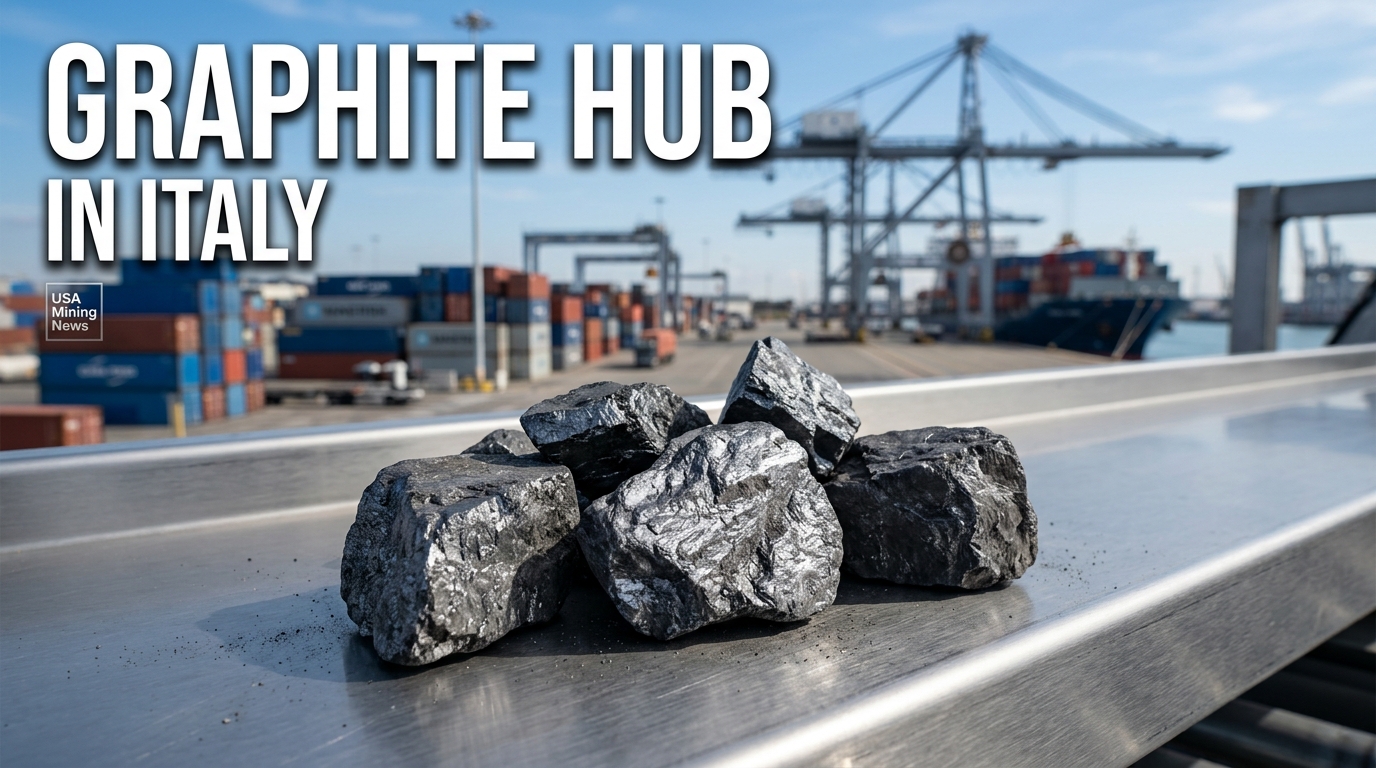
In a pivotal move set to significantly bolster Europe's domestic supply chain for critical raw materials, International Graphite, an Australian-headquartered company with established processing expertise, has formally entered into a joint venture and shareholders’ agreement with Alkeemia, a prominent European chemical manufacturer. Announced on June 17, 2026, this strategic partnership aims to establish a state-of-the-art graphite processing hub at Alkeemia’s industrial site in Porto Marghera, Italy. The collaboration is poised to combine International Graphite’s profound experience in advanced graphite processing with Alkeemia’s robust existing industrial infrastructure, creating a vital onshore capability for a material classified as strategic by the European Union.
The project represents a direct response to the escalating global demand for high-purity graphite, particularly from the burgeoning electric vehicle (EV) battery and renewable energy storage sectors. More critically, it aligns squarely with the objectives of the EU’s Critical Raw Materials Act, which seeks to enhance regional resilience and reduce dependence on external suppliers for key industrial inputs. Europe currently relies on China for nearly all of its processed graphite requirements, a situation that both companies and the broader EU seek to fundamentally transform through initiatives such as this.
Pioneering a Domestic European Graphite Supply Chain
The creation of this processing hub marks a significant step towards manufacturing graphite products within Europe, a strategic imperative given the continent's ambitious decarbonization targets and the rapid expansion of its gigafactory ecosystem. International Graphite’s role will encompass its specialized knowledge in graphite processing and technical services, while Alkeemia brings to the table its extensive industrial footprint and an existing 99-year lease on the Porto Marghera site. This synergy is designed to not only accelerate the project's development but also to ensure efficient, high-quality production tailored to European market specifications.
The initial phase of the project is meticulously designed to achieve a production capacity of approximately 10,000 tonnes per annum (tpa) of an array of graphite products. This foundational capacity is slated for potential expansion to 15,000 tpa in a subsequent development phase, demonstrating a commitment to scaling output to meet anticipated market growth. Such production volumes are crucial for supporting the diverse industrial applications of graphite, ranging from advanced battery anodes to specialized lubricants and refractories, thereby underpinning a broad spectrum of European manufacturing.
Strategic Location and Infrastructure Advantages
The selection of Porto Marghera in Italy for this processing hub is strategically astute, offering substantial logistical and operational advantages. The site is a well-established industrial port, providing direct access to critical transportation networks including shipping, rail, and road. This multi-modal access is indispensable for the efficient import of graphite concentrate feedstock from various global sources and, equally important, for the seamless distribution of finished graphite products to manufacturing facilities across Europe. The ability to leverage existing port infrastructure significantly reduces initial capital expenditure and operational complexities compared to developing a greenfield site, allowing the project to prioritize processing capabilities.
Furthermore, Alkeemia’s existing operations at Porto Marghera as a hydrofluoric acid and fluoro derivatives manufacturing platform provide inherent benefits. These include established utility connections, industrial permits, and potentially a skilled workforce with experience in complex chemical processing. Shared services and operational synergies with Alkeemia’s current activities could further optimize the hub's operational efficiency and cost structure, contributing to the viability and competitiveness of the European-produced graphite.
Phased Development and Production Timelines
The project adheres to a clearly defined timeline, signaling confidence and proactive planning from both partners. An initial Final Investment Decision (FID) for the processing hub is targeted to be achieved by the third quarter of 2026 (Q3 2026). Following this crucial financial commitment, construction of the facility is scheduled to commence immediately after securing all necessary permits, which are also anticipated within Q3 2026. This streamlined approach aims to minimize delays and expedite the realization of processing capabilities.
Assuming these milestones are met, the ambitious but achievable target for the start of commercial production is set for the second half of 2027. This timeline positions the International Graphite-Alkeemia joint venture to become one of the earliest significant domestic suppliers of processed graphite within the European Union under the new regulatory framework, offering a timely solution to critical supply chain vulnerabilities.
Technical Foundation and Product Development
Underpinning the project’s technical feasibility is extensive preparatory work already undertaken by International Graphite. The company has reported successful production of graphite products at both laboratory and pilot scales, confirming that material processed through their expertise meets stringent target specifications. This de-risking of the technical process is a critical element for investor confidence and operational success.
In a testament to the collaborative spirit and forward planning, Alkeemia is actively constructing a 200 tpa graphite purification pilot plant at the Porto Marghera site. International Graphite has been allocated half of this initial capacity for ongoing testing and optimization, ensuring that the final commercial process is robust and efficient. Looking further ahead, there are concrete plans to significantly increase the overall graphite purification output at the site to 20,000 tpa by the end of this decade. This demonstrates a long-term vision for the hub as a major purification center, not just a primary processing facility.
Crucially, the testwork has incorporated a variety of commercially available feedstocks sourced from third-party suppliers. This multi-source feedstock strategy is vital for establishing a resilient supply chain, reducing reliance on any single mine or region, and enabling the hub to generate a diverse range of high-specification graphite products tailored to various end-use applications in the European market.
Addressing Europe's Critical Raw Material Imperative
The establishment of this graphite processing hub is deeply significant in the context of global geopolitical shifts and Europe’s strategic autonomy. Graphite is explicitly classified as a strategic raw material under the EU’s Critical Raw Materials Act. This landmark legislation sets forth ambitious targets, stipulating that by 2030, at least 40% of the EU’s annual consumption of strategic raw materials must be processed within the bloc. The International Graphite-Alkeemia project directly contributes to fulfilling this critical objective.
Europe’s current reliance on imports, particularly from China, for nearly 100% of its processed graphite needs presents substantial economic and geopolitical risks. Diversifying the supply chain through domestic processing capabilities mitigates exposure to potential trade disruptions, price volatility, and geopolitical tensions. This initiative not only enhances Europe's economic security but also strengthens its competitiveness in sectors vital to the green transition, such as battery manufacturing and renewable energy technologies.
International Graphite's Broader European Strategy
The Italian processing hub is not an isolated venture for International Graphite but rather a key component of a broader, more comprehensive strategy to establish a significant presence in the European graphite market. In July 2025, the company further cemented its commitment to the region by partnering with Arctic Graphite and investment firm Graphite Investment Partners to establish an expandable graphite processing facility in Germany. This earlier project signals International Graphite’s intent to build out a portfolio of processing capabilities across Europe, addressing different facets of the graphite market. The presence of two significant projects within the continent underscores the company's strategic vision to become a vital enabler of Europe’s transition to a sustainable, independent critical raw material supply chain.
Industry Implications and Future Outlook
For the global mining industry and its investors, the International Graphite-Alkeemia joint venture in Italy represents a compelling case study in strategic partnerships addressing critical supply chain gaps. It highlights the growing importance of downstream processing close to end-user markets, driven by regulatory incentives like the EU CRM Act and the imperative for supply chain resilience.
The project offers tangible benefits:
- Enhanced Supply Security: Reduces Europe’s vulnerability to external supply shocks for a foundational battery material.
- Economic Development: Creates high-value industrial jobs and fosters local expertise in advanced material processing in Italy.
- Environmental Sustainability: Potentially allows for a more localized and perhaps less carbon-intensive supply chain compared to long-distance imports.
- Investment Precedent: Serves as a model for future collaborations in other critical raw materials within Europe, encouraging further investment in regional processing capacities.
As the world accelerates towards a cleaner energy future, the demand for processed graphite is projected to surge exponentially. Initiatives like the Porto Marghera hub are critical steps in ensuring that Europe is not merely a consumer of these essential materials but also a significant processor and supplier. The success of this joint venture will be closely watched by industry stakeholders, offering valuable insights into the opportunities and challenges of re-shoring complex industrial supply chains in the era of strategic autonomy.