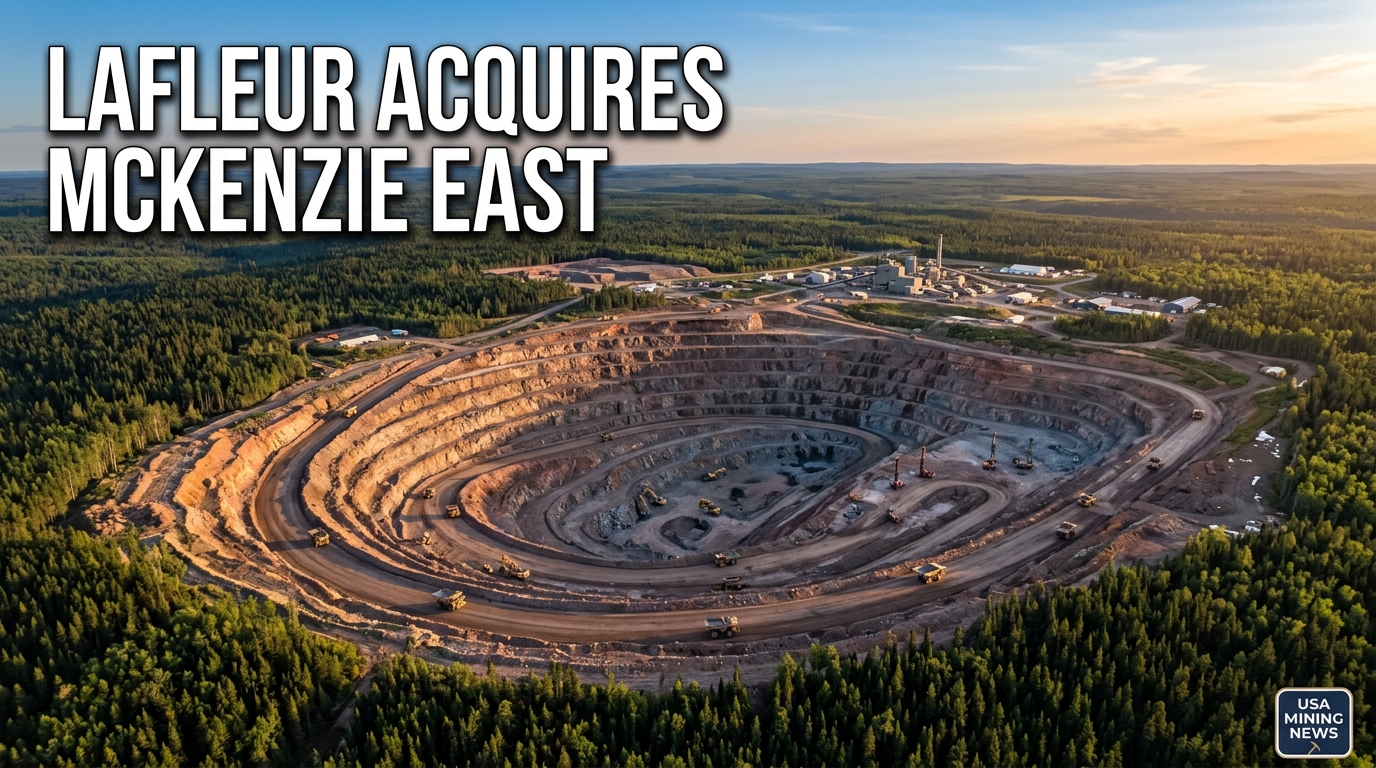
The competitive landscape of Canada's gold sector continues to see strategic maneuvers aimed at consolidating resources and optimizing production, with LaFleur Minerals emerging as a proactive player in the highly coveted Val-d’Or mining district of Québec. On April 29, 2026, LaFleur formalized an arm’s length agreement to acquire the McKenzie East Gold Project, a move that is poised to significantly enhance the company’s long-term operational footprint in a region renowned as Canada's largest gold-producing area. This acquisition aligns directly with LaFleur's ambitious strategy to build a vertically integrated mine-to-mill operation, leveraging its existing Beacon Gold Mill.
LaFleur Amplifies Val-d’Or Footprint with McKenzie East Acquisition
The agreement for the McKenzie East Gold Project involves a cash payment of C$30,000, equivalent to approximately $21,960.2 USD, and the issuance of 175,000 common shares of LaFleur Minerals to First Atlas Resources, the vendor. This transaction is contingent upon receiving the necessary exchange approvals, representing a structured approach to growth. The McKenzie East property itself is substantial, comprising 46 mineral claims covering 1,781.18 hectares (ha), as formally issued by Québec’s Ministry of Natural Resources and Forests.
The strategic impetus behind this acquisition is multifaceted. Primarily, LaFleur intends to intensively explore the McKenzie East site with the objective of defining new gold resources. The success of this exploration would be pivotal, as any delineated resources could potentially supply feedstock for LaFleur’s nearby Beacon Gold Mill, which is situated approximately 20km from the adjacent McKenzie Break Deposit, thus reinforcing a crucial aspect of the company's vertically integrated mine-to-mill strategy. This strategy seeks to streamline the entire production chain from mineral extraction to processing, ultimately aiming for enhanced efficiency and cost control within the Val-d’Or district.
Historical exploration efforts at McKenzie East, conducted by First Atlas Resources and its predecessors, provide a foundational understanding of the property's prospectivity. These efforts have included a suite of modern geophysical and geochemical techniques, such as induced polarisation (IP) geophysics, mobile metal ion (MMI) soil geochemistry, and airborne magnetics, all complemented by diamond drilling. Such historical data will be invaluable to LaFleur’s exploration teams as they commence their intensified exploration programs, helping to target prospective zones for future drilling and resource classification.
Proximity to Major Players and Deposits: The McKenzie Break Context
A defining characteristic of the McKenzie East acquisition is its immediate adjacency to the McKenzie Break Gold Deposit, a significant asset now held by Fresnillo. Fresnillo, a global gold producer and a primary silver miner, secured the McKenzie Break asset through its acquisition of Probe Gold in January 2026. This proximity is critical; it places LaFleur Minerals in direct operational vicinity to a major, established global miner with significant experience in the region, suggesting a shared geological context and potential for analogous mineralization styles.
The McKenzie Break Deposit itself is a substantial project, encompassing 183 mineral claims spread over 78.5 square kilometers (km²). It is notable for its existing infrastructure, which includes underground development extending to approximately 80 meters (m) and year-round road access—features that underscore its advanced stage of development and the robust infrastructure present in this part of Val-d’Or. The McKenzie Break Deposit is also situated approximately 20km north of the Novador Project, another prominent development in the region, further highlighting the density of significant gold projects within a relatively confined area.
The strategic importance of owning properties adjacent to large, known deposits cannot be overstated in the mining industry. It often implies that the geological structures and mineralizing environments that host the primary deposit may extend onto the adjacent claims. For LaFleur, the mere proximity to a Fresnillo-owned asset like McKenzie Break offers not only a de-risking factor but also potential insights into exploration models and geological controls that could accelerate their own resource definition efforts at McKenzie East.
Val-d’Or: A Premier Gold Mining Jurisdiction
Québec’s Val-d’Or mining district stands as a cornerstone of Canadian mineral production, legitimately earning its designation as the largest gold-producing region in the country. This reputation is built on decades of successful mining operations, favorable geological characteristics, and a well-developed support infrastructure. The region is part of the Abitibi Greenstone Belt, one of the world's most prolific Archean greenstone belts, known for hosting numerous lode gold and volcanogenic massive sulphide (VMS) deposits.
The advanced infrastructure in Val-d’Or, including established road networks, access to power, and a skilled labor pool, significantly reduces the capital expenditure and operational challenges typically associated with greenfield exploration projects. For companies like LaFleur and Fresnillo, operating in such a mature jurisdiction offers considerable advantages in terms of logistical efficiency and regulatory predictability. Furthermore, Québec’s robust mining regulations and supportive government policies often make it an attractive destination for mineral exploration and development investment.
The inherent prospectivity of the Val-d’Or district, combined with its operational advantages, makes strategic acquisitions and resource expansion within this area particularly impactful. Companies that can consolidate ground, especially near existing infrastructure and known deposits, are often in a strong position to unlock significant value. LaFleur’s move to expand its holdings around its Beacon Gold Mill within this district is a clear example of capitalizing on these regional strengths.
LaFleur's Broader Strategic Initiatives and Recent Wins
The acquisition of McKenzie East is not an isolated event but rather a critical component of LaFleur Minerals' broader strategic vision. The company is actively pursuing an aggressive strategy to expand its gold resources, particularly those that can be economically processed at its Beacon Gold Mill. This integrated approach aims to create a sustainable, long-term production profile within the Val-d’Or area.
Complementing the McKenzie East acquisition, LaFleur has also reported highly encouraging drilling results from its Swanson Gold Project. Recent diamond drilling at Swanson has revealed extensive mineralization extending beyond the project's current resource estimates. These significant findings include:
- 2.29 grams per tonne (g/t) gold over 68.3m, indicating a robust intercept of good grade.
- 1.18 g/t gold over 255.04m, showcasing broad zones of mineralization with economic potential, particularly relevant for bulk-tonnage mining scenarios.
These drilling results are critical as they highlight substantial depth potential and continuity of mineralization at Swanson, suggesting that the deposit could host considerably larger resources than previously understood. Furthermore, the identification of additional high-grade zones within these broader intercepts underscores the quality of the gold mineralization. Such strong exploration success at Swanson bolsters LaFleur’s overall resource inventory and provides additional confidence in its growth trajectory. The combined success at Swanson and the strategic acquisition of McKenzie East paint a picture of a company actively executing on its growth strategy through both organic exploration and inorganic expansion.
Looking ahead, LaFleur is also exploring additional acquisitions to further strengthen its production capacity. This proactive stance, combined with its commitment to sustainable gold production from the Val-d’Or area, positions the company for continued growth and potential leadership in the regional gold sector.
Implications for the Canadian Gold Sector
Transactions like LaFleur’s acquisition of McKenzie East hold significant implications for the broader Canadian gold sector. They demonstrate the ongoing appetite for high-quality assets in established jurisdictions, especially those near existing infrastructure and major deposits. For junior and intermediate producers, such strategic acquisitions are vital for growing their resource base, improving their operational efficiencies, and ultimately enhancing shareholder value.
The consolidation of properties in prolific regions such as Val-d’Or often leads to optimized exploration expenditures and improved resource allocation, as companies can leverage economies of scale and shared technical expertise. Furthermore, the intensified exploration efforts by companies like LaFleur, particularly on properties historically explored, can lead to new discoveries or expansions of known deposits, fueling future production and economic activity in the region. The continued investment from both established global players like Fresnillo and growth-oriented companies like LaFleur underscores the enduring appeal and economic vitality of Canadian gold mining.
Future Outlook and Next Steps
With the McKenzie East acquisition now in place, LaFleur Minerals is poised for an intensive phase of exploration. The immediate next steps will involve comprehensive geological mapping, surface sampling, and targeted diamond drilling campaigns designed to delineate and define new gold resources, leveraging the historical data available. The ultimate goal is to expand the company’s resource base to a point where McKenzie East can contribute materially to the feed for its Beacon Gold Mill, thereby fully realizing the synergistic benefits of a mine-to-mill operation.
LaFleur’s long-term vision remains firmly focused on establishing itself as a leading, vertically integrated gold producer in the Val-d’Or district. The strategic acquisition of McKenzie East, coupled with the promising results from the Swanson Gold Project and the ongoing pursuit of additional growth opportunities, paints a picture of a company committed to sustainable growth and operational excellence. As LaFleur continues to advance its projects and explore new ventures, its progress will be closely watched by industry observers keen to see how this aggressive regional strategy unfolds in one of the world's most important gold mining regions.