Luanshya Copper Mine Set for August 2026 Restart, Targeting 100,000 tpa by 2030
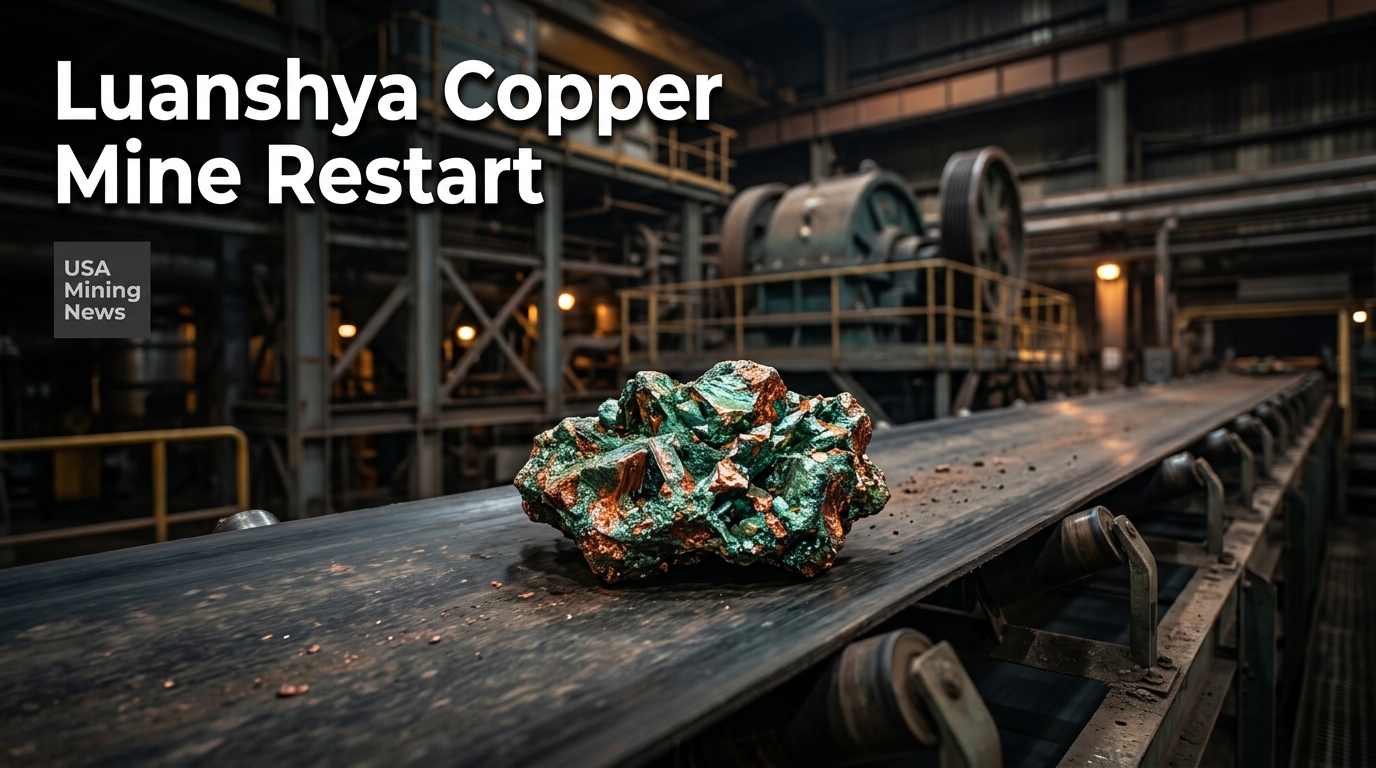
Luanshya, Zambia – After years of strategic redevelopment and substantial investment, the Luanshya Copper Mine is on track to recommence production at its upper section in August 2026. This pivotal announcement from the Ministry of Mines and Minerals Development of Zambia signals a major step forward for one of the nation’s historically significant copper assets and underscores the revitalized focus on enhancing Zambia’s position in the global copper market. The phased restart, driven by Chinese investment, aims to achieve an impressive output of approximately 100,000 tonnes per annum (tpa) of copper by 2030, a figure that is poised to significantly contribute to Zambia's national production targets.
A Phased Return to Production: Dewatering Paves the Way
The return to operational status for the Luanshya Copper Mine is meticulously planned across two distinct phases, commencing with the upper mine section. This initial phase is scheduled to begin production in August 2026, following the successful completion of extensive dewatering operations. These complex operations have been critical in preparing the mine for safe and efficient restart. As of March 27, 2026, an impressive 87.9 million cubic meters of water had been evacuated from the mine, clearing the necessary subterranean spaces for ongoing infrastructure development and construction activities. Furthermore, the commissioning of a massive 580-megalitre pump chamber on March 31, 2026, marks another key achievement, providing the robust pumping capacity required to support persistent redevelopment efforts.
The second phase of the project focuses on the lower section of the mine, with production currently slated to begin in 2029. This subsequent phase is contingent upon the continued progress of the redevelopment of the critical 28 Shaft, an intricate undertaking managed by China Luanshya Mine (CLM). This phased approach demonstrates a pragmatic strategy, allowing for operational learning and resource optimization as the mine gradually scales up its production capabilities.
Key Stakeholders and Transformative Investment
At the center of the Luanshya Mine's resurgence is China Nonferrous Mining Corporation (CNMC), which initially acquired the mine in 2009 and maintains a controlling 80% stake. CNMC’s subsidiary, China Luanshya Mine (CLM), has been instrumental in spearheading the redevelopment efforts. The commitment to reviving Luanshya is evident in the substantial investment poured into the project. The redevelopment of the 28 Shaft alone represents an investment of roughly $710 million (equivalent to 4.85 billion Chinese Yuan). This significant capital outlay encompasses critical infrastructure improvements, including state-of-the-art new shaft systems, the construction of a modern concentrator plant, and other essential associated infrastructure necessary for large-scale copper extraction and processing. To date, more than $75 million has already been invested, signaling concrete progress on the ground.
The Zambian government, through its Ministry of Mines and Minerals Development, has been a proactive partner in this revival. The government has repeatedly underscored its commitment to revitalizing the nation's mining sector. This includes a strategic emphasis on enhancing employment opportunities for Zambian citizens and ensuring that the economic benefits derived from the country’s rich mineral resources are widely shared among its populace. The collaboration between CNMC, CLM, and the Zambian government exemplifies a public-private partnership aimed at leveraging foreign investment for national development.
Ambitious Production Targets and Economic Resurgence
Once fully operational, the Luanshya Copper Mine is projected to become a significant contributor to Zambia's copper output, targeting an annual production of around 100,000 tonnes by 2030. This figure is particularly important for Zambia, a nation that historically ranks among Africa's top copper producers and has ambitious goals to further increase its national production. Achieving this target would not only restore Luanshya’s status as a major producer but also significantly bolster Zambia's overall contribution to the global copper supply.
Beyond the direct commodity output, the project is delivering substantial socio-economic benefits to the local communities. Currently, the redevelopment has generated 883 contractor jobs, providing immediate employment and economic stability. At peak operations, total employment at the mine is projected to increase to approximately 3,000 individuals. This influx of jobs is expected to have a profoundly positive impact, strengthening economic activity in Luanshya and its surrounding areas, fostering local businesses, and improving livelihoods through direct employment and associated ancillary services.
Strategic Importance in the Global Copper Market
The resurgence of the Luanshya Copper Mine carries significant implications for the broader mining industry and the global copper market. Copper is a critical metal, often referred to as 'Dr. Copper' due to its perceived ability to indicate global economic health. Its demand is currently experiencing a structural uplift driven by the accelerating global energy transition. Copper is fundamental for electric vehicles (EVs), renewable energy infrastructure (solar panels, wind turbines), and advanced electronics, all of which are sectors experiencing robust growth worldwide. A new source of 100,000 tpa of copper, even if phased in over several years, represents a meaningful addition to the global supply chain at a time when many analysts predict future supply deficits.
For Zambia, a nation seeking to diversify its economy while maximizing benefits from its abundant mineral wealth, the Luanshya restart is strategically vital. It reinforces the country's reputation as a reliable copper supplier and signals its readiness for substantial foreign direct investment in the mining sector. The involvement of CNMC also highlights the continuing strategic interest of Chinese enterprises in securing and developing critical mineral resources in Africa, a trend that shapes global resource geopolitics.
Looking Ahead: Expansion and Partnership Potential
The redevelopment of the Luanshya Copper Mine is not merely about reactivating existing infrastructure but also about positioning the asset for future growth. The two-phase development plan is designed to ensure sustainable and incremental increases in production capacity. Furthermore, there is proactive exploration for additional opportunities. China Luanshya Mine (CLM) is reportedly considering a potential collaboration with ZCCM Investments Holdings, Zambia’s state-owned mining investment company. This collaboration would focus on exploring mining prospects in newly acquired areas within the Luanshya region, potentially unlocking further mineral wealth and expanding the operational footprint of the project.
This forward-looking approach underscores a commitment to long-term value creation. Such partnerships with state entities like ZCCM Investments Holdings are crucial for ensuring alignment with national development goals and fostering a stable operating environment. The success of the Luanshya restart could serve as a blueprint for similar revitalization projects across Zambia's rich Copperbelt, attracting further investment and fostering sustainable growth in a sector central to the nation's economic prosperity.
In conclusion, the impending restart of the Luanshya Copper Mine represents a triumph of strategic planning, significant capital investment, and collaborative efforts between international corporate entities and the Zambian government. With production expected to begin in August 2026 and a target of 100,000 tpa by 2030, Luanshya is poised to re-establish itself as a cornerstone of Zambia's mining industry and a noteworthy supplier in the increasingly demanding global copper market.