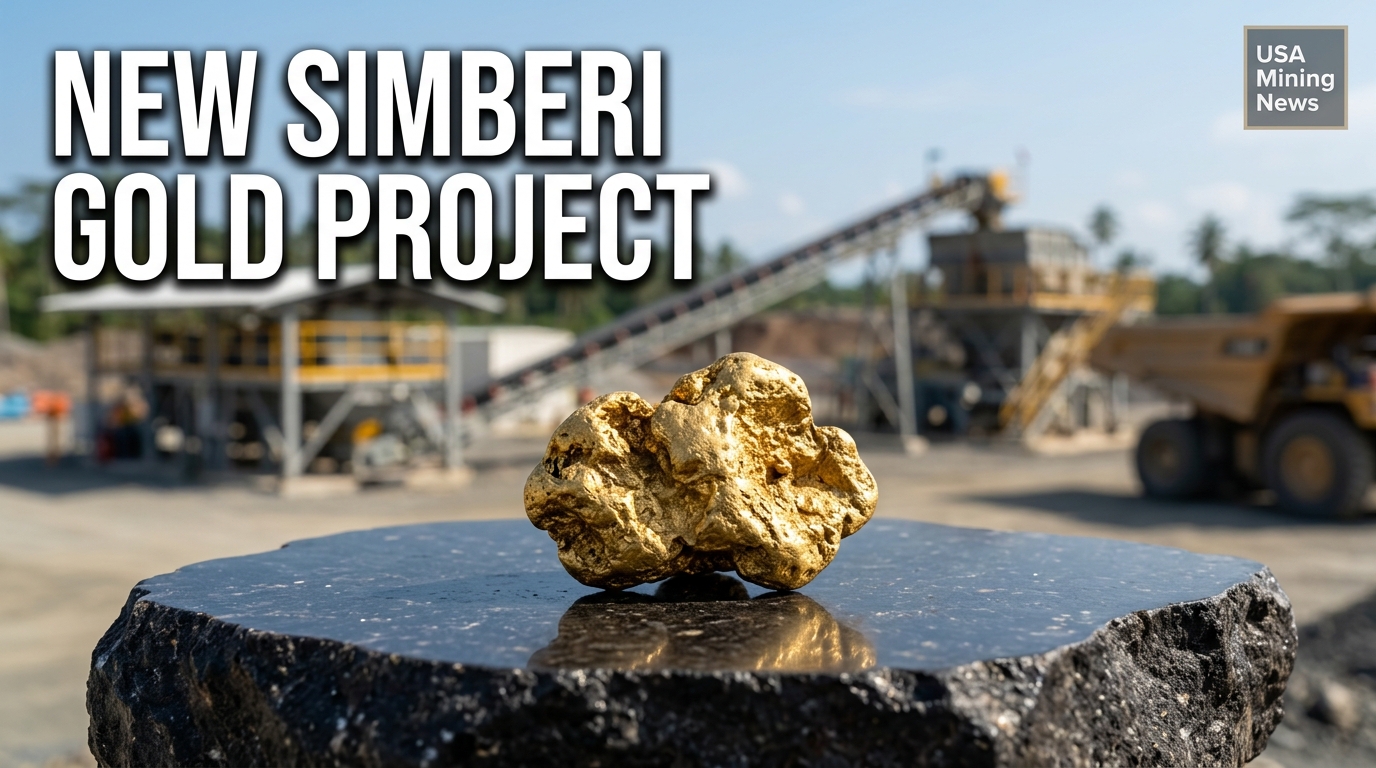
St Barbara Fortifies New Simberi Gold Project with Lingbao Investment and Final Investment Decision
Phoenix, AZ – April 2, 2026 – St Barbara has announced a pivotal advancement for its New Simberi Gold Project in Papua New Guinea, securing a substantial A$389 million (approximately $269.5 million USD) investment from Lingbao Gold Group. This significant capital infusion coincides with the official approval of the project’s Final Investment Decision (FID), marking a definitive commitment to proceed with the construction phase. The developments, revealed by the Australian-based gold producer, underpin a strategic repositioning and a substantial enhancement of the company’s gold production profile, as reported by USA Mining News.
The investment from Lingbao Gold Group, coupled with the FID approval, solidifies the financial foundation for the ambitious expansion of the Simberi operations. This strategic move is poised to transform the existing mine into a modern, higher-capacity processing facility focusing on sulphide ore, promising a significant increase in gold output and an extended mine life. These developments underscore the ongoing trend of international partnerships de-risking major mining projects and bringing significant capital into the global resource sector.
A Landmark Investment and Final Investment Decision
The A$389 million ($269.5 million) investment from Lingbao Gold Group represents a crucial financial endorsement for the New Simberi Gold Project. This capital, which became effective upon completion of the transaction, empowers St Barbara to fully fund its 50% share of the project’s estimated construction costs. The total construction cost for the New Simberi Gold Project is projected at $333 million. Notably, St Barbara had already expended approximately $13 million on the project by March 2026, demonstrating its prior commitment and progress.
The approval of the Final Investment Decision, reached collaboratively with Lingbao, signifies the culmination of extensive technical and financial evaluations, indicating that the project is deemed commercially viable and technologically sound. An FID is a critical gateway in large-scale mining developments, approving the allocation of capital and resources for the full construction phase, moving a project from planning and feasibility studies into actual physical development. For St Barbara, this decision, alongside the financial backing, has significantly de-risked the project’s development pathway and is expected to unlock substantial long-term value for the company and its shareholders.
Commenting on this milestone, St Barbara managing director and CEO Andrew Strelein stated, “Today’s completion of the Lingbao transaction and approval of the FID represents a major milestone for St Barbara. The New Simberi Gold Project is a long-life, low-cost operation fully funded for development and will increase production to over 200 kozpa. This transaction along with the FID approval significantly de-risks the development of the project and unlocks long-term value for the company and shareholders. The project will also deliver significant benefits to the local communities and PNG stakeholders.”
Strategic Partnership with Lingbao Gold Group
The collaboration with Lingbao Gold Group, a prominent Chinese gold mining enterprise, is more than just a financial transaction; it represents a strategic partnership that leverages international expertise and capital. Such alliances are increasingly common in the global mining industry, particularly for projects located in complex or developing jurisdictions. Lingbao’s investment provides not only capital but also potentially opens avenues for operational efficiencies and market access.
By bringing in a strong partner, St Barbara has mitigated a significant portion of the financial burden and risk associated with developing a major gold project. This partnership structure is often favored in capital-intensive industries like mining, where large upfront investments and a long project development timeline necessitate robust financial backing and shared risk. The involvement of a global player like Lingbao signals confidence in the project’s economics and the broader investment climate in Papua New Guinea’s mining sector.
The New Simberi Gold Project: Technical Specifications and Operational Expansion
The New Simberi Gold Project is designed as an expansion of the existing Simberi mining and processing operations, which have been a cornerstone of St Barbara’s portfolio. The primary objective of this expansion is to pivot towards processing higher-grade sulphide ore reserves, a strategic shift that promises to enhance the project’s economic viability and extend its operational lifespan. Sulphide ores often present more complex processing requirements compared to oxide ores but typically host higher metal grades, justifying the investment in more advanced processing infrastructure.
Key operational targets for the expanded project include:
- Increased Mining Output: The project is slated to boost mining output to approximately 20 million tonnes per annum (mtpa), effectively doubling the current output of 10 mtpa. This significant increase in throughput signals a scaled-up mining fleet and processing capacity designed to handle a larger volume of material efficiently.
- Enhanced Gold Production: Following the expansion, the project aims to elevate annual gold production to over 200,000 ounces per annum. This level of production would place New Simberi among the more substantial gold operations in the Asia-Pacific region, contributing significantly to St Barbara’s overall gold output.
- Competitive All-In Sustaining Costs (AISC): The anticipated all-in sustaining cost (AISC) for the project is projected to be between $1,100 and $1,400 per ounce. AISC is a comprehensive metric that includes all costs associated with producing an ounce of gold, from exploration and mine site operating costs to corporate overheads and sustaining capital. This projected range positions New Simberi as a relatively low-cost producer within the current global gold market, which is crucial for profitability and resilience against gold price fluctuations.
- Extended Mine Life: Based solely on the existing ore reserves, the project boasts a projected mine life of 13 years. This provides a long-term production horizon, offering stability and predictable cash flows. Importantly, this estimate does not factor in any additional mineral resource conversions from current resources or future exploration targets, suggesting potential for further mine life extensions as exploration continues and geological confidence improves.
Financial Implications and Strategic Positioning for St Barbara
Financially, the Lingbao transaction is a game-changer for St Barbara. The company reported a robust cash balance of A$504 million, excluding an additional A$26 million held as the initial cash position of a jointly owned subsidiary. This strong cash position provides significant financial flexibility and operational resilience.
Furthermore, St Barbara anticipates recording an approximate A$0.5 billion gain from this transaction, which will be integrated into its financial results for fiscal year 2026 (FY26). A notable advantage of this gain is that it is expected to incur no tax liabilities, maximizing the positive impact on the company’s bottom line. This substantial financial boost not only reinforces St Barbara’s balance sheet but also significantly enhances its capacity for future growth and investment.
The New Simberi development aligns with St Barbara’s broader strategy of portfolio optimization. In August 2024, the company divested its complete stake in Catalyst Metals, securing cash proceeds of A$25.2 million. This move, preceding the Lingbao deal, suggests a deliberate strategy to streamline its asset base and focus capital on high-potential, high-return projects like New Simberi. Such strategic divestments and investments are common in the mining industry as companies continually re-evaluate their portfolios to maximize shareholder value.
The complexities and strategic importance of this deal were supported by prominent advisors, with Macquarie Capital (Australia) acting as the financial adviser and Mallesons providing legal counsel for St Barbara. Their involvement underscores the thorough due diligence and expert negotiation required for transactions of this magnitude.
Regulatory Landscape and Future Developments
While the Lingbao transaction and FID are complete, St Barbara is also navigating other important regulatory processes in Papua New Guinea. The company is awaiting regulatory approval for a separate transaction with Kumul Mineral Holdings, which requires clearance from Papua New Guinea’s Independent Consumer and Competition Commission (ICCC) and the National Executive Council (NEC). Kumul Mineral Holdings, as the state-owned mining company, often plays a role in major resource projects within PNG, reflecting the nation’s interest in its mineral wealth.
St Barbara maintains confidence that these approvals will be granted soon. Crucially, the company has clarified that any potential delay in the Kumul transaction will not impact the recently completed Lingbao deal or the Final Investment Decision for the New Simberi Gold Project, ensuring the project’s immediate progress remains unhindered. This independence provides a strong foundational certainty for the project’s construction and subsequent operational phases.
With the FID approved, the focus now shifts entirely to the construction phase of the New Simberi Gold Project. This will involve significant capital expenditure on infrastructure development, plant construction, and expansion of mining facilities. The successful execution of this phase will be critical to realizing the project’s full potential and achieving the production targets.
Industry Impact and Value Creation
The New Simberi Gold Project’s advancement holds significant implications beyond St Barbara’s corporate balance sheet. In a global commodities market often characterized by volatility, investments in new, long-life, and low-cost gold production are critical. As gold continues to serve as a strategic asset for investors and an industrial metal, the addition of over 200,000 ounces per annum from a sustainably positioned operation will contribute to global supply stability.
For Papua New Guinea, the project represents continued foreign direct investment, job creation, and economic benefits for local communities. The mining sector is a cornerstone of PNG’s economy, and responsible development of its natural resources is vital for national prosperity. Andrew Strelein’s emphasis on "significant benefits to the local communities and PNG stakeholders" highlights the broader socioeconomic contributions expected from the project, including employment, infrastructure development, and community programs.
Furthermore, the successful structuring and funding of this project through an international partnership could serve as a model for future large-scale developments in emerging mining jurisdictions, demonstrating effective strategies for risk-sharing and capital mobilization.
Conclusion
St Barbara’s announcement of the A$389 million investment from Lingbao Gold Group and the Final Investment Decision for the New Simberi Gold Project marks a transformative moment for the company. With its 50% share of construction costs fully funded, a robust cash balance, and a clear path to significantly increased, low-cost gold production, St Barbara is well-positioned for long-term growth and enhanced shareholder value. This strategic progression in Papua New Guinea not only solidifies St Barbara’s operational footprint but also underscores the enduring attractiveness of gold assets and the power of strategic international collaborations in the global mining industry.