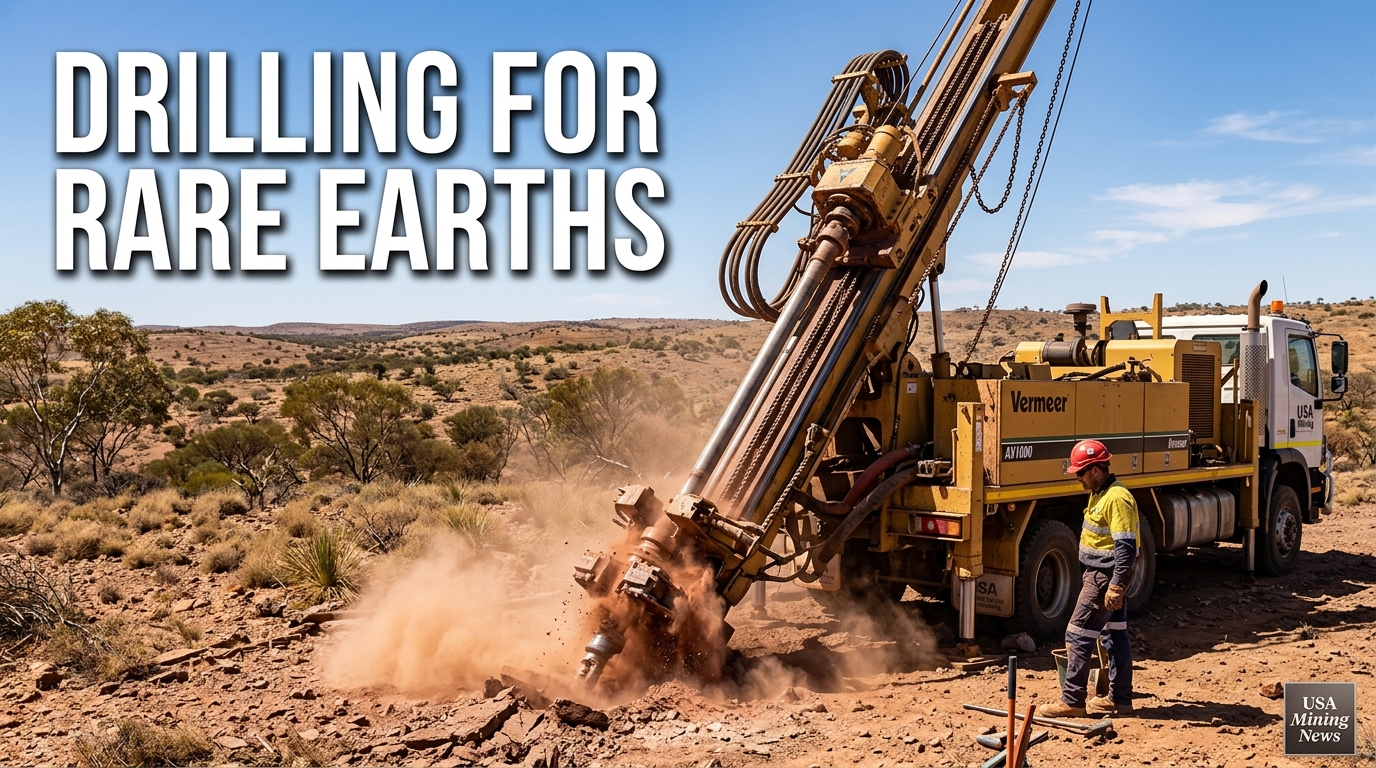
In a significant development for Australia's burgeoning critical minerals sector, Magnetite Mines announced on April 21, 2026, the commencement of an air core drilling program at its wholly-owned Ironback Hill rare earth element (REE) project. Located in north-east South Australia, approximately 12 kilometers south of the company's flagship Razorback Iron Ore Project, this exploration initiative represents a strategic step forward in delineating a potentially valuable shallow, clay-hosted REE resource.
The drilling program, initially delayed by challenging weather conditions including significant rainfall and flooding that impacted site access, is now fully underway. This progression underscores Magnetite Mines' commitment to advancing its diversified mineral interests and capitalizing on the global demand for rare earths, which are indispensable components in a wide array of high-tech and green energy applications.
Strategic Step Forward: Drilling Commences at Ironback Hill
The current air core drilling program at Ironback Hill is designed to be both structured and cost-effective, comprising up to 2,000 meters of drilling. Its primary objective is to gain a comprehensive understanding of the rare earth mineralisation identified at the site. Specifically, the program aims to:
- Assess the spatial extent of the clay horizons containing REEs.
- Determine the thickness and continuity of these mineralized layers.
- Generate sufficient samples for preliminary mineralogical and metallurgical evaluation, which is crucial for assessing potential processing routes and economic viability.
Magnetite Mines is directing its exploration efforts along key creek and drainage areas. The company's geological model suggests that REE mineralisation has the potential to expand both downstream and laterally beyond the areas previously sampled. This targeted approach is expected to provide critical data to refine the existing geological model and inform subsequent phases of exploration.
Commenting on the commencement of operations, Magnetite Mines Managing Director Tim Dobson stated, "While mobilisation and site access were temporarily impacted by significant rainfall and flooding in the region, we are pleased to now have site access restored and drilling under way. Commencing drilling at Ironback Hill is an important step in advancing this emerging REE prospect. This relatively small, phased programme is designed to test the spatial extent of the clay-hosted mineralisation and the geological controls that influence its occurrence, while also generating additional samples to support geological modelling and ongoing mineralogical and metallurgical assessment." This sentiment underscores the methodical approach the company is taking to de-risk and define the Ironback Hill project.
Unveiling a Persistent Resource: The Discovery History of Ironback Hill REEs
The discovery of REE mineralisation at Ironback Hill is a testament to the value of historical data re-examination. The initial identification of near-surface, clay-hosted REEs occurred in August 2025. This breakthrough came from the reassessment of archived reverse circulation (RC) drill samples that were originally collected between 2011 and 2012 for iron ore exploration purposes. The company reported additional positive findings from this reassessment in November 2025, further validating the prospectivity of the region for REEs.
The Ironback Hill REE site is strategically located within Exploration Licence (EL) 6126, nestled in the well-known Braemar Iron Region of South Australia. Its proximity, approximately 250 kilometers north-east of Adelaide, provides logistical advantages for potential future development. Geologically, the REE mineralisation itself is found in close association with the Ironback Hill magnetite iron ore deposit, which is situated on tenements owned by Ironback, a subsidiary of Magnetite Mines. This co-location could offer efficiencies in terms of infrastructure and operational management should both resources advance to development.
Geological Profile and Exploration Strategy
The geological characteristics of the Ironback Hill REE mineralisation are particularly compelling. The rare earths are hosted within shallow, oxidized clay and silt layers that lie directly above a weathered basement rock. This near-surface occurrence is a key factor in the economic attractiveness of such deposits, as it generally implies lower stripping ratios and potentially reduced mining costs compared to deeper hard rock deposits.
A distinctive feature of the mineralisation at Ironback Hill is its apparent association with local creek and drainage systems. This suggests a geological control where these hydrological pathways have played a role in concentrating the rare earth elements within the accessible clay and silt horizons. This understanding directly informs Magnetite Mines' exploration strategy, focusing on extending drilling along these identified drainage areas where the company's model predicts an expansion of mineralisation both downstream and laterally.
The use of air core drilling is particularly apt for this geological setting. Air core drilling is a rapid and relatively inexpensive method for sampling shallow, unconsolidated or weathered ground. It is effective in obtaining representative samples from soft clay and weathered bedrock, making it an ideal choice for the initial stages of exploration in this type of environment. By using this cost-effective method, Magnetite Mines can efficiently gather extensive data on the spatial distribution and characteristics of the REE mineralisation over a broad area.
The Broader Significance of Clay-Hosted Rare Earth Elements
The pursuit of clay-hosted rare earth elements at Ironback Hill holds significant implications within the global context of critical minerals supply. Rare earth elements are a group of 17 chemically similar metallic elements that are vital for numerous modern technologies, including electric vehicle motors, wind turbines, defense systems, and consumer electronics. The global supply chain for these elements has often been characterized by concentration in a few geographic regions, leading to concerns about supply security and geopolitical influence.
Clay-hosted REE deposits, particularly ionic adsorption clay (IAC) deposits, are highly sought after due to several attractive characteristics, though the specific classification as an IAC for Ironback Hill is not yet stated. Generally, these types of deposits are known for potentially lower capital expenditure (CAPEX) and operating expenditure (OPEX) due to simpler mining and processing requirements compared to hard rock deposits. The REEs in these deposits are typically adsorbed onto clay minerals, rather than being bound within complex crystalline lattices, which can facilitate easier leaching and extraction processes. Should Ironback Hill exhibit similar characteristics, it could potentially offer a more environmentally friendly and economically viable pathway to rare earth production.
For Australia, developing domestic sources of REEs is a strategic imperative. The nation has a strong focus on diversifying global supply chains and establishing itself as a reliable supplier of critical minerals to allied economies. Projects like Ironback Hill contribute directly to this national strategy, fostering economic resilience and supporting advanced manufacturing sectors globally.
Magnetite Mines' Evolving Portfolio and Regional Importance
Magnetite Mines has historically been focused on the development of its flagship Razorback Iron Ore Project, a significant magnetite iron ore resource in the Braemar region. The discovery and subsequent focused exploration of REEs at Ironback Hill represent an important diversification for the company's asset portfolio. This strategic move could enhance the company's overall value proposition by adding a critical mineral stream alongside its iron ore interests.
Prior to initiating the drilling campaign, Magnetite Mines diligently secured all necessary regulatory permits and approvals. This included obtaining heritage clearances in February 2026, demonstrating the company's commitment to responsible and compliant exploration practices. Such groundwork is essential for fostering positive relationships with local communities and stakeholders, and ensuring the long-term viability of mineral projects.
What Lies Ahead: Next Steps and Potential Impact
The successful completion of this initial 2,000-meter air core drilling program will be instrumental in shaping the future trajectory of the Ironback Hill project. The data collected will be used to refine the company's geological model, providing a clearer picture of the controls on mineralisation, its continuity, and potential resource size. The mineralogical and metallurgical samples will offer crucial insights into the amenability of the clays to REE extraction, a key determinant of the project's economic viability.
The findings from this program will directly inform future exploration activities, which could include further infill drilling, definition drilling, or even the commencement of preliminary economic assessments. If the results are favorable, Ironback Hill could evolve into a significant contributor to Australia's critical minerals output, complementing existing rare earth projects in the country and strengthening global supply chains. For investors and industry watchers, the progress at Ironback Hill will be closely monitored as a barometer for the potential of new, diversified critical mineral sources.
In conclusion, Magnetite Mines' initiation of drilling at Ironback Hill marks a pivotal moment for both the company and the broader rare earth sector in Australia. As the global demand for critical minerals continues to escalate, projects that demonstrate efficient and targeted exploration, particularly for strategically important elements such as REEs, are positioned to play a crucial role in shaping the future of industrial supply and technological innovation.