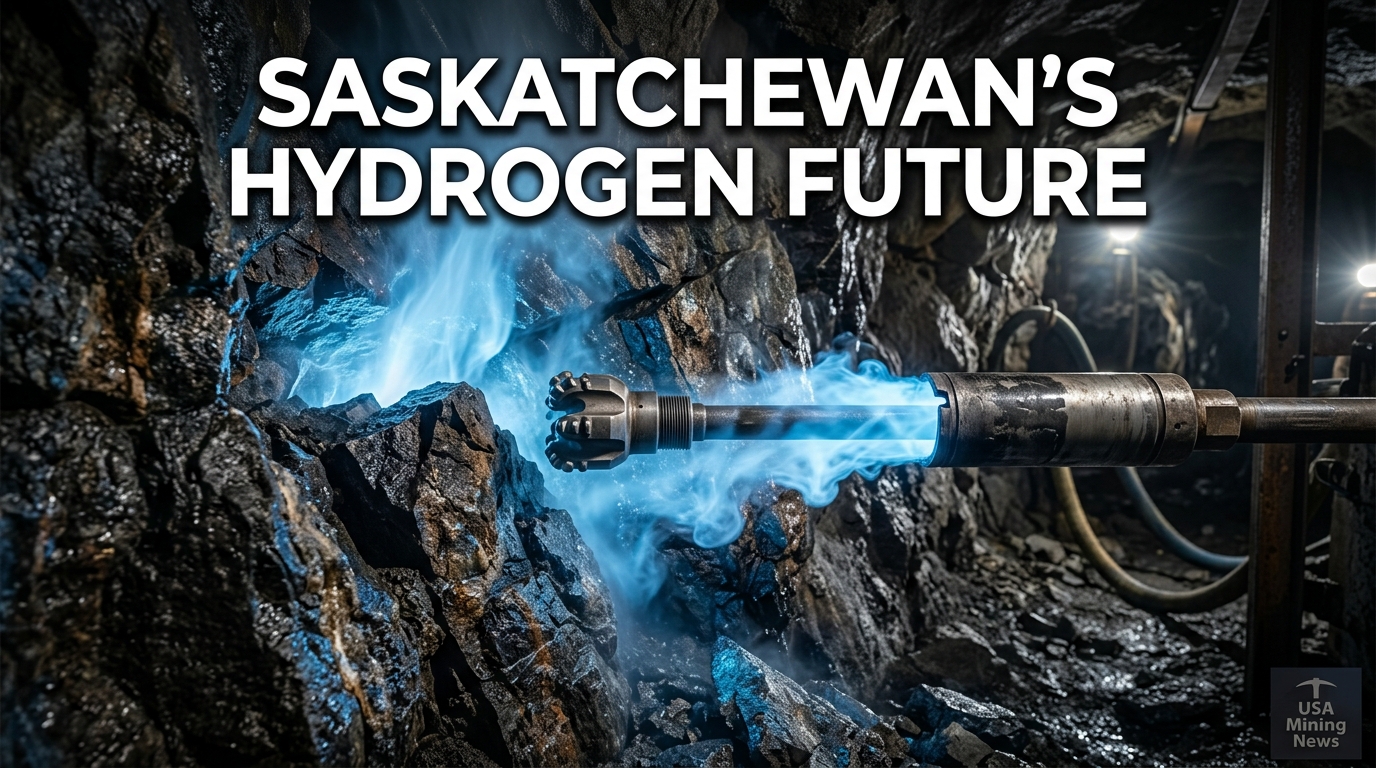
Saskatchewan Poised for Global Leadership in Natural Hydrogen Commercialization Through MAX Power Mining and Moose Jaw Partnership
May 15, 2026 – A significant development in the burgeoning field of clean energy has emerged from Canada, as junior energy company MAX Power Mining (CSE: MAXX) announced a strategic partnership with the City of Moose Jaw. This collaboration is set to accelerate the potential commercialization of natural hydrogen within Saskatchewan’s largest industrial corridor, a move that could establish the province as a pivotal player in the global energy transition.
The alliance, formalized under a memorandum of understanding (MOU) signed recently, aims to jointly advance opportunities within the Regina-Moose Jaw Industrial Corridor. This region is not merely an administrative boundary but a recognized strategic hub of energy infrastructure in south-central Saskatchewan, already hosting critical developments such as Bell Canada’s proposed data centre, touted as Canada’s largest.
The implications of this partnership extend beyond local development; it aligns regional infrastructure, diverse industries, policy frameworks, and economic development initiatives. For MAX Power Mining, this agreement provides a crucial framework as it progresses the Lawson natural hydrogen system—recognized as Canada’s inaugural natural hydrogen drilling discovery—toward commercial validation. This initiative underscores a growing global imperative for reliable, clean, and affordable baseload energy, a demand that natural hydrogen is uniquely positioned to address.
MAX Power and City of Moose Jaw Forge Strategic Alliance
The recently inked MOU between MAX Power Mining and the City of Moose Jaw creates a formal pathway for collaboration on the commercialization of natural hydrogen. This is more than a simple agreement; it is a strategic alignment designed to synergize various provincial and municipal assets with MAX Power’s cutting-edge exploration efforts. The Regina-Moose Jaw Industrial Corridor, a focal point of this collaboration, is strategically vital due to its existing energy infrastructure, skilled workforce potential, and its role as a nexus for various industries including the significant agricultural sector and the aforementioned major data center development.
MAX Power's Lawson discovery is situated approximately 80 kilometers northwest of Moose Jaw. Crucially, the company’s extensive Genesis Trend, identified through geological and geophysical exploration, extends directly through this industrial corridor. This geological alignment is a key factor in MAX Power’s confidence that the region is "uniquely positioned" to bridge large-scale natural hydrogen discovery potential with future end-use demand. The strategy encompasses not only resource extraction but also comprehensive infrastructure development, workforce growth, and long-term regional economic expansion, painting a holistic picture of sustainable industrial evolution.
For the City of Moose Jaw, a well-established industrial centre with a robust history in energy and resource processing, partnering with MAX Power provides an opportunity to diversify its economic base and position itself at the forefront of a new, low-carbon energy economy. It represents a proactive step in attracting investment and fostering innovation in an era where energy security and environmental stewardship are paramount.
The Lawson Discovery: Pioneering Natural Hydrogen in Saskatchewan
The Lawson natural hydrogen system carries the distinction of being Canada’s first natural hydrogen drilling discovery. This initial breakthrough has positioned MAX Power Mining as a frontrunner in the exploration and development of this nascent energy source within the Canadian landscape. The proximity of this discovery to a major industrial corridor like Regina-Moose Jaw is particularly advantageous, minimizing the logistical challenges typically associated with bringing a new energy resource to market.
Natural hydrogen, often referred to as "white hydrogen" or "gold hydrogen," is a form of hydrogen generated naturally within the Earth's crust through geological processes. Unlike blue or grey hydrogen, which rely on fossil fuels and carbon capture, or green hydrogen, produced via electrolysis using renewable electricity, natural hydrogen offers the potential for a significantly lower carbon footprint at the point of origin and potentially lower production costs, assuming viable and scalable extraction methods can be developed. Its discovery marks a paradigm shift in how hydrogen, a critical component in the decarbonization of heavy industry, transportation, and power generation, might be sourced in the future.
The advancement of the Lawson project towards "commercial validation" is a critical phase. This typically involves extensive appraisal drilling, rigorous resource estimation using internationally recognized standards, pilot production programs, and preliminary engineering studies. These steps are essential to demonstrate the technical feasibility and economic viability of extracting and processing natural hydrogen on a commercial scale, thereby de-risking the project for potential investors and off-takers.
Expanding Horizons: The Bracken Well Target and Helium Potential
The momentum generated by the Lawson discovery was significantly buoyed by MAX Power’s announcement in January regarding the identification of a robust target for drill testing a second natural hydrogen discovery in Saskatchewan. This new target is situated at the Bracken well location, further expanding the potential footprint of natural hydrogen resources within the province.
Technical details from the Bracken well location provide compelling evidence of the region’s prospectivity. Core desorption tests conducted on nine samples from a zone immediately above the natural hydrogen discovery in the Basement Complex yielded noteworthy helium values. These values registered as high as 8.7%, with an average of 4.4%. The presence of elevated helium is significant for several reasons. Helium, a valuable inert gas with diverse industrial applications (e.g., in MRI machines, rocket fuel, fiber optics), is often found in conjunction with natural hydrogen accumulations, serving as an indicator of geological conditions conducive to hydrogen generation. Furthermore, the co-production of helium could significantly enhance the economic viability of natural hydrogen projects, offering an additional high-value revenue stream.
These findings from the Bracken well underscore the potential for a multi-resource play in Saskatchewan, positioning MAX Power not just as a natural hydrogen explorer but also as a potential producer of a critical strategic gas like helium. The confirmation of a second target within a relatively short timeframe since the Lawson discovery suggests a systematic and successful exploration strategy, boosting confidence in the broader potential of the Genesis Trend and Saskatchewan's geological setting for clean energy resources.
Saskatchewan's Role in the Global Clean Energy Transition
MAX Power CEO Ran Narayanasamy articulated a bold vision for Saskatchewan’s future, stating in a news release, "Saskatchewan has long played a foundational role in feeding and powering the world, and we believe Natural Hydrogen represents the next chapter in that legacy." This statement reflects a deep understanding of the province's rich history as a resource provider, from agriculture to potash, uranium, and oil & gas, and positions natural hydrogen as critical to its continued relevance in a transitioning global economy.
The rapid acceleration of plans to establish Saskatchewan as the world’s birthplace of natural hydrogen commercialization comes at a time when the global need for reliable, clean, affordable baseload energy has never been greater. Governments and industries worldwide are grappling with the dual challenge of meeting escalating energy demands while simultaneously achieving ambitious decarbonization targets. Natural hydrogen, if commercially viable at scale, offers a unique solution that circumvents many of the technological and economic hurdles associated with traditional low-carbon hydrogen production methods.
Narayanasamy further emphasized the broader economic benefits of MAX Power’s endeavors: "As MAX Power advances its natural hydrogen project toward commercial validation, we see a meaningful opportunity to support innovation, attract investment, create long-term economic value and help position this region at the forefront of a new category of domestically sourced clean energy." This highlights the multiplier effect of such a pioneering industry—not just direct energy production, but also the growth of auxiliary services, research and development, and a skilled workforce trained in new energy technologies.
Market Implications and Future Outlook
The successful commercialization of natural hydrogen in Saskatchewan could have profound market implications. It would introduce a new, potentially cost-competitive, and environmentally attractive source of hydrogen that could challenge existing production paradigms. For the mining industry, this represents a diversification into resource exploration and extraction that extends beyond traditional minerals and metals, embracing the subsurface potential for gaseous energy forms.
The path forward for MAX Power Mining and the City of Moose Jaw will involve several key stages. These include ongoing exploration and appraisal drilling to delineate the full extent of the natural hydrogen resource, detailed environmental impact assessments, engagement with Indigenous communities, and the securing of necessary regulatory approvals. Moreover, the development of specialized infrastructure for hydrogen processing, storage, and transportation will be paramount. The existing energy infrastructure within the Regina-Moose Jaw corridor will undoubtedly play a critical role in facilitating these developments.
The partnership’s success would not only benefit Saskatchewan through economic diversification and job creation but would also elevate Canada's profile as a leader in clean energy innovation. As nations worldwide compete to establish themselves in the hydrogen economy, a significant and successfully commercialized natural hydrogen resource could provide Canada with a distinct competitive advantage, fostering export opportunities and attracting international investment into its energy sector.
Conclusion: A New Chapter for Energy Exploration
The collaboration between MAX Power Mining and the City of Moose Jaw marks a pivotal moment in the global pursuit of sustainable energy solutions. With the Lawson discovery leading the charge and the promising Bracken well target on the horizon, Saskatchewan is well on its way to cementing its status as a pioneering region in the commercialization of natural hydrogen. This initiative represents more than just a new energy discovery; it symbolizes a forward-thinking approach to leveraging geological endowments for long-term economic prosperity and environmental stewardship. The mining and energy industries will be watching closely as this new chapter in energy exploration unfolds, potentially redefining the future of clean baseload power.