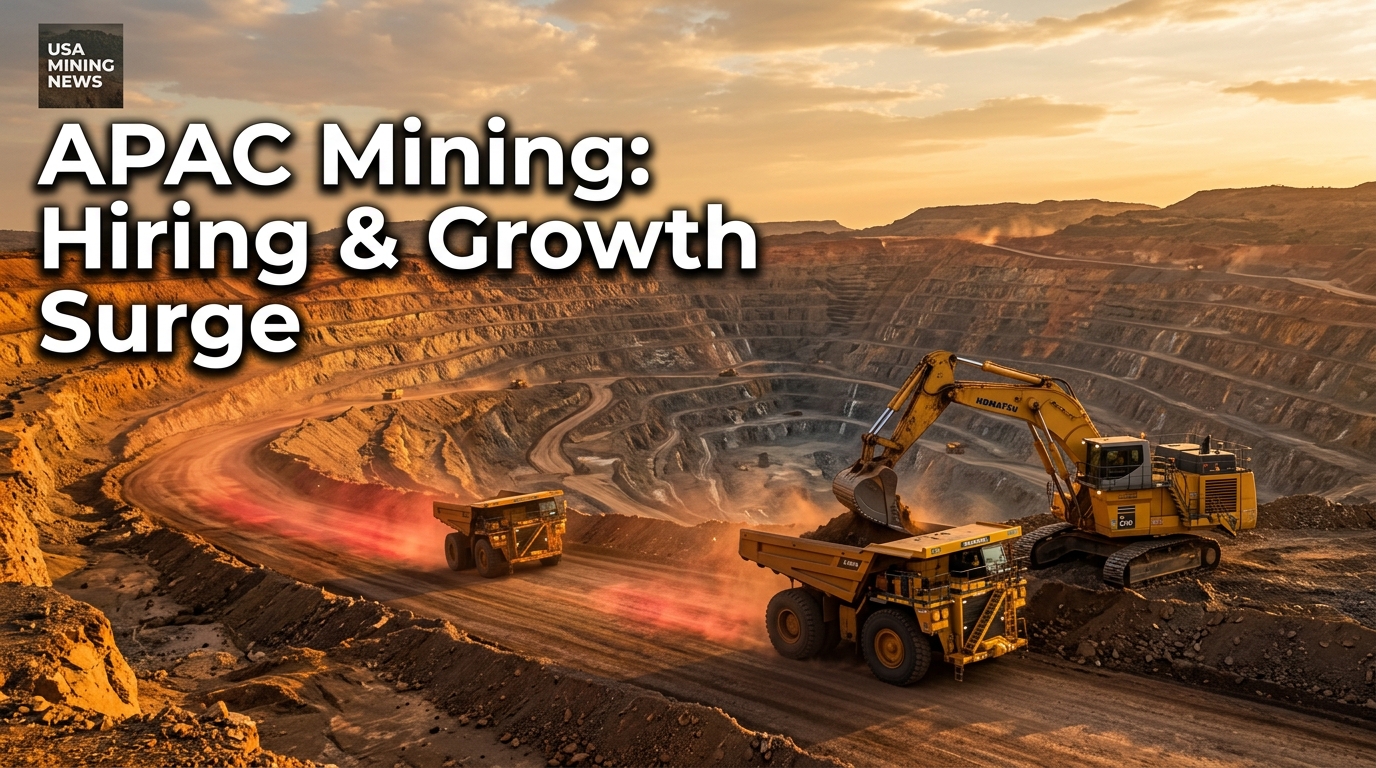
The global mining industry, perpetually seeking forward-looking indicators to guide strategic decisions, is currently observing a notable surge in the Asia-Pacific (APAC) region. New analysis released on June 25, 2026, highlights a substantial 30% year-over-year increase in active job postings related to mining equipment throughout APAC. This significant uptick is more than just a statistic; it functions as a crucial early warning system, revealing where demand, operational capacity, and competitive dynamics are rapidly shifting within one of the world's most vital mining geographies.
APAC's Mining Momentum: A 30% Surge in Equipment Hiring
The Asia-Pacific region, a cornerstone of global mineral supply and a critical driver of industrial demand, is experiencing robust growth in its mining sector. The latest data reveals that active job postings for roles associated with mining equipment have climbed by an impressive 30% compared to the previous year. This metric, meticulously tracked and analyzed, provides a granular, point-in-time snapshot of investment and expansion within the industry.
This surge in hiring signals a multi-faceted expansion. It strongly indicates that mining companies in APAC are either initiating new projects, significantly expanding existing operations, or undertaking substantial fleet modernizations and upgrades. The demand for skilled personnel to operate, maintain, and manage sophisticated mining machinery – from massive haul trucks and excavators to advanced drilling systems and processing plants – directly translates to a heightened need for the equipment itself.
The APAC region encompasses diverse and mineral-rich countries, all contributing to various supply chains, including those for essential base metals, precious metals, and critical minerals vital for the global energy transition. A 30% increase in equipment-related hiring across this broad and varied landscape underscores a widespread commitment to enhancing production capabilities and operational throughput, suggesting strong fundamentals underpinning the sector's growth.
The Diagnostic Power of Workforce Data
In an industry characterized by long lead times and substantial capital expenditure, access to timely and granular data is paramount for informed decision-making. As outlined in a recent expert analysis by GlobalData, titled "Jobs by numbers: unlocking the latest workforce data to outperform your market," detailed hiring and workforce statistics offer an invaluable "early warning system" for business performance.
Traditional financial reports often provide lagging indicators, reflecting past performance. In contrast, workforce data, particularly concerning active job postings, serves as a leading indicator, offering a forward-looking view. By dissecting which roles, skill sets, and geographical areas companies are actively recruiting for, industry leaders can gain profound insights into several critical areas:
- Investment Decisions: A sustained increase in equipment operator, maintenance technician, or mining engineer roles suggests a commitment to new or expanded projects, guiding capital allocation strategies.
- Cost Control: Anomalies or sharp increases in specific hiring categories can highlight potential pressure points in labor markets or areas of intense investment activity, allowing companies to pre-emptively manage costs.
- Competitiveness: Tracking competitors' hiring patterns can reveal their strategic moves into new products, services, or market segments, enabling companies to identify gaps in their own strategies or respond proactively.
The GlobalData report emphasizes that human capital is a key asset with a demonstrable link to a company's future operating performance. Despite this, there has been a noticeable lack of robust, data-driven solutions to exploit this powerful relationship. The call for "granular, timely and clean data relating to jobs" is directly addressed by such analyses, providing a powerful instrument for strategic planning.
Deciphering Demand and Capacity Shifts: Will Order Books Catch Up?
The 30% hike in mining equipment hiring directly impacts the ecosystem of equipment manufacturers and rental providers. A robust demand for personnel to operate machinery invariably implies a significant and growing demand for the machinery itself. This raises a pertinent question for the industry: will equipment manufacturers' order books be able to catch up with this accelerated demand?
Historically, the mining equipment sector has experienced cycles of heightened demand, often leading to extended lead times for new machinery delivery. The current surge in APAC suggests that miners are committing to substantial capital projects or fleet renewals. This means increased orders for a wide range of heavy equipment, including:
- Haul Trucks: Essential for moving vast quantities of ore and waste.
- Excavators and Loaders: Critical for digging, loading, and material handling.
- Drills: For exploration, blastholes, and various mining applications.
- Processing Equipment: Crushers, grinding mills, and flotation cells needed for mineral extraction.
- Ancillary Equipment: Dozers, graders, and utility vehicles supporting overall operations.
If manufacturers are not prepared for this rapid acceleration, extended lead times could become a significant challenge, potentially delaying project timelines for mining companies and impacting their production targets. This scenario would also likely boost the mining equipment rental market, as companies seek interim solutions to meet operational requirements without immediate capital outlay for new purchases.
Furthermore, the nature of hiring might also hint at technological shifts. An increase in hiring for roles related to automation, data analytics, or electric vehicle maintenance could indicate a move towards more advanced, sustainable mining practices, placing specific demands on equipment suppliers for next-generation machinery.
Strategic Implications for Industry Stakeholders
The insights derived from APAC's mining equipment hiring trends have profound strategic implications across the entire mining value chain:
For Mining Operators:
- Resource Planning: Companies must anticipate competition for skilled labor and plan recruitment, training, and retention programs proactively.
- Capital Expenditure: The data can inform decisions on fleet expansion, technology adoption, and project acceleration, requiring careful financial planning.
- Supply Chain Resilience: Understanding potential constraints on equipment supply allows companies to negotiate better terms, diversify suppliers, or consider rental options.
For Equipment Manufacturers and Suppliers:
- Production Planning: The rise in hiring is a clear signal to ramp up production capacity, optimize supply chains for components, and potentially expand manufacturing facilities.
- Innovation and R&D: Tracking specific skill demands can guide investment in new product development, especially for autonomous, electric, and digitally integrated machinery.
- Aftermarket Services: A larger operational fleet translates to increased demand for parts, maintenance, and support services, presenting a growth opportunity.
For Investors and Analysts:
- Market Sentiment: Strong hiring trends provide positive sentiment, indicating underlying growth and investment in the sector.
- Company Performance Benchmarking: Investors can evaluate individual mining companies' and equipment manufacturers' growth strategies against broader market hiring patterns.
- Risk Assessment: Potential labor shortages or equipment supply bottlenecks revealed by job data can factor into risk assessments for relevant stocks.
Navigating the Competitive Landscape with Data
Beyond indicating overall market growth, granular job data offers a distinct advantage in navigating the competitive landscape. By systematically tracking the types of roles competitors are recruiting for, companies can gain actionable intelligence on their rivals' strategic intentions. For example:
- If a competitor begins aggressively hiring in a new geographical sub-region within APAC, it might signal their intention to enter or expand operations in that specific market.
- A spike in postings for specific technical skills, such as robotics engineers or data scientists, could indicate a competitor's investment in automation or digital transformation initiatives.
- Similarly, focused hiring for roles related to specific mineral processing or extraction methods might reveal an intent to diversify commodity exposure or enhance efficiency in particular resource types.
This level of competitive insight allows companies to identify not only potential competitive threats but also strategic white spaces, informing decisions on where to invest, what technologies to prioritize, and where to build their own talent pipelines to avoid being outmaneuvered.
The Road Ahead: What This Means for 2026 and Beyond
As of June 25, 2026, the 30% year-over-year increase in mining equipment hiring in APAC represents a powerful harbinger of continued expansion and robust activity in the region's mining sector. This trend suggests that mining companies are confident in the long-term demand for minerals and are actively investing in the operational capabilities required to meet this demand.
Looking ahead, the industry must prepare for several potential outcomes:
- Sustained Demand for Equipment: The current hiring spree will translate into tangible demand for new and replacement machinery, putting pressure on manufacturers.
- Labor Market Dynamics: The heightened competition for skilled labor could lead to wage inflation and a greater need for advanced training and upskilling programs across the APAC region.
- Technological Acceleration: The need for efficiency and productivity will likely drive further adoption of advanced mining technologies, influencing the types of equipment and skills in demand.
The emphasis on leveraging granular, timely, and clean job data, as highlighted by GlobalData, will only intensify. In an increasingly complex and dynamic global economy, such intelligence will differentiate industry leaders, enabling them to make proactive decisions that drive growth, manage costs, and secure a competitive edge.
The APAC mining sector is clearly in an expansionist phase, and the pulse of its hiring activity provides clarity on its trajectory. Industry stakeholders who closely monitor these signals and integrate them into their strategic frameworks will be best positioned to capitalize on the opportunities and navigate the challenges of the evolving global mining landscape.