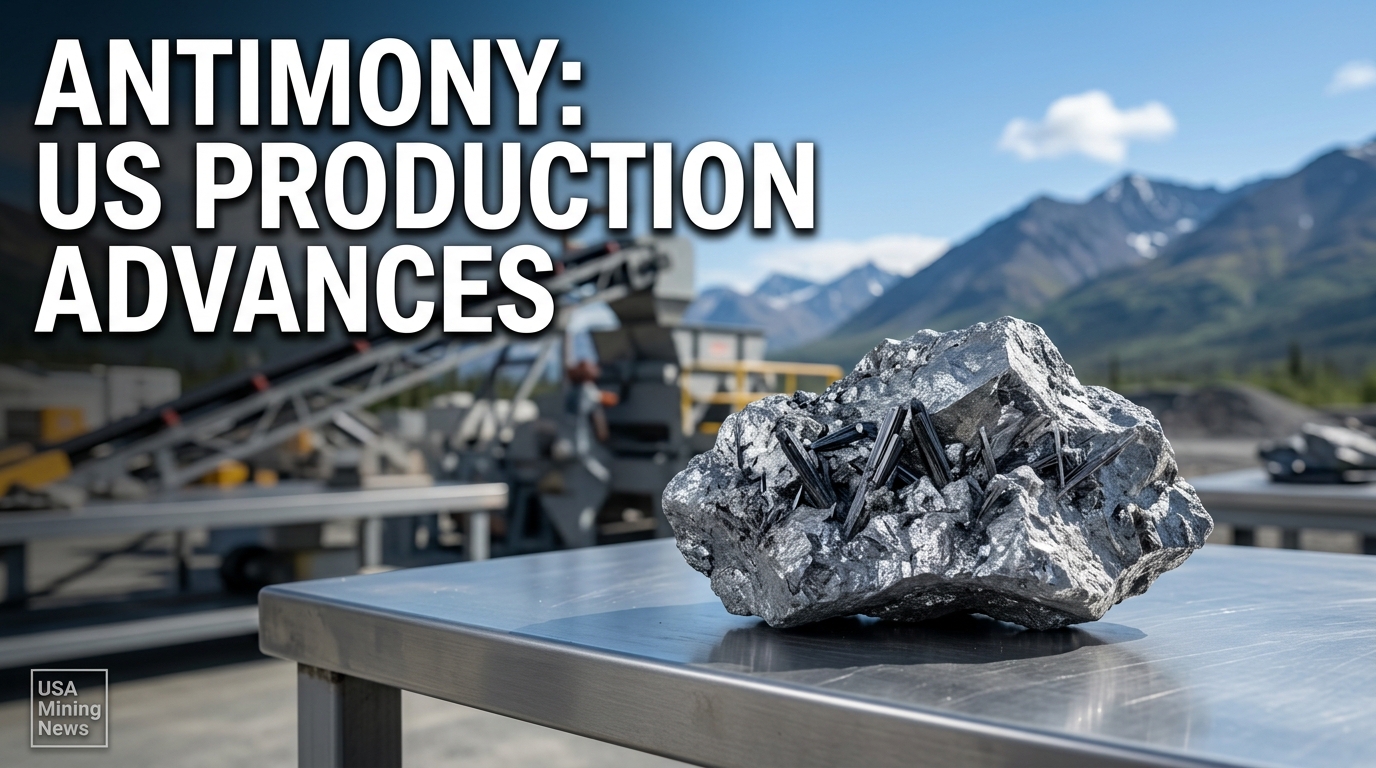
ANCHORAGE, Alaska – In a pivotal development for the United States’ critical mineral supply chain, Nova Minerals has announced the completion of the engineering and design phase for its antimony pilot processing plant at the Estelle project site in Alaska. This advancement, detailed on July 14, 2026, positions Nova Minerals to become a significant domestic producer of antimony, a mineral deemed critical for national security and emerging technologies.
The company confirmed that the comprehensive design work covers multiple operational facilities crucial for the project's success. These include the Whiskey Bravo front-end processing site, where initial ore handling will occur, and the Port MacKenzie beneficiation plant and refinery, equipped for advanced processing and refining stages. This strategic completion of engineering design represents a major milestone, transitioning the project from conceptualization to the execution phase, as confirmed by Nova Minerals’ CEO Christopher Gerteisen.
Meeting Stringent Military-Grade Specifications
A cornerstone of Nova Minerals' strategy for the Estelle antimony project is its commitment to producing high-quality material, specifically antimony trisulfide, that adheres to exacting military-grade specifications. These rigorous standards, historically established by the US Department of War, underscore the critical nature of antimony for defense applications. The ability to meet such strict requirements is paramount for any domestic supply intended for strategic national needs.
The pilot plant’s operational design incorporates a cleaner hydrometallurgical processing method. This modern approach, which uses aqueous solutions to extract and recover metals from ores, is often favored over traditional pyrometallurgical (high-temperature) methods due to its generally lower environmental footprint and greater process control. The adoption of hydrometallurgy aligns with contemporary industry trends towards more sustainable and efficient mineral processing.
Furthermore, the plant’s modular design offers inherent flexibility and a strategic advantage for future expansion. This modularity allows for the integration of additional refining circuits as demand dictates, potentially enabling the production of other critical antimony compounds such as antimony trioxide and antimony metal. This foresight in design suggests Nova Minerals is preparing for a multifaceted market approach and long-term facility growth.
Accelerated Procurement and Construction Kick-off
With the engineering phase concluded, Nova Minerals is poised to initiate construction activities for the pilot plant in the current quarter. The company has already made substantial progress on the procurement front, with key process plant equipment either delivered to the site or currently in transit. This proactive approach has been instrumental in maintaining the project's aggressive timeline, with CEO Christopher Gerteisen noting the company remains "ahead of schedule."
A significant aspect of this accelerated procurement strategy involved the acquisition of a substantial volume of equipment from a recently decommissioned North American processing facility. This opportunistic purchasing decision has yielded more than 40 containers of essential components, including crushers, a ball mill, ore sorters, screens, flotation cells, and conveyors. Sourcing equipment in this manner has not only reduced procurement times but also facilitated a quicker transition from engineering to the physical construction phase, sidestepping potential delays often associated with new equipment manufacturing and delivery for greenfield projects.
The strategic benefits of this approach are manifold:
- Reduced Lead Times: Leveraging existing, ready-to-deploy equipment significantly cuts down on the typical lengthy lead times for new machinery.
- Cost Efficiency: Acquiring equipment from a decommissioned facility often presents a more cost-effective solution compared to purchasing new units.
- Environmental and Sustainability Advantages: Reusing industrial equipment contributes to a circular economy, reducing the demand for new manufacturing and thus lowering the project’s embedded carbon footprint.
Processing Pathway: From Ore to Military-Grade Product
The operational blueprint for the Estelle pilot plant details a well-defined processing pathway. Bulk sample material, crucial for validating the plant's design and performance, will be sourced from the Stibium and Styx locations within the broader Estelle Project claims. These zones are known for their stibnite (antimony sulfide) mineralization.
The sourced ore will first be transported to the Whiskey Bravo site for primary processing. This initial stage typically involves crushing and grinding to reduce the ore particle size, preparing it for subsequent beneficiation. Following primary processing, the material will be moved to the Port MacKenzie facility for further concentration and refining. This two-stage approach optimizes logistics and allows for specialized processing at dedicated facilities.
Once fully operational, the plant will process this stibnite-bearing material to generate the targeted antimony trisulfide product. The refined product will undergo robust quality control measures, including filtration and drying, before being prepared for shipment. This final product is intended for direct sale into various markets or for further downstream applications, particularly those requiring military-grade specifications.
The Strategic Imperative of Domestic Antimony Supply
The significance of Nova Minerals’ Estelle project extends far beyond its technical achievements. Antimony is classified as a critical mineral by nations worldwide, including the United States, due to its indispensable role across numerous strategic industries and its vulnerability to supply chain disruptions. Geopolitically, the majority of global antimony production and processing capacity resides in a limited number of countries, primarily China, Russia, and Tajikistan, creating a concentrated supply risk for Western economies.
Antimony's diverse applications underscore its strategic importance:
- Defense and Aerospace: Beyond the US Department of War specifications for antimony trisulfide, the metal is vital in specialized ammunition, lead-acid batteries for military vehicles, and as an alloying agent to harden metals for various defense components.
- Flame Retardants: Antimony trioxide is widely used as a synergist with halogenated flame retardants in plastics, textiles, and coatings for consumer goods and industrial applications.
- Energy Storage: It is a component in certain advanced battery technologies, including lead-acid batteries and some nascent flow battery chemistries.
- Semiconductors and Electronics: High-purity antimony is used in infrared detectors, diodes, and as a dopant in semiconductor manufacturing.
- Other Industrial Uses: Pigments, ceramics, glass, and friction materials also rely on antimony compounds.
The establishment of a domestic antimony supply chain, such as that envisioned by Nova Minerals in Alaska, offers several profound advantages for the United States. It enhances national security by reducing reliance on foreign sources for critical defense materials, bolstering economic resilience by securing a vital input for domestic manufacturing, and creating high-skilled jobs within the US mining sector.
Leadership Perspective and Future Outlook
Christopher Gerteisen, CEO of Nova Minerals, expressed strong confidence in the project's trajectory, stating, "We continue to make rapid progress on the antimony project and remain ahead of schedule, with another major milestone now completed." He further elaborated that "The engineering and design plan has been developed based on extensive metallurgical test work and process flowsheet development," emphasizing the robust technical foundation underpinning the pilot plant.
With the engineering phase concluded and key equipment procurement finalized, Gerteisen highlighted that "the project has entered the execution phase." This pronouncement signals the company's readiness to move from planning to active construction and commissioning. The successful operation of the pilot plant will be instrumental in de-risking the larger Estelle Antimony Project, providing invaluable data on processing efficiency, product quality, and operational costs. This information will inform the feasibility studies and design parameters for a potential full-scale commercial operation.
The modular design of the pilot plant implies a scalable future, allowing Nova Minerals to strategically expand refining capabilities to produce different antimony compounds as market demand evolves. This adaptability, combined with a secured domestic supply of a critical mineral, positions Nova Minerals as a key player in strengthening the United States’ industrial base and critical mineral independence.
As construction commences, the mining industry will closely watch Nova Minerals' progress. The Estelle project represents not just another mining operation but a strategic imperative to secure a domestic supply of a mineral essential for modern defense, technology, and economic stability.