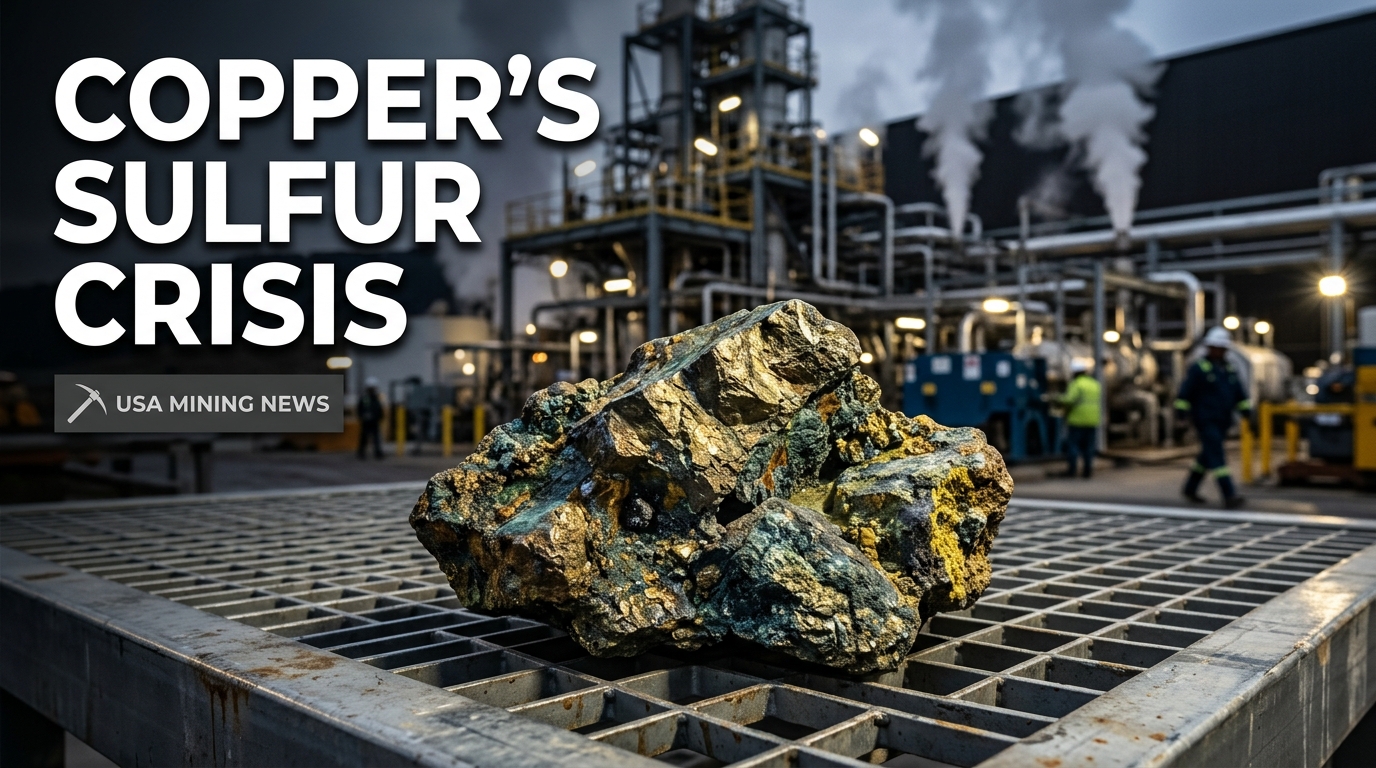
In an op-ed published May 4, 2026, Randy Allen delivered a stark message to the global mining industry: the evolving copper supply crisis is not an issue of dwindling ore deposits, but rather a profound challenge in sulfur management. This assertion, coming amidst severe disruptions in global commodity markets, posits that sulfur, often relegated as an undesirable byproduct, is in fact one of the most strategically vital materials on Earth, whose mismanagement now acts as a binding constraint on copper production.
The immediate catalyst for this intensified scrutiny was China’s recent decision, on May 1, to halt all exports of sulfuric acid. The ripple effects across commodity markets have been immediate and pronounced, yet the true significance extends beyond a single trade restriction. It underscores a vulnerability that the mining sector has been slow to fully comprehend: the critical dependency of modern industrial economies on a chemical whose supply chain is surprisingly fragile.
The Indispensable Chemical: Sulfuric Acid's Foundational Role
Known across industries as "the king of chemicals," sulfuric acid is a ubiquitous cornerstone of industrial activity. Global production surpasses an astounding 260 million metric tonnes annually, underpinning a vast array of manufacturing processes. Approximately 60% of this enormous output is channeled directly into fertilizer manufacturing. Without sulfuric acid, the production of essential phosphate fertilizers would cease, inevitably leading to a catastrophic collapse in global crop yields and, by extension, food security. This dependency establishes a deep, often overlooked connection between the mining industry and global agriculture.
The remaining 40% of sulfuric acid production is equally critical, serving as an indispensable reagent in key industrial sectors. It is vital for copper and nickel extraction, where it plays a central role in heap-leach operations and other hydrometallurgical processes. Beyond base metals, sulfuric acid is essential for uranium processing, a fundamental component in nuclear energy. Furthermore, its applications extend to high-tech manufacturing, including semiconductor fabrication—a sector increasingly vital for defense, communication, and computing. Traditional heavy industries also rely heavily on it for steel pickling and petroleum refining. Simply put, no industrialized economy can function without a robust and secure supply of sulfuric acid.
This widespread utility creates a fascinating interdependency. Copper ore processing, particularly smelting, inherently generates sulfuric acid and iron-based co-products like ferrous sulfate. These materials are precisely what the agricultural sector needs for fertilizers and soil amendments. When this processing, and the subsequent beneficiation of sulfur, occurs domestically within copper-producing nations, both the mining and agricultural sectors stand to benefit from a secure, localized supply chain. However, when these critical chemical conversions happen predominantly in distant geographies, both industries become acutely exposed to geopolitical and logistical vulnerabilities.
China's Pivotal Role and the Unraveling Supply Chain
For nearly two decades, China has solidified its position as the world’s largest exporter of sulfuric acid. This dominance is not accidental; it is intrinsically linked to the nation's substantial investment in base metal smelting capacity. China has built nearly half of the world’s copper smelting capacity, turning the byproduct sulfur dioxide into a valuable, marketable commodity. Indeed, approximately 40% of China's sulfuric acid exports directly originate from its metal smelting operations. This infrastructure not only feeds global copper supply but also supports China’s domestic fertilizer industry, its burgeoning rare earth processing sector, and a wide array of downstream chemical manufacturing. For China, the acid is not merely a side effect of metal production; it is a vital economic engine.
The rapid shift in this dynamic has been breathtaking. In 2025, Chinese sulfuric acid exports experienced a significant surge, increasing by 73% to reach 4.65 million tonnes. Fast forward less than a year, and the situation has completely reversed. Facing a burgeoning domestic deficit, primarily driven by the need to protect its own fertilizer production, China has entirely halted all sulfuric acid exports. This dramatic turn from record exports to a near-total ban underscores the extreme volatility now characterizing this critical commodity.
A Cascade of Disruptions Impacts Global Miners
China's export ban is not an isolated event but part of a broader, compounding series of supply chain disruptions that have rapidly unfolded over mere weeks. The closure of the Strait of Hormuz has effectively blocked seaborne sulfur from the Persian Gulf, a major global source. Simultaneously, Russia has extended its own export ban on sulfuric acid through June 2026. Turkey has announced parallel restrictions, and the Democratic Republic of Congo (DRC) has cut its export volumes. This perfect storm of restrictions has sent shockwaves through the global mining industry, particularly impacting nations heavily reliant on imported sulfuric acid.
One of the most immediate and severely affected regions is Chile. Historically, Chile imports more than a million tonnes of Chinese sulfuric acid annually, a supply that is absolutely crucial for its vast heap-leaching operations. These operations are responsible for producing roughly a fifth of global copper. The impact has been immediate and financially punitive, with spot prices for sulfuric acid delivered to Chile doubling since February. The same unprecedented squeeze is now being felt by copper and cobalt miners in the DRC and Zambia, nations that also depend on a stable supply of this critical chemical for their processing operations.
The Fundamental Problem: Sulfur as a Perennial Waste Product
For decades, the mining industry’s approach to sulfur has been shaped by the persistent challenge of its processing. Sulfur is typically not viewed as valuable. Its association with the unpleasant odors of rotten eggs, flatulence, and feces has undoubtedly contributed to its general perception. In the context of copper mining, sulfur has primarily been a waste product that the industry has perpetually managed as a liability rather than an asset.
The main method for processing copper sulfides, the predominant form of copper ore, involves concentration followed by combustion. This process enriches the copper content while endeavoring to push most of the sulfur into waste piles. The enriched ore is then smelted at extreme temperatures, with whatever sulfur dioxide can be captured being converted into sulfuric acid. Over the years, the industry has invested billions of dollars in mitigation technologies and infrastructure to contain the environmental consequences of this sulfur-laden waste. Standard modern processing facilities now incorporate advanced scrubbers, meticulously lined tailings facilities, sophisticated water treatment systems, and the imperative systems required to convert captured sulfur dioxide into sulfuric acid.
However, the fundamental chemistry of smelting makes complete sulfur containment extraordinarily difficult. Despite the immense investments, the environmental consequences persist: acid mine drainage continues to poison watersheds for decades, fugitive emissions degrade air quality around smelting operations, and tailings facilities store sulfide-laden waste that remains a long-term liability for generations. These are not abstract environmental concerns; they are the tangible reasons why mining companies frequently encounter organized community opposition, suffer permitting delays that can stretch for decades, and experience a significant erosion of their crucial social license to operate. As EY has consistently identified, the erosion of social license stands as the mining industry’s number one business risk. When a local community has witnessed sulfur contaminate its water sources for a generation, no amount of economic argument or promise of employment will earn permission for the next project proposal. Randy Allen offers a poignant analogy: trying to cook over an open flame indoors. Regardless of how sophisticated the ventilation system, combustion will always produce smoke. The problem, he argues, is not about building a better exhaust hood, but pondering whether there is a fundamentally different and cleaner way to cook.
Reframing Sulfur: From Cost Center to Revenue Stream
The emerging perspective argues for a radical reframe of sulfur’s role, transforming it from a perpetual cost center into a valuable revenue stream. The economics of this shift are striking. For every tonne of copper produced from sulfide concentrates, approximately 3 to 3.5 tonnes of sulfuric acid are inherently generated, either through smelting or select hydrometallurgical alternatives. This acid possesses a clear market value.
The potential for value creation is even greater for operations that can integrate the conversion of co-located pyrite—a common iron sulfide mineral often present in copper deposits—into sulfuric acid and various iron-based co-products. These co-products include ferrous sulfate, highly valued by the agricultural sector for fertilizers and soil conditioning, and iron oxide pigments, which find extensive use in the construction industry. Under this integrated model, an orebody that was previously valued solely for its copper content is transformed into a sophisticated polymetallic operation, boasting multiple diversified revenue streams. These streams could include copper cathode, sulfuric acid, elemental sulfur, ferrous sulfate, and even precious metals that are often found alongside copper. In this scenario, the sulfur, once a heavy environmental and financial burden, becomes a powerful economic instrument that significantly enhances a project’s viability and profitability.
Towards Domestic Self-Sufficiency and Strategic Autonomy
The path forward, as articulated by Allen, is not to simply seek out new external suppliers of sulfuric acid, which merely shifts dependency. Instead, the imperative for copper-producing nations is to cultivate self-sufficiency – to eliminate the need for external supply altogether. This involves processing their own sulfide ores at or near the mine site, thereby capturing not only copper but also domestically generating sulfuric acid and every other valuable co-product.
Consider the strategic implications: in Chile, locally produced sulfuric acid could directly feed into the nation’s extensive heap-leaching operations, drastically reducing reliance on volatile international markets and transport costs. In the United States, acid generated from domestic copper mining operations, such as those in Arizona, could supply the demanding semiconductor fabrication facilities of companies like TSMC, In, and others, bolstering national supply chain security for a critical high-tech industry. This approach offers a pathway for copper-producing nations to reduce their exposure to geopolitical risks and commodity price volatility, simultaneously fostering robust domestic industries. By adding significant value onshore, these nations can transition from dependency to strategic autonomy in the processing of critical minerals, building resilient supply chains essential for their own industrial and agricultural sectors.
Conclusion: A New Era for Copper Mining
Randy Allen’s analysis brings into sharp focus a fundamental truth: the copper supply crisis is intricately linked to how the industry perceives and manages sulfur. As global supply chains for sulfuric acid become increasingly constrained and volatile, the traditional paradigm of sulfur as an unwanted waste product is no longer sustainable. The imperative is clear: the mining industry must embrace innovative processing technologies that enable the conversion of sulfur from a costly environmental liability into a valuable, marketable asset. This strategic pivot promises not only to alleviate current copper supply pressures but also to enhance the economic viability of mining projects, fostering greater domestic self-sufficiency and resilience across vital industrial sectors globally.