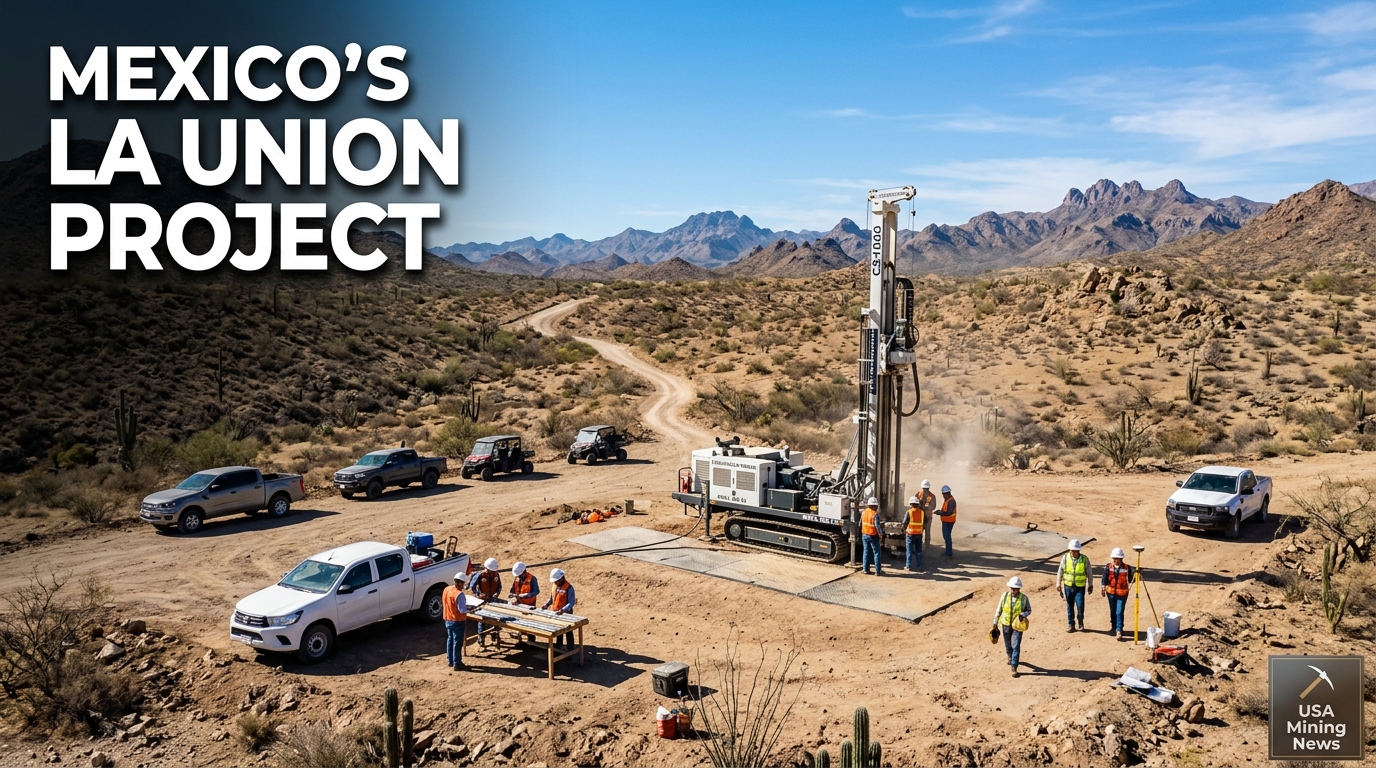
Sonora, Mexico – In a significant development for the North American mining sector, Questcorp Mining, in collaboration with partner Riverside Resources, has formally commenced its Phase 2 exploration program at the La Union Project, strategically located in the highly prospective mining state of Sonora, Mexico. This advancement, announced on April 1, 2026, marks an important step in systematically delineating and expanding the known mineralized zones, catalyzed by promising findings from the initial Phase 1 drilling completed in January 2026.
Advancing Exploration in Sonora's Prolific Terrain
Mexico stands as a globally recognized leader in mineral production, particularly for silver, and is a significant producer of gold, copper, and zinc. Sonora, in particular, is a cornerstone of this output, boasting numerous world-class mines and a well-established infrastructure that supports extensive exploration and development activities. The La Union Project, centered within this prolific region, benefits from an advantageous geological setting known for hosting diverse types of precious and base metal deposits.
The commencement of Phase 2 fieldwork underscores the confidence that Questcorp Mining and Riverside Resources place in the project's potential. Following a comprehensive 12-hole Phase 1 drill program, which concluded with its findings announced in January 2026, the joint venture is now intensifying its efforts. The goal for this second phase is to meticulously refine existing targets identified during initial investigations and to generate an expanded pipeline of new drillable prospects across the expansive district-scale property.
Significant Gains from Phase 1 Drilling
The preceding Phase 1 program provided crucial insights into the geological and mineralogical characteristics of the La Union Project. Two key areas, the Union Mine and Luis Hill, delivered particularly compelling results that have directly informed the strategic direction of Phase 2. At the historic Union Mine, initial chip-channel sampling returned a high-grade interval of 30 meters grading an impressive 20.2 grams per tonne (g/t) gold and 226 g/t silver. Such a high-grade intersection over a significant width is a strong indicator of robust mineralization and represents a primary focus for continued detailed exploration. Chip-channel samples, typically taken across exposed rock faces, provide valuable early-stage data on mineralization trends and grades, guiding the placement of subsequent drill holes.
Equally significant was the discovery at Luis Hill, where exploration identified a new style of sediment-hosted gold (SHGD) mineralization. A 42-meter section here graded 0.3 g/t gold. While this grade may appear modest compared to the high-grade findings at Union Mine, the “sediment-hosted” characteristic, coupled with observations of “Carlin-like” mineralization, is profoundly important for its potential scale. Carlin-type deposits, named after the prominent Carlin Trend in Nevada, USA, are renowned for their typically lower-grade but extremely large tonnage gold resources, making them highly attractive targets for major mining companies seeking long-life assets.
Strategic Objectives and Technical Depth of Phase 2
The Phase 2 program is designed as a multifaceted exploration effort, extending beyond simple drilling to build a more comprehensive understanding of the project’s geology and mineralization controls. Key objectives for this phase include:
- Refining Current Drill Targets: Leveraging geological, geochemical, and geophysical data from Phase 1 to precisely delineate the most promising areas for subsequent drilling.
- Generating New Drill Targets: Expanding the search across the district-scale property to identify entirely new zones of interest, particularly where mineralization trends extend beyond previously explored areas.
- Focus on Sediment-Hosted Gold (SHGD) Targets: Intensive follow-up on the significant SHGD targets identified at Luis Hill during Phase 1, with a goal to better understand their geological context and extent.
- Continued Sampling at the Union Mine: Further detailed sampling, including chip-channel and potentially trenching, to delineate the high-grade gold-silver mineralization and prepare for targeted drilling.
- Exploring Lead and Zinc Anomalies at Famosa North: Investigation of base metal anomalies which could indicate the presence of polymetallic mineralization, potentially diversifying the project’s resource base.
- Structural Mapping: Detailed structural analysis in the northern part of the property, assisted by external consultants, to understand the fault and fracture systems that often control the emplacement of mineral deposits.
Complementing these ground-based activities, an expanded aeromagnetic drone survey will be conducted. This advanced geophysical technique involves flying drones equipped with magnetometers to measure subtle variations in the Earth's magnetic field. Such variations can indicate the presence of different rock types, alteration zones, and structural features that are often associated with buried mineral deposits. The data gathered from this survey will be critical for enhancing geological interpretation and further refining drill targets ahead of the planned summer drilling program in 2026.
A District-Scale Vision: Multiple Mineralization Styles
One of the most compelling aspects of the La Union Project is its demonstrated potential for multiple, distinct styles of mineralization across a district-scale land package. This diversity significantly increases the project's overall prospectivity and resilience, as it is not reliant on a single geological model. The three primary styles identified are:
- Carbonate Replacement Deposit (CRD): These deposits are typically high-temperature, vein- and manto-style mineralized bodies that form when hydrothermal fluids react with carbonate host rocks. Mexico is famous for its CRD-style deposits, which often yield vast quantities of silver, lead, zinc, and frequently significant gold credits. The presence of CRD targets at La Union aligns with a well-established and productive geological model for the region.
- Sediment-Hosted Gold (SHGD) similar to Carlin-style systems: As highlighted by the Luis Hill discovery, this style holds the potential for very large, albeit often lower-grade, gold deposits. Carlin-type systems usually involve microscopic gold disseminated within sedimentary rocks, presenting a distinct exploration challenge and a major prize if proven economically viable.
- Structurally Controlled Gold Mineralisation: This common and widespread style of mineralization occurs when gold is deposited along faults, shear zones, and fracture networks within host rocks. These structures act as conduits for mineralizing fluids, concentrating gold in distinct zones that can be high-grade.
The coexistence of these varied mineralization styles within a single project provides a diversified exploration portfolio, appealing to a broad spectrum of mining investors and demonstrating the versatility and potential scale of the La Union Project.
Corporate Strategy and Collaboration: Questcorp and Riverside
The collaborative framework between Questcorp Mining and Riverside Resources is foundational to the project's systematic advancement. Riverside Resources’ strategic move, announced in March 2026, to formally consolidate the Famosa mineral concessions into its land package holds particular importance. This consolidation enhances their already district-scale land position, creating a contiguous and larger exploration footprint. Acquiring adjacent ground where mineralization trends are known to continue into new target areas is a textbook strategy in mineral exploration, reinforcing the rationale for the expanded Phase 2 activities.
Saf Dhillon, President and CEO of Questcorp Mining, articulated the company's strategic focus, stating, “The commencement of our Phase 2 programme marks an important step in advancing the La Union Project. With a fully funded programme now underway, we are focused on systematically refining existing targets while expanding our pipeline of new opportunities across the district.” He further emphasized, “The combination of CRD-style mineralisation and the emerging sediment-hosted gold potential at Luis Hill continues to demonstrate the scale and versatility of the project. We look forward to building on these results as we advance toward the next phase of drilling.” Dhillon’s comments underscore a commitment to rigorous, data-driven exploration while highlighting the dual-pronged potential that makes La Union particularly attractive.
Permitting, Funding, and the Path Forward
A crucial factor in the timely progression of any mining project is the securing of necessary permits and adequate funding. Questcorp Mining's announcement that all required permits are secured and contractors are engaged, coupled with the program being "fully funded," speaks volumes about the project's operational readiness and robust financial backing. This efficiency stands in stark contrast to many projects globally that often face delays due to regulatory bottlenecks or insufficient capital, positioning La Union for an accelerated development path.
Looking ahead, the successful execution of Phase 2 is directly geared towards preparing for the "next fully funded drilling phase," which is planned for the summer of 2026. The geological mapping, geochemistry, geophysics, and structural analysis currently underway are all designed to convert promising anomalies and broad target areas into precise, high-priority drill targets. The results of this summer drilling will be pivotal in further defining the resource potential and advancing the La Union Project towards potential resource estimation and economic assessment.
The La Union project represents a significant opportunity in what remains a highly sought-after jurisdiction for mineral discovery. With strong initial results, a comprehensive exploration strategy, and the commitment of its joint venture partners, the project is well-positioned to unlock substantial value in one of Mexico's most important mining districts.