Questcorp Advances North Island Copper Project with Strategic IP Survey in British Columbia
Vancouver, BC – February 27, 2026 – Questcorp Mining, a junior exploration company focused on developing mineral assets, has announced the commencement of a crucial induced polarisation (IP) survey at its North Island Copper Project. Located near Port Hardy on Vancouver Island, British Columbia, Canada, this 1,168-hectare property is emerging as a compelling target within the global quest for new copper resources. The strategic geophysical program underscores Questcorp’s disciplined approach to de-risking exploration and advancing its Marisa Zone porphyry copper system towards a drill-ready state.
The North Island Copper Project: A Strategic Porphyry Target
The North Island Copper Project is strategically situated on Vancouver Island, a region known for its rich polymetallic deposits, including historical copper production. Porphyry copper deposits, such as the Marisa Zone targeted by Questcorp, are significant for the mining industry due to their typically large tonnage potential, even if grades are comparatively lower than vein-type deposits. These deposits are often central to large-scale, long-life mining operations, providing a stable supply of copper, a metal critical for global electrification, renewable energy infrastructure, and the burgeoning electric vehicle market.
Questcorp's 1,168-hectare land package, located near established infrastructure and the deep-water port of Port Hardy, offers logistical advantages that can significantly lower future development costs if a major discovery is made. The project's primary appeal lies in its interpreted porphyry copper system within the Marisa Zone, which has a demonstrated history of mineralization, providing a strong foundation for current exploration efforts.
Unpacking the Induced Polarisation (IP) Survey: Technical Details and Objectives
The core of Questcorp’s current exploration push is the induced polarisation (IP) survey, a geophysical technique widely employed in mineral exploration, particularly effective for identifying disseminated sulfide mineralization often associated with porphyry copper systems. IP surveys measure the chargeability and resistivity of subsurface materials:
- Chargeability: This refers to the ability of rocks to store an electrical charge, which is often enhanced by the presence of metallic minerals like sulfides (e.g., chalcopyrite, pyrite) disseminated within the rock matrix. Porphyry deposits are frequently characterized by an extensive footprint of disseminated sulfides.
- Resistivity: This measures how resistant a material is to the flow of electric current. Alteration zones, often associated with porphyry systems, can have distinct resistivity signatures compared to surrounding host rocks.
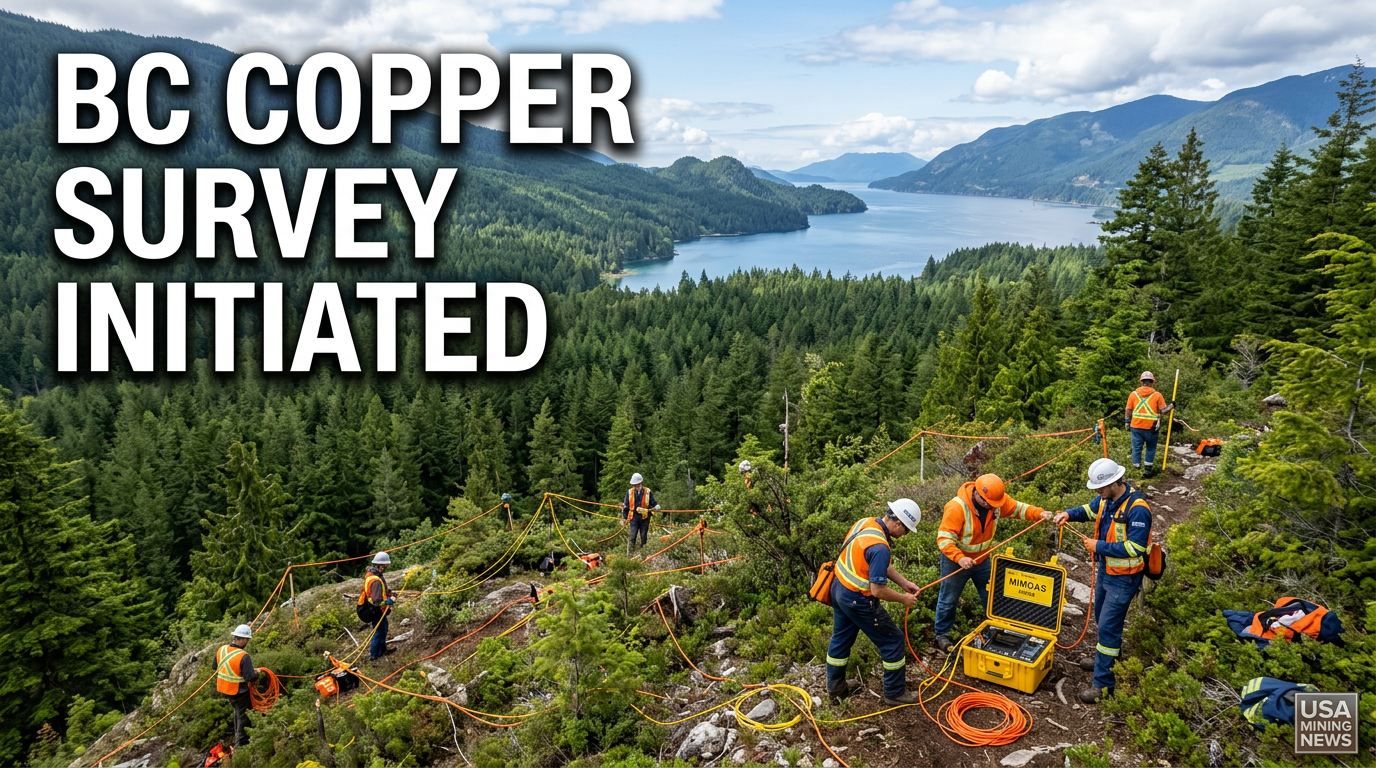
The current survey program is substantial, spanning 10–15 line kilometres. It is being executed by Peter E. Walcott & Associates, a reputable geophysical consulting firm based in Coquitlam, British Columbia, known for its expertise in mineral exploration geophysics. The primary aim of this undertaking is twofold: to verify and enhance historical geophysical targets within the Marisa Zone, and crucially, to provide high-resolution data to assist in creating follow-up drilling targets. This systematic approach is standard practice in modern exploration, ensuring that costly drilling funds are allocated to the most promising anomalies.
A key aspect of the ongoing survey’s methodology involves positioning the new IP lines between the existing 1992 IP lines. By following the historical survey azimuth and adding infill lines, Questcorp aims to significantly increase the data resolution across the target area. This strategy will allow for a more detailed and accurate three-dimensional understanding of potential mineralized zones. Upon completion, both the historical and the newly acquired datasets will be integrated to produce updated chargeability and resistivity models, alongside detailed pseudosection interpretations. These advanced models are fundamental for enhancing precision in subsurface targeting, serving as indispensable tools before committing to any subsequent diamond drilling program.
Leveraging Historical Data: Insights from 1991/1992 Exploration
The current IP survey is not operating in a vacuum; it directly builds upon a foundation of historical exploration data that has already demonstrated the project's potential. Prior work in the early 1990s, specifically following a 1991 IP chargeability anomaly, led to a diamond drilling program in 1992. Out of five holes drilled, two successfully intersected copper mineralization, providing tangible evidence of a mineralized system within the Marisa Zone.
The historical drill results are noteworthy:
- DDH92-01: This drill-hole intersected 0.078% copper over 56.39 metres.
- DDH92-03: This hole returned 0.041% copper over 70.71 metres.
While these grades might appear modest at first glance, they are significant indicators for a porphyry system, where mineralization is typically disseminated over hundreds of metres rather than concentrated in high-grade veins. Importantly, the historical records indicate that higher copper grades were reported at depth in DDH92-03, suggesting potential for increasing mineralization with depth, a common characteristic in porphyry deposits where the core of the system often hosts richer zones. Both mineralized intervals were found within altered quartz diorite, a common and favourable host rock for porphyry copper mineralization globally.
These historical intercepts provide crucial validation for the use of IP geophysics in this specific geological setting and confirm the presence of a targetable copper system. The new, higher-resolution IP data is expected to refine these historical anomalies, potentially outlining the geometry and extent of the mineralization with much greater clarity, thereby greatly improving the chances of successful follow-up drilling.
Questcorp's Strategic Vision and Financial Positioning
Saf Dhillon, President and CEO of Questcorp Mining, articulated the company’s strategic rationale behind the current exploration phase. "The North Island Copper Project represents a compelling porphyry copper target with demonstrated historical mineralisation," he stated. Dhillon emphasized that "This IP programme is a disciplined step toward refining our geological model and advancing toward drill-ready targets." His remarks highlight a methodical and prudent approach to exploration, focusing on de-risking before committing to more capital-intensive activities like drilling.
The ability to execute such programs is underpinned by robust financial planning. Questcorp recently solidified its financial position, having secured an initial investment from Sorbie Bornholm in November 2025. This institutional investor, based in the UK, provides significant backing and demonstrates a degree of external confidence in Questcorp's assets and strategy. Dhillon confirmed, "With our recent financings completed, the company is well positioned to execute its planned exploration programmes while maintaining a prudent approach to capital deployment." This financial strength allows Questcorp to systematically progress its projects without undue pressure, optimizing its exploration expenditure.
The Broader Market Context: Copper's Enduring Demand
The exploration for new copper deposits, especially large-scale porphyry systems, is more critical now than ever. The global transition towards a greener economy is driving unprecedented demand for copper. Forecasts consistently project significant supply deficits in the coming decade, fueled by:
- Electrification Growth: Massive investments in grid modernization and expansion.
- Renewable Energy: Solar panels, wind turbines, and energy storage systems are all copper-intensive.
- Electric Vehicles (EVs): EVs require significantly more copper per unit than traditional internal combustion engine vehicles, with charging infrastructure adding further demand.
- Data Centers and AI Infrastructure: The expansion of digital technologies and AI deployment relies heavily on copper for efficient data transmission and power delivery.
Simultaneously, the industry faces challenges in bringing new supply online, including declining ore grades at existing mines, longer lead times for permitting and developing new projects, and increased capital expenditure. Against this backdrop, advancing a prospect like the North Island Copper Project in a mining-friendly jurisdiction like British Columbia takes on increased significance. British Columbia boasts a well-established regulatory framework, a skilled workforce, and existing infrastructure, all of which contribute to a more predictable and potentially faster path to development compared to many other global jurisdictions.
Outlook and Next Steps
The completion of the current IP survey by Peter E. Walcott & Associates represents a critical milestone for Questcorp Mining. The next immediate steps involve the comprehensive interpretation of the collected data, integration with historical information, and the subsequent generation of updated 3D models. This will lead directly to the identification of refined, high-priority drill targets within the Marisa Zone.
A successful outcome from this IP program – meaning the outlining of robust, coherent geophysical anomalies correlated with historical mineralization – would significantly de-risk the North Island Copper Project. It would move Questcorp closer to initiating a diamond drilling campaign, which is the ultimate test of a mineral prospect. For investors, the systematic de-risking of exploration projects at each stage, from geophysics to drilling, is a key indicator of responsible capital management and increases the potential for significant value creation should a substantial resource be delineated. The North Island Copper Project, with its historical successes and Questcorp’s focused approach, is poised to potentially contribute to the future supply of this indispensable metal.