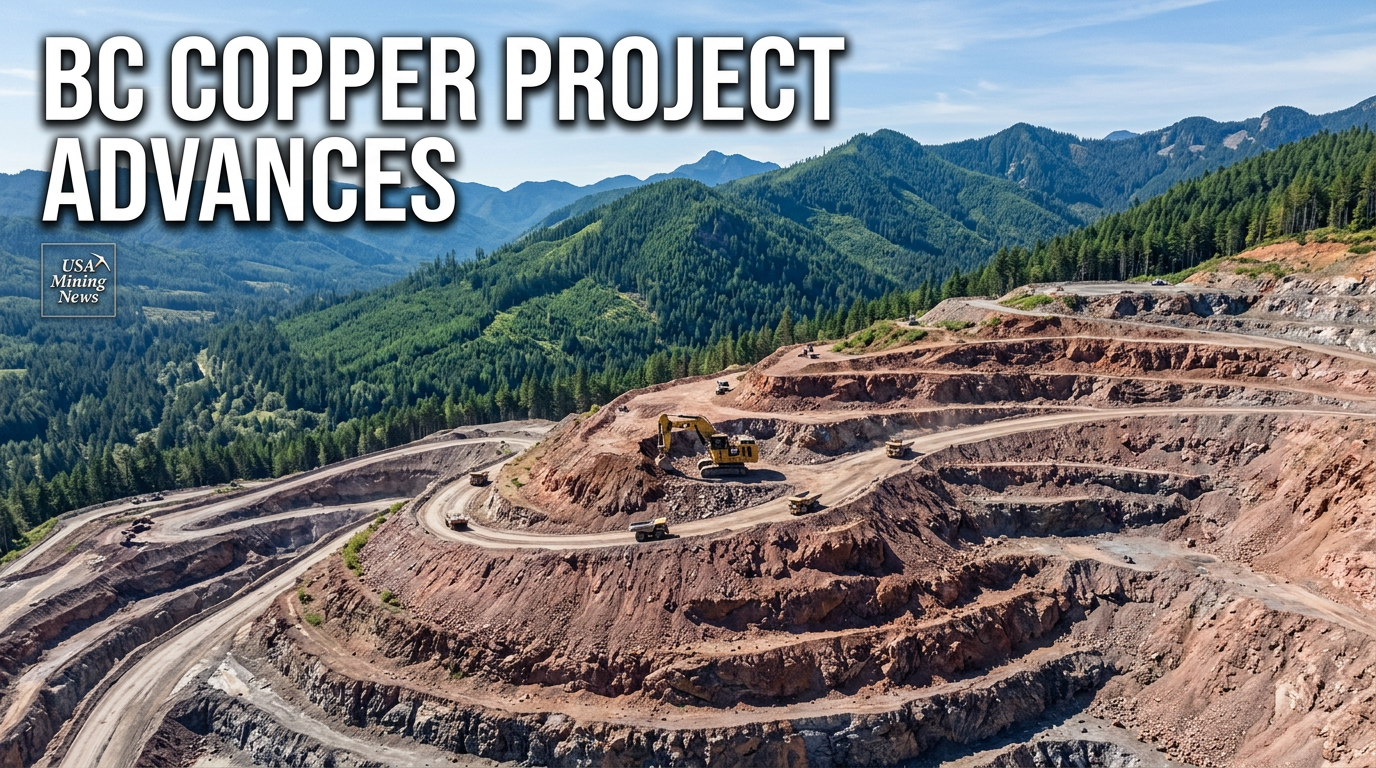
Questcorp Mining Completes Pivotal Geophysical Survey at North Island Copper Project, Eyes 2026 Drilling Program
Vancouver, BC – March 11, 2026 – Questcorp Mining, a junior explorer focused on compelling mineral assets, has announced the successful completion of a 12.8-line kilometre induced polarisation (IP) survey at the Marisa Zone, a key prospect within its North Island Copper Project in British Columbia, Canada. This crucial geophysical milestone marks a significant step forward in the company's efforts to define high-priority drill targets at the 1,168-hectare property, strategically located near Port Hardy on Vancouver Island.
The completion of this modern IP survey is not merely a procedural step but a substantive affirmation of historical data, which indicated promising copper mineralisation associated with a chargeability anomaly first identified in 1992. The company is now poised to integrate these new findings with legacy data, aiming to develop a comprehensive 3D geological model that will guide future exploration expenditures and, ultimately, a planned drilling programme slated for the latter half of 2026.
Questcorp Advances North Island Copper Project with Geophysical Data
The newly concluded IP survey, covering 12.8-line kilometres across the Marisa Zone, represents the latest technical advancement for Questcorp Mining at its North Island Copper Project. Situated on 1,168 hectares of prospective ground, the project area is geographically positioned near the community of Port Hardy on Vancouver Island, an area known for its geological potential within British Columbia's prolific mining landscape. The primary objective of this recent survey was to refine and reconfirm the presence of the known chargeability anomaly, which in past exploration efforts, has been directly correlated with sulphide-hosted copper mineralisation.
Following the successful data acquisition phase, Questcorp Mining's technical team is now engaged in a detailed analysis of the geophysical data. This evaluation is critical for interpreting the subsurface characteristics depicted by the IP survey. To maximise the utility of both historical and contemporary data, the company has engaged Peter E. Walcott and Associates. This specialist firm has been tasked with the crucial role of integrating the new IP findings with data derived from a 1992 IP survey. The ultimate goal of this integration is the creation of a thorough 3D inversion model of the Marisa Zone. This sophisticated model is expected to provide an unparalleled subsurface view, enabling Questcorp to identify and prioritise specific drill targets with enhanced precision and confidence.
The Strategic Importance of Induced Polarisation Surveys
Induced Polarisation (IP) surveys are a cornerstone of modern mineral exploration, particularly effective in identifying disseminated sulphide mineralisation often associated with significant copper deposits, such as porphyries. The technique works by measuring the chargeability of subsurface materials, which is their ability to store electrical charge. Sulphide minerals, frequently hosts for valuable metals like copper, tend to exhibit higher chargeability compared to barren rock. Therefore, an IP chargeability anomaly typically signifies the presence of potential mineralisation.
For exploration companies like Questcorp Mining, the deployment of an IP survey is a strategic investment in derisking a project. It allows geologists to 'see' through overburden and gain insights into the distribution and geometry of sulphide bodies at depth, without the immediate expense of drilling. The data generated provides critical vectors for subsequent drilling programs, ensuring that costly drill holes are optimally placed to intersect potential ore bodies. When integrated with other geological, geochemical, and geophysical data, IP surveys contribute significantly to building a robust geological model, moving a project from conceptual understanding to advanced targeting. The successful confirmation of the historical anomaly through Questcorp's recent survey thus translates directly into increased confidence regarding the Marisa Zone's mineral potential.
Historical Context and Promising Intercepts at Marisa Zone
The Marisa Zone's potential for copper mineralisation is not a new discovery but benefits from historical exploration work that laid the groundwork for Questcorp's current campaign. Past exploration activities conducted in 1992 were instrumental in identifying the significant IP chargeability anomaly that has now been re-confirmed by Questcorp's recent survey. Crucially, a drilling programme conducted in the same year directly tested this anomaly.
Out of the five diamond drill holes completed in 1992, two specifically targeted the identified IP signature, yielding compelling results. Drill-hole DDH92-01 intersected 0.078% copper over 56.39 metres, while DDH92-03 returned 0.041% copper over 70.71 metres. Both of these intercepts were found within an altered quartz diorite host rock, a geological setting commonly associated with porphyry-style copper deposits globally. Of particular note with DDH92-03 was the observation of increasing copper grades with depth, a characteristic that often indicates proximity to a more significant mineralised body at deeper levels. These historical results are critical because they provide direct evidence of copper mineralisation spatially linked to the geophysical anomaly that Questcorp's latest IP survey has now successfully verified. This re-affirmation significantly enhances the project's prospectivity and provides tangible targets for renewed drilling efforts.
Catalyst for Drilling: From Data to Discovery
With the IP survey successfully completed and the historical chargeability anomaly re-confirmed, Questcorp Mining is rapidly progressing towards identifying definitive drill targets. The next pivotal phase involves the culmination of the 3D inversion model by Peter E. Walcott and Associates, which will integrate both the recent and the 1992 IP data. This integrated model is designed to provide a comprehensive three-dimensional representation of the subsurface, offering geoscientists a clearer understanding of the geometry and distribution of the potential mineralised structures. Such advanced modelling is indispensable in modern exploration, allowing for the meticulous refinement of drill hole locations to maximize the chances of intercepting significant mineralisation.
Questcorp's strategic pathway is clearly defined, with the company aiming to initiate the permitting process for a comprehensive drilling programme either late in the first half (H1) or early in the second half (H2) of 2026. This timeline is contingent upon the final interpretations derived from the 3D model and the subsequent regulatory permitting approvals. Saf Dhillon, President and CEO of Questcorp Mining, underscored the importance of these developments, stating, “This recently completed IP survey represents an important step in advancing the Marisa Zone target. The survey has successfully confirmed the presence of the historical chargeability anomaly identified in earlier work. Once Walcott and Associates completes the 3D inversion and our technical team finishes reviewing the results, we expect to refine potential drill targets and move toward a drill programme later in 2026.” This statement highlights the critical link between robust geophysical data and the progression towards a targeted and efficient drilling campaign, essential for moving the project from an exploration concept to a potential discovery.
Strategic Funding Underpins Exploration Ambitions
Advancing a project through critical exploration phases, from geophysical surveys to extensive drilling, requires substantial capital. Questcorp Mining has prudently addressed this need through a key financial injection in late 2025. In November 2025, the company successfully secured an initial investment from Sorbie Bornholm, a UK-based institutional investor. This strategic financing provided Questcorp with C$2 million (equivalent to approximately $1.42 million US dollars at the time) specifically allocated to continue work on its primary projects, including the North Island Copper Project, and to bolster its general working capital needs.
Securing investment from an institutional entity like Sorbie Bornholm is a significant vote of confidence in Questcorp's assets and management strategy, especially within the often-challenging junior mining finance landscape. Such funding is vital for exploration companies, enabling them to execute planned work programs without undue delays, retain key technical personnel, and react opportunistically to new data. This capital infusion ensures Questcorp has the financial runway to complete the 3D inversion modelling, undertake the necessary permitting activities, and, crucially, fund the subsequent drill program at the Marisa Zone, thereby maintaining project momentum towards potential discovery.
British Columbia's Favourable Mining Landscape
British Columbia stands as a globally recognised and highly prospective jurisdiction for mineral exploration and mining. The province's rich geological endowment, particularly its abundance of porphyry-style deposits which are primary sources of copper, gold, and molybdenum, attracts significant investment. Vancouver Island, where the North Island Copper Project is located, forms part of the geological terranes known for hosting such deposits. The region benefits from established infrastructure, including proximity to Port Hardy, which provides essential services and logistical support for mining operations.
Beyond geology, British Columbia maintains a well-defined regulatory framework and a skilled workforce, supported by a history of resource development. The province's commitment, albeit with stringent environmental and social considerations, to responsible resource extraction provides a relatively stable operating environment for mining companies. In the broader market context, copper remains a critical commodity, underpinning the global transition to green energy, electric vehicles, and essential infrastructure development. The increasing demand for copper, coupled with potential supply constraints, continuously places projects with significant copper potential, such as Questcorp's North Island Copper Project, in a favourable position for future development and investor interest. The Marisa Zone's location within this established and promising mining jurisdiction further enhances its strategic appeal.
The Road Ahead for Questcorp Mining
The successful completion of the IP survey at the Marisa Zone marks a critical juncture for Questcorp Mining and its North Island Copper Project. It underscores the company's diligent, systematic approach to exploration, building upon historical successes with modern geophysical techniques. The impending 3D inversion model, integrating decades of data, is set to provide an unprecedented level of clarity, transforming geophysical signals into precise, drill-ready targets. This technical development, combined with the strategic financial backing from Sorbie Bornholm, positions Questcorp to execute its envisioned drill program efficiently.
The mining industry will be closely watching as Questcorp transitions from data interpretation to active drilling in late H1 or early H2 2026. The results from this forthcoming drill program will be instrumental in defining the scale and nature of the copper mineralisation at the Marisa Zone, holding the potential to significantly enhance the project's value and contribute to British Columbia's legacy as a world-class copper producer. For investors and industry professionals, Questcorp Mining's methodical advancement of the North Island Copper Project represents a compelling case study in value creation through targeted exploration in a proven jurisdiction.