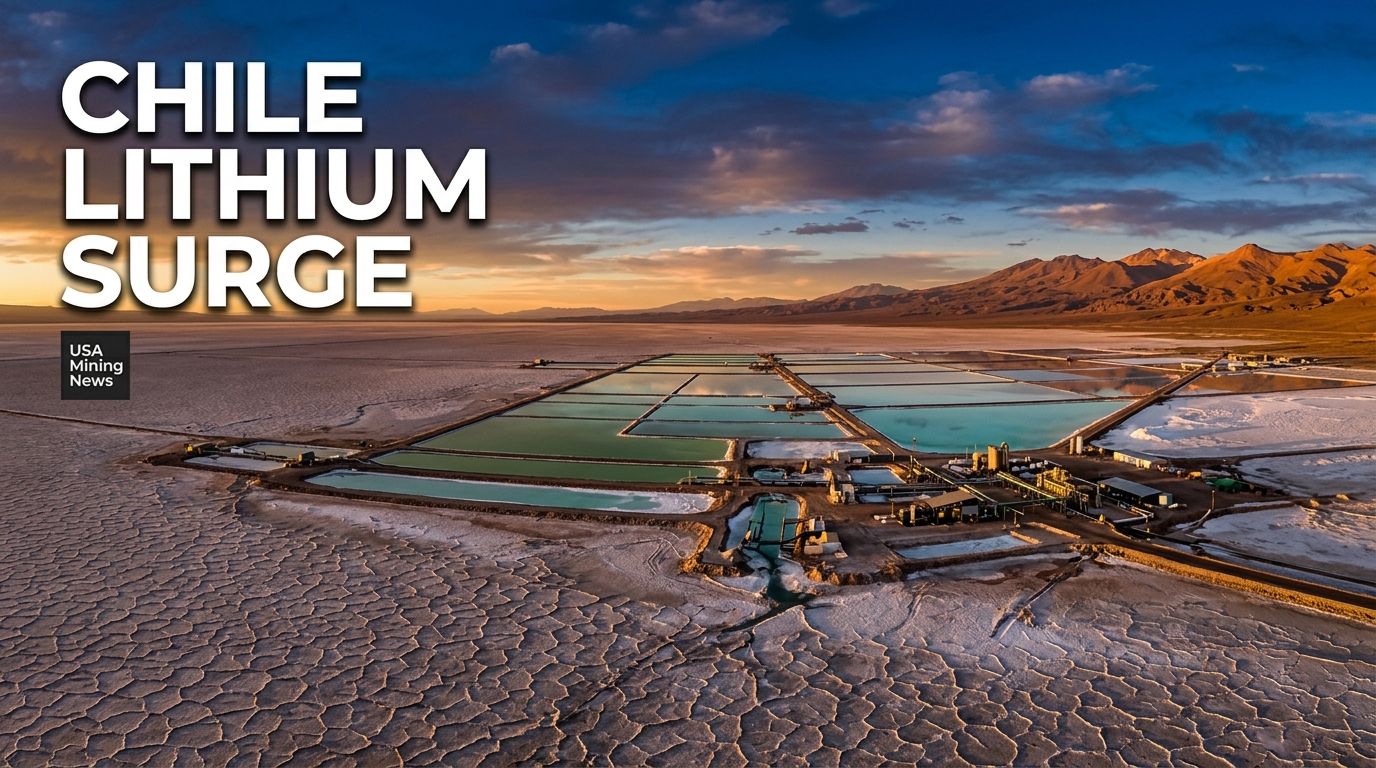
Santiago, Chile – March 24, 2026 – Chile, a pivotal player in the global lithium market, stands on the cusp of a significant production surge in 2026, with ambitious strategic initiatives set to redefine its role in supplying the critical battery mineral. As the world’s second-largest lithium producer, trailing only Australia, Chile is solidifying its position through a combination of capacity expansions at existing operations and a transformative national policy framework designed to foster long-term growth and national control over its invaluable brine resources. The nation's lithium output, predominantly lithium carbonate extracted from the brines of the Salar de Atacama in the Antofagasta region, is experiencing robust growth, signaling a new chapter for this strategic commodity.
Salar de Atacama: The Enduring Heart of Chilean Lithium Production
The Salar de Atacama remains the cornerstone of Chile’s lithium extraction industry. Its highly concentrated brines have historically made Chile a dominant force in global supply. As of this analyst comment dated March 24, 2026, the country’s lithium metal production is estimated to have increased significantly in the preceding year, reaching an impressive 64,100 tonnes (t) in 2025. This 10.1% year-on-year rise was primarily fueled by heightened output from Sociedad Química y Minera de Chile S.A. (SQM)'s extensive operations within the Salar de Atacama, directly attributed to ongoing capacity expansions at their facilities.
Looking forward, the momentum is expected to continue. Chile’s lithium output is projected to climb further by 4.9% to approximately 67,300t in 2026. This sustained increase is a direct consequence of the continuous capacity expansion and optimized operational performance at the Salar de Atacama mine. Currently, the production landscape is highly concentrated, with SQM and Albemarle Corporation standing as the two major companies dominating lithium production in the country. Their longstanding presence and operational expertise in the Salar de Atacama have been critical for maintaining Chile's status as a leading producer.
Strategic Nationalization and Policy Shifts Transform the Landscape
Beyond operational enhancements, Chile has embarked on profound strategic initiatives from a policy perspective, aiming to reshape and expand its lithium industry with a strong nationalistic vision. A pivotal moment occurred in April 2023, when President Gabriel Boric announced the nationalization of the country’s lithium industry. This bold move was articulated as a critical strategy to secure the nation’s battery minerals – essential components for the global transition to green energy – with an overarching goal to achieve a sustainable energy future by 2050.
The core of this policy intends to establish a new, state-owned lithium mining company, purposed to work exclusively across the entire lithium supply chain. This new entity would operate under the strategic oversight of CODELCO, the nation’s formidable state-owned copper mining corporation, leveraging its extensive experience in large-scale resource management. The primary objective of this nationalization policy is to assert greater control over the lithium mined within Chile, strategically limiting the ownership share of private investors, whether domestic or foreign. Under this new framework, private investment in the lithium industry is now explicitly channelled through public-private partnerships (PPPs), with the stipulated condition that the National Lithium Company will hold a minimum 51% share in the ownership of any new lithium projects.
It is crucial for industry stakeholders to note that the Chilean government has committed to honoring the existing contracts of established private players, such as SQM and Albemarle, until their predefined expiry dates. However, the government has also signaled its openness to forming partnerships with these companies under the new structure, even before their contracts conclude. This strategic alignment aims to integrate private sector expertise with national objectives. While this policy ensures state control, it has also sparked discussions within the global mining investment community regarding the potential for diversion of foreign investments to other nations, particularly those with less restrictive ownership requirements such as Australia, currently the world’s leading lithium producer, and Argentina, a fellow member of the "lithium triangle" renowned for its vast brine resources.
Accelerating Regulatory Frameworks and New Project Development
The regulatory momentum underpinning Chile's National Lithium Strategy gained considerable pace throughout 2025. In April 2025, Chile’s Mining Ministry took significant steps to accelerate the implementation of the strategy by introducing a streamlined application process for Special Lithium Operating Contracts (CEOLs). This simplified pathway was opened for exploration and exploitation across multiple underdeveloped salt flats, including geographically diverse locations such as Agua Amarga, Ascotán, and Coipasa. This initiative aims to diversify production beyond the Salar de Atacama and encourage new project development.
A tangible outcome of this accelerated framework was achieved in September 2025, when Chile’s state-owned mining company Empresa Nacional de Minería (Enami) signed the very first CEOL. This historic agreement marks an important milestone, granting Enami the rights to exploit the Salares Altoandinos project, situated in the Atacama Region. This development underscores the government’s commitment to expanding its direct involvement and operational footprint in the burgeoning lithium sector.
The Landmark Codelco-SQM Joint Venture: Nova Andino Litio SpA
Further cementing the new era of public-private cooperation, a monumental announcement was made on December 27, 2025. Following a comprehensive series of reviews and negotiations, CODELCO and SQM officially declared the establishment of a joint venture entity named Nova Andino Litio SpA. This strategic partnership is designed to manage and develop lithium extraction operations within Chile’s critically important Salar de Atacama, with a long-term vision extending through to 2060.
The formation of Nova Andino Litio SpA represents a direct and significant implementation of the new National Lithium Strategy, illustrating how existing private sector expertise can be integrated with governmental directives. This public-private partnership is explicitly aimed at boosting operational excellence, fostering greater sustainability in extraction practices, and ensuring shared value creation for the nation and its stakeholders. The extended timeframe of the agreement, reaching over three decades, provides substantial certainty and a stable framework for large-scale, responsible lithium production from the Salar de Atacama, which is crucial for international buyers and investors alike.
Future Outlook and Long-Term Production Projections
Looking further into the future, Chile’s lithium output is projected to grow marginally yet steadily over the next decade. Over the forecast period, the country’s lithium output is expected to exhibit a compound annual growth rate (CAGR) of 2.9%, ultimately reaching an estimated 87,200t by 2035. This projected growth is underpinned by the anticipated commissioning of several key projects that will contribute significantly to the national supply:
- Enami’s Salares Altoandinos Lithium Project, which is slated to commence operations in 2027.
- Cleantech Lithium’s Laguna Verde project, also expected to be commissioned in 2027.
- Codelco’s Maricunga project, targeted for commissioning in 2030, further diversifying state-owned participation.
These new ventures, combined with the continued output from the Nova Andino Litio SpA joint venture in Salar de Atacama, are strategically vital for Chile to meet its long-term production ambitions and solidify its global market share amidst burgeoning demand for electric vehicle batteries and renewable energy storage solutions.
Broader Implications for the Global Lithium Market
Chile's evolving lithium strategy carries profound implications for the global mining industry and the broader clean energy transition. As the world mobilizes towards decarbonization, the demand for lithium is projected to skyrocket, making reliable and sustainable supply chains paramount. Chile's hybrid approach—combining increased state control with partnerships with experienced private entities—aims to strike a balance between resource sovereignty and attracting the necessary capital and technical expertise.
For investors, while the 51% state ownership requirement for new projects introduces a new dynamic in risk assessment, the commitment to honor existing contracts and the formation of major PPPs like Nova Andino Litio SpA offer a degree of stability and predictability for incumbent players. The streamlined CEOL process also signals an active effort by the government to open up new development opportunities beyond the concentrated Salar de Atacama, potentially broadening the investment appeal to a wider range of developers.
The competition for global lithium supply remains intense. Chile's policy shifts will be closely watched by rival producers in Australia, Argentina, and emerging players worldwide. How successful Chile is in balancing national interest with fostering a vibrant, competitive investment environment will determine its long-term ability to capitalize on its vast lithium reserves and contribute meaningfully to the world's urgent need for battery minerals, ultimately influencing the pace of the green energy transition by 2050.