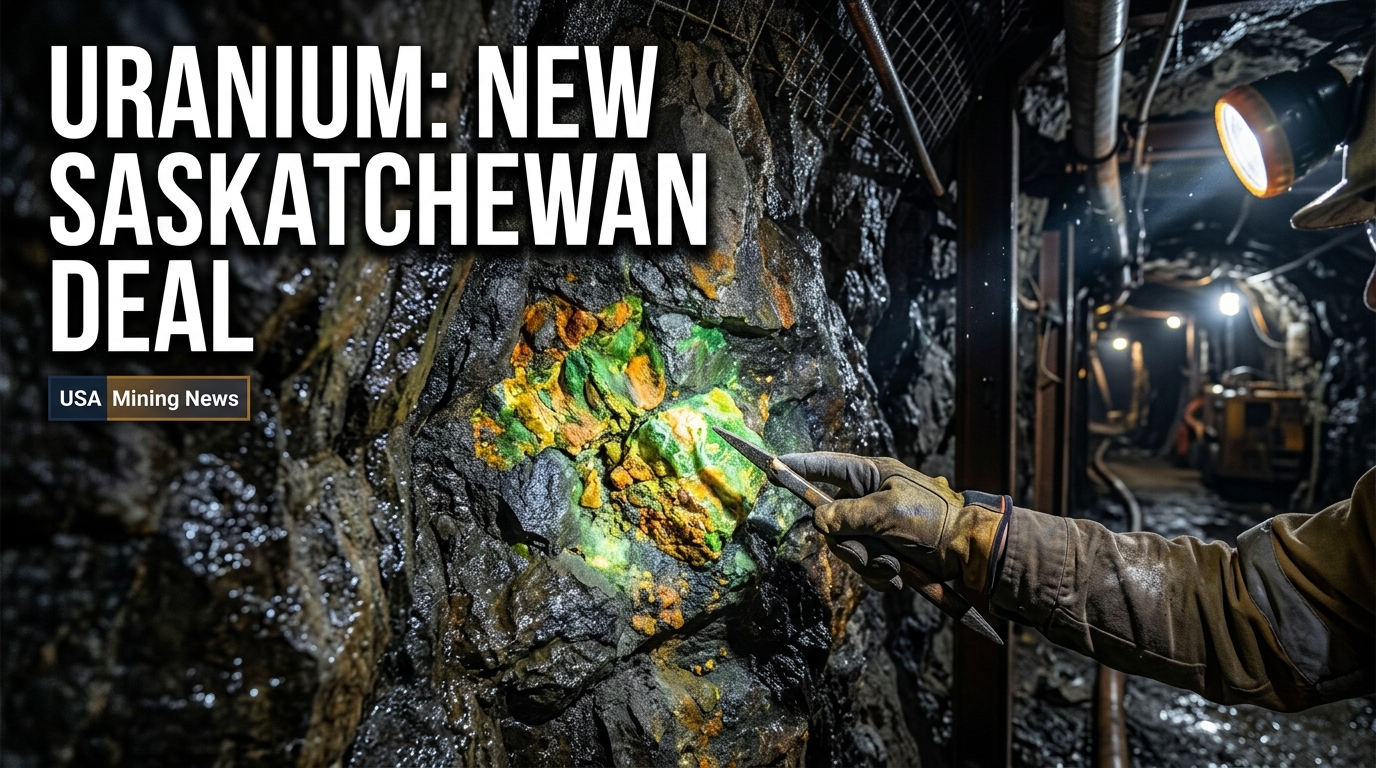
July 17, 2026 – In a significant development for Canada’s burgeoning uranium sector, Skyharbour Resources, a leading explorer in the prolific Athabasca Basin region, has announced the signing of a non-binding Letter of Intent (LoI) with Purecore Metals. This agreement paves the way for Purecore Metals to potentially option up to a 100% interest in Skyharbour’s Yurchison uranium property, strategically situated in the mineral-rich Wollaston Domain of Northern Saskatchewan. The transaction, officially revealed today by Skyharbour, underscores the continued strategic importance of Saskatchewan for critical mineral exploration and development, particularly for uranium in a tightening global market.
A Strategic Alliance for Exploration
The LoI details a framework for Purecore Metals to acquire an interest in 22 contiguous mineral claims, encompassing a substantial 35,029 hectares (approximately 86,558 acres) of mineral tenure. This agreement represents a calculated move for both companies: for Skyharbour, it potentially de-risks and advances one of its numerous projects by bringing in a partner; for Purecore Metals, it offers an entry into one of the world's most prospective uranium regions. The Yurchison property holds considerable promise, lying approximately 75 kilometers (km) south of Cameco’s renowned Rabbit Lake operation, one of Canada’s longest-running uranium mines. The property’s accessibility is further enhanced by Highway 905, which conveniently crosses directly through the claim block, a critical advantage for exploration logistics in remote northern regions.
Geological Prospectivity in the Wollaston Domain
The geological setting of the Yurchison property is particularly compelling for uranium exploration. It is situated within the esteemed Wollaston Domain, a geological belt renowned for hosting significant basement-type uranium deposits, many of which extend beyond the traditional boundaries of the Athabasca Basin itself. The property's geology is characterized by Wollaston Supergroup metasedimentary gneisses, which are of particular interest due to their typical association with high-grade uranium mineralization. Within this framework, areas exhibiting graphitic pelitic gneisses in close proximity to Archean granitic rocks are considered highly prospective. This geological juxtaposition creates ideal conditions for the concentration of uranium and other associated minerals, forming the structural and geochemical traps necessary for economic deposits.
The presence of graphitic gneisses is especially significant. Graphite acts as a reducing agent, precipitating uranium from hydrothermal fluids as it moves through fault zones and fracture systems. This mechanism is a hallmark of many high-grade unconformity-related and basement-hosted uranium deposits found throughout the Athabasca Basin and the broader Wollaston Domain.
Historical Context and Modern Revival of Exploration
The Yurchison property is not a new discovery; it has a history of exploration dating back several decades. Most of the extensive historical work, which included various airborne and ground geophysical surveys, prospecting, geological mapping, sampling, and drilling, was conducted prior to the year 2000. While these earlier programs laid fundamental groundwork, modern exploration techniques, particularly advanced geophysics and geochemical analysis, often provide a much clearer picture of subsurface mineralization.
Notably, historical prospecting efforts near identified trenches yielded encouraging results for uranium. Specifically, samples from outcrop and float material revealed uranium mineralization ranging from 0.09% to 0.30% triuranium octoxide (U3O8), the primary commercially traded form of uranium. In addition to uranium, these samples also returned significant molybdenum (Mo) values, ranging between 2,500 parts per million (ppm) and 6,400 ppm. Molybdenum is often a pathfinder element for certain styles of uranium mineralization and itself holds value as an industrial metal. Furthermore, past exploration has indicated the property's potential to host not only basement-type uranium deposits but also other valuable mineral types, including copper and zinc, suggesting a broader polymetallic potential.
More recent exploration initiatives by Skyharbour, conducted in 2022 and 2023, signal renewed interest and a modern approach to unlocking the property's potential. These programs included comprehensive airborne electromagnetic, magnetic, and radiometric surveys. Such surveys are crucial for identifying subsurface conductors (which can indicate graphitic zones or fault structures), magnetic anomalies, and direct radiometric signatures that point to uranium accumulation. The interpretation of this contemporary geophysical data will undoubtedly guide future drilling campaigns, providing precise targets for testing the extent and grade of mineralization.
Skyharbour Resources: A Dominant Player in the Athabasca Basin
Skyharbour Resources has established itself as a prominent exploration company within the Canadian uranium space, particularly focused on the Athabasca Basin region. The company boasts an extensive portfolio of uranium exploration assets, totaling 43 separate projects. Cumulatively, these projects represent a substantial footprint of over 662,887 hectares of mineral tenure, demonstrating Skyharbour’s strategic commitment to identifying and developing new uranium resources. Their business model often involves optioning out projects to partner companies, allowing for broader exploration across their vast land package while conserving capital and leveraging the expertise of collaborators like Purecore Metals. This strategy is critical in the capital-intensive world of mineral exploration, spreading risk and maximizing the potential for discovery.
The Uranium Market and Strategic Importance
The decision by Skyharbour and Purecore Metals to advance exploration on the Yurchison property comes at a time of renewed global interest in nuclear power and, consequently, in the security of uranium supply. As nations worldwide grapple with climate change targets and seek reliable, carbon-free energy sources, nuclear energy is experiencing a renaissance. This global shift is driving demand for uranium, with prices reflecting increasing market tightness. The Athabasca Basin, with its uniquely high-grade uranium deposits, remains the world's premier jurisdiction for primary uranium production.
Projects like Yurchison, even at an early exploration stage, are therefore strategically important. They represent the future pipeline of supply that will be crucial to meet long-term demand. For junior explorers like Purecore Metals, securing an interest in a property within such a proven domain offers significant upside potential, attracting investor interest in a commodity whose market fundamentals are strengthening. The option agreement highlights the continuing confidence in Saskatchewan's geological prospectivity and its role as a leading global supplier of nuclear fuel.
The Path Forward: Due Diligence and Definitive Agreement
The non-binding LoI represents an initial, crucial step in what could become a long-term partnership. The finalization of the transaction remains subject to several standard conditions that are customary in the mining industry. These include a thorough due diligence process by Purecore Metals, allowing them to meticulously review all existing data, conduct site visits, and assess the technical and financial viability of the project. Following successful due diligence, both Skyharbour and Purecore will need to agree upon and execute definitive terms for the mineral property option agreement.
Furthermore, the transaction is contingent upon receipt of necessary board approvals from both companies, ensuring alignment with their respective corporate strategies. Any required regulatory clearances must also be obtained, a standard procedure for significant mineral property transactions in Canada. Once these conditions are met, a definitive agreement will formalize Purecore Metals' pathway to earning an interest in Yurchison, triggering committed exploration expenditures and potential staged payments to Skyharbour Resources. The outcome of these negotiations will be closely watched by industry observers, as it could mark the beginning of an intensified exploration push in a promising region of Northern Saskatchewan.