Tali Resources Launches Major 9,000-Meter Drill Campaign Targeting Critical Minerals in Central Australia
October 14, 2026 – Tali Resources, an emerging player in the Australian exploration landscape, is poised to launch a substantial 9,000-meter aircore drilling program in central Australia. This ambitious initiative, scheduled to commence in October, is designed to thoroughly test a series of high-priority geophysical and geological anomalies across two distinct and highly prospective mineral trends: the Don Juan-Alakol trend and the Central Australian Suture. The program underscores the increasing global focus on securing supplies of critical minerals essential for advanced technologies and the global energy transition.
Tali Resources Embarks on Extensive Drilling Program in Central Australia
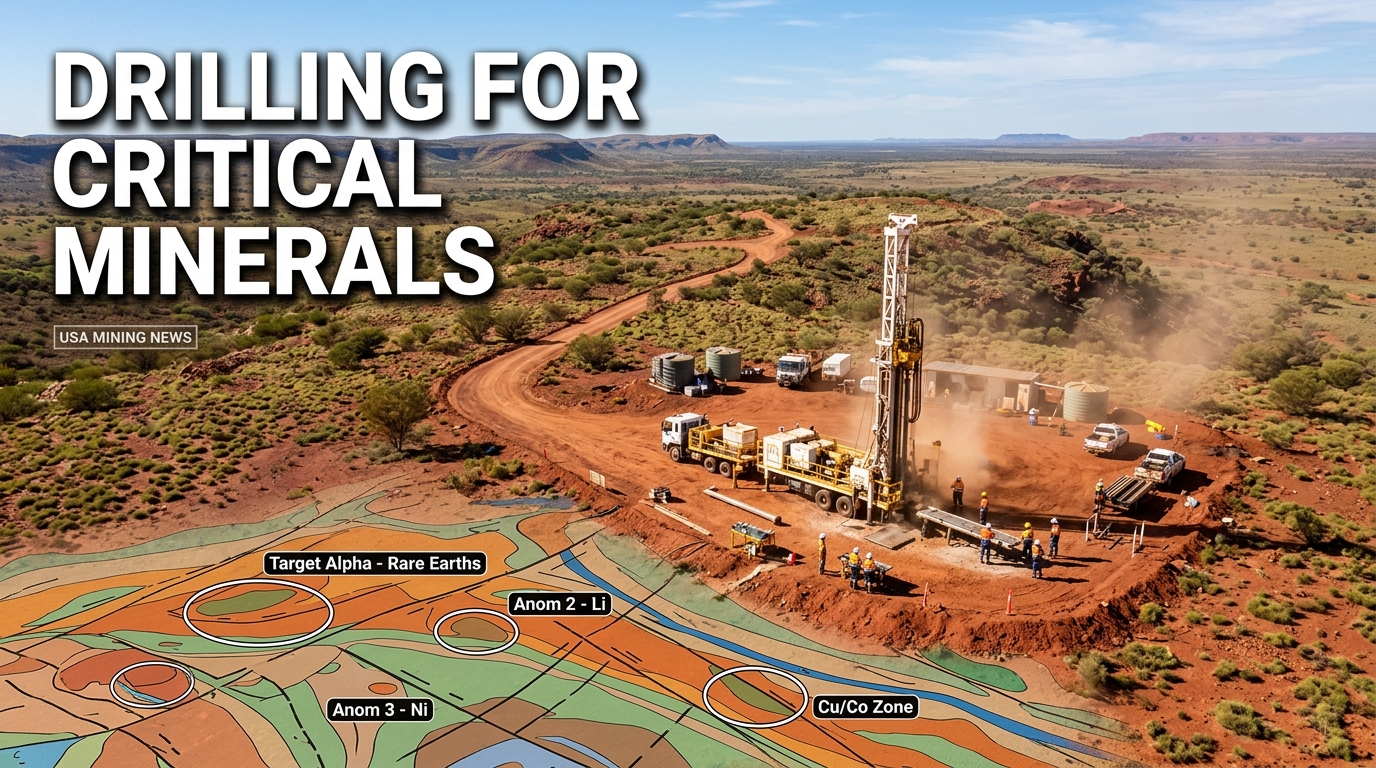
The core of Tali Resources' current exploration strategy is encapsulated in this extensive drilling campaign, which will employ aircore methods across approximately 9,000 meters. This program represents a significant investment in evaluating the mineral potential of a vast and largely underexplored region of central Australia. The overarching goal is to define the subsurface geology and assess the presence of economic concentrations of critical minerals.
Specifically, the drilling will target a total of twelve distinct anomalies. Seven of these are situated within the compelling 45-kilometer-long Don Juan-Alakol alkaline ultramafic intrusive system, a geological feature that has garnered significant attention for its potential to host carbonatite-associated mineralization. The remaining five targets are located along the Central Australian Suture, another geological domain known for its prospectivity.
Targeting the 45km Don Juan-Alakol Alkaline Intrusive System
The Don Juan-Alakol trend will be the primary focus of the initial phase of drilling, with approximately 5,500 meters allocated to test previously undrilled anomalies within this extensive 45-kilometer-long alkaline ultramafic intrusive system. The selected targets include Don Juan South-East, Don Juan East, Don Juan South, Don Juan West, and several specific locations within the Alakol prospect. These zones were pinpointed following detailed gravity and magnetic survey data, which revealed features indicative of multiple intrusive bodies. In the context of alkaline intrusive systems, such geophysical signatures are often direct indicators of significant mineralizing potential.
The geological underpinnings of this prospect are particularly compelling. The Don Juan and Alakol prospects lie within an ultramafic intrusive system that has been confirmed to host aillikite. Aillikite is a rare, potassium-rich ultrabasic lamprophyre rock type, which is of critical importance because it is commonly found in close spatial and temporal association with carbonatite deposits. Carbonatites themselves are igneous rocks composed of more than 50% carbonate minerals, and they are globally recognized as the primary source for a suite of high-value elements, including niobium, rare earth elements (REEs), titanium, phosphorus, and, in some instances, copper mineralization.
Rhys Bradley, Managing Director of Tali Resources, articulated the significance of these findings, stating, “Our review of the Don Juan-Alakol trend has reinforced the scale and prospectivity of this 45km-long alkaline intrusive system. Historical drilling intersected aillikite in seven of eight holes, a rock type commonly found proximal to carbonatites, both globally and within the West Arunta.” This statement underscores the strong geological confidence driving Tali Resources' current exploration strategy, leveraging a well-established global understanding of critical mineral deposit models.
The presence of aillikite, combined with the extensive geophysical anomalies, suggests that Tali Resources is systematically exploring a system with considerable potential for multiple critical minerals. The specific commodities often linked to such geological settings – niobium, titanium, and phosphorus – are vital for steel production, aerospace, fertilizers, and a variety of high-tech applications. Rare earth elements, in particular, are indispensable for permanent magnets used in electric vehicles, wind turbines, and defense technologies, placing them at the forefront of global strategic mineral interests.
Expanding Exploration to the Central Australian Suture
Concurrent with the drilling efforts at Don Juan-Alakol, Tali Resources has planned an additional 3,500 meters of aircore drilling along the Central Australian Suture. This program will target five distinct prospects: Caspian North, Caspian North-East, Verde East, Verde West, and Hutt West. This region has also seen historical exploration, providing a valuable foundation for Tali Resources' current campaign.
Historical exploration efforts in the area, notably by Toro Energy in 2011, included detailed soil, rock chip, and lag sampling over the Don Juan prospect. The results from these earlier studies were highly encouraging, revealing significant responses for base metals such as nickel and chromium. Furthermore, these surveys identified anomalous concentrations of key pathfinder elements, including copper, arsenic, and antimony, which often indicate the presence of underlying economic mineralization.
Crucially, the historical rock-chip samples yielded particularly promising results for critical minerals, recording up to 3.2% total rare earth elements (TREEs). This figure is significant, especially considering the specific REEs identified: neodymium, dysprosium, terbium, praseodymium, and yttrium. These particular rare earths are classified as "heavy" and "light" rare earths, respectively, and are among the most strategically important due to their indispensable roles in high-strength magnets and advanced electronics. The presence of these elements at such concentrations in surface samples strongly suggests the potential for higher-grade rare earth mineralization within the broader intrusive complex, warranting the aggressive follow-up drilling planned by Tali Resources.
Geological Significance and Commodity Context
The exploration by Tali Resources is strategically positioned within a global landscape increasingly prioritizing the supply of critical minerals. Alkaline intrusive systems, particularly those associated with carbonatites, are renowned geological settings for a diverse suite of high-value elements. These systems are typically formed in stable continental rift environments, allowing for the deep-seated ascent of mantle-derived magmas that can concentrate incompatible elements to economic levels. The West Arunta region, where Tali Resources is active, has recently emerged as a significant frontier for critical mineral exploration in Australia, drawing parallels to other globally important carbonatite provinces.
The commodities targeted—rare earth elements, niobium, titanium, and phosphorus—are foundational to numerous industrial and technological applications. Rare earth elements are the bedrock of the green energy transition, powering electric vehicle motors, wind turbine generators, and sophisticated defense systems. Niobium is critical for high-strength low-alloy steel used in pipelines and structural components, while titanium finds application in aerospace and medical implants due to its strength-to-weight ratio and corrosion resistance. Phosphorus is, of course, essential for agriculture as a fertilizer and for various chemical processes.
Australia, already a leading producer of traditional commodities, is strategically positioning itself to become a major supplier of critical minerals, reducing global reliance on a concentrated few sources. Projects such as Tali Resources' Don Juan-Alakol and Central Australian Suture initiatives are vital steps in achieving this broader national and international objective, contributing to diversified supply chains and enhanced resource security.
Market Implications and Future Outlook
For Tali Resources, the success of this 9,000-meter drilling program could be transformative. Positive results, such as the intersection of significant carbonatite-hosted mineralization, would materially de-risk the project, potentially leading to a significant re-rating of the company and attracting further investment. The market for critical minerals, particularly rare earths, remains robust, driven by persistent demand growth and geopolitical considerations around supply chain resilience. New discoveries of high-grade, accessible deposits are highly sought after by end-users and investors alike.
The immediate next steps for Tali Resources will involve the diligent execution of the drilling program, followed by comprehensive laboratory analysis of the collected samples. This data will be crucial for understanding the precise mineralogy, grade, and spatial distribution of mineralization. Based on these results, the company will then plan subsequent phases of exploration, which could include infill drilling, metallurgical test work, and ultimately, the estimation of a maiden mineral resource. Such a progression would mark a significant milestone towards de-risking the project and moving it along the development pipeline.
For the broader mining industry and investors, Tali Resources’ program represents another compelling exploration play in Australia’s burgeoning critical minerals sector. The emphasis on high-tech metals and elements that are vital for future economies positions such projects favorably. As global economies continue their transition towards decarbonization and digitalization, the strategic importance of securing reliable sources of these raw materials will only intensify, making successful exploration campaigns like Tali Resources’ critically important.