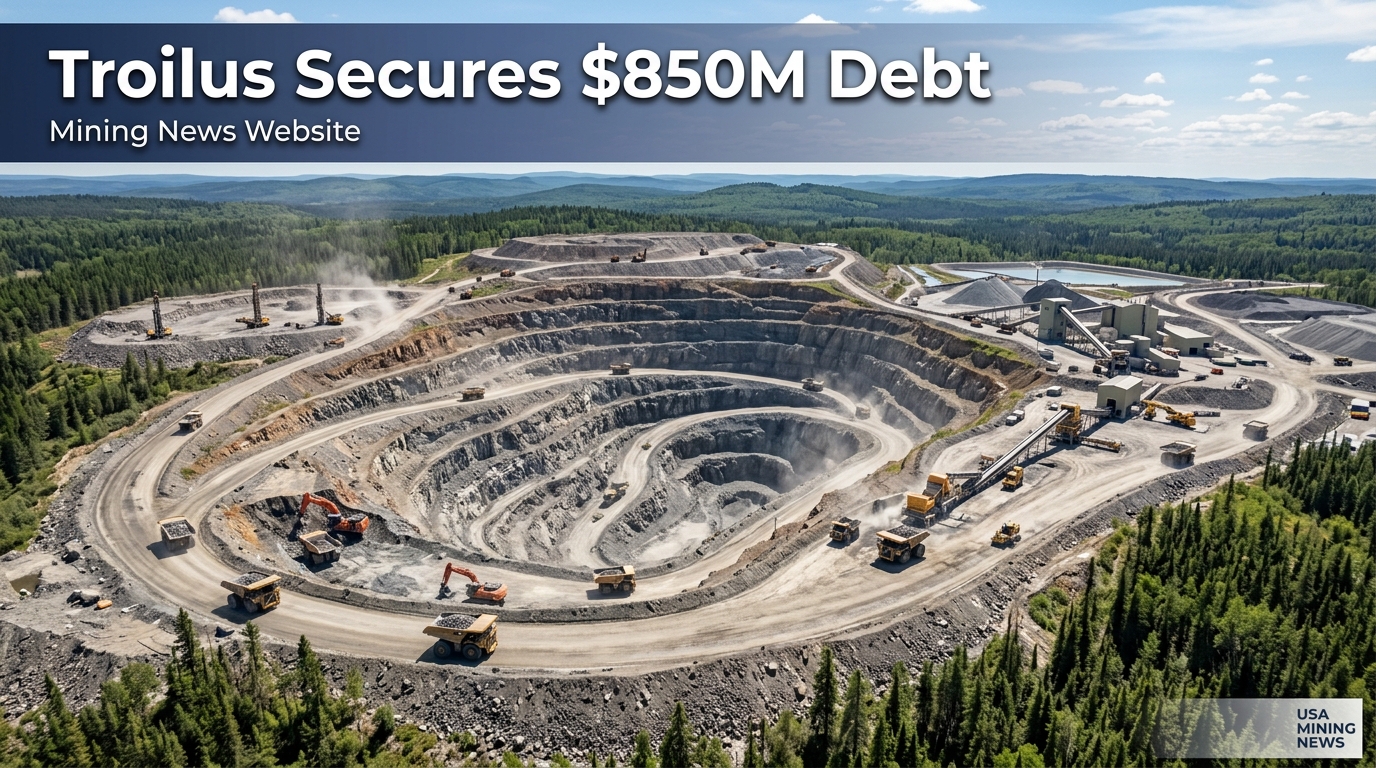
Québec, Canada – September 29, 2026 – Troilus Mining, a key player in Canada’s burgeoning mineral sector, has announced a major financial breakthrough for its flagship Troilus Gold-Copper Project. The company has successfully secured a credit-approved commitment letter totaling $850 million (approximately C$1.21 billion) in debt underwriting from leading international financial institutions, KfW IPEX-Bank and Société Générale. This pivotal development significantly de-risks the project's financing pathway and moves a substantial portion of the necessary capital from preliminary mandates to firm commitments, following extensive due diligence.
The commitment marks a critical juncture for the Troilus Gold-Copper Project, situated in the historically rich mining district of Québec, Canada. This funding is designed to underpin the substantial capital expenditure required for the project’s development and eventual construction, propelling it closer to becoming a significant new source of gold and copper production in North America. The announcement, dated September 29, 2026, underscores the rigorous work undertaken by Troilus and its financial advisors to establish the project’s viability and secure robust financial backing.
A Comprehensive Debt Financing Package
The $850 million commitment from KfW IPEX-Bank and Société Générale is a cornerstone of a larger, planned total debt financing package projected to reach $1.1 billion. This comprehensive financing strategy aims to cover the extensive costs associated with bringing a large-scale mining project from development to production. The remaining $250 million of the package is anticipated to come from Export Development Canada (EDC), a Canadian Crown corporation dedicated to supporting and developing Canada's export trade. However, EDC's contribution remains subject to its final internal approval process, a standard procedure for such significant governmental financial involvement.
According to Troilus, the credit-approved commitment letter represents a significant advancement from its previously announced debt financing mandate. The shift from a mandate, which typically outlines potential terms and interest, to a credit-approved commitment signifies that the lenders have completed their comprehensive evaluation and are prepared to provide the specified funds, subject to the fulfillment of certain conditions. This progression offers considerably more certainty regarding the project’s funding than earlier stages.
Rigorous Due Diligence and Structured Financing
The approval from KfW IPEX-Bank and Société Générale was granted only after an exhaustive due diligence process. This process, standard for large-scale project financing in the global mining industry, encompassed a thorough review of various critical aspects:
- Technical Factors: Assessment of the project’s geology, resource estimates, mining plan, processing methodology, and overall operational feasibility.
- Environmental Factors: Evaluation of potential environmental impacts, mitigation strategies, and adherence to stringent Canadian and international environmental regulations.
- Social Factors: Review of community engagement, Indigenous relations, labor practices, and the project’s broader socio-economic contributions and impacts.
- Financial Factors: Scrutiny of financial models, cost estimates, revenue projections, and the project’s overall economic robustness and ability to generate sufficient cash flows for debt repayment.
The debt commitments are structured as senior secured project finance facilities. This type of financing is specifically tailored for large-scale, capital-intensive projects, where repayment is primarily dependent on the project’s future cash flows. As with any complex financial agreement of this magnitude, the facilities are subject to a series of conditions precedent. These include, but are not limited to:
- The completion of the full $1.1 billion financing facility.
- Obtaining all necessary regulatory approvals from provincial and federal authorities in Canada.
- The agreement and execution of definitive legal documentation.
- Final approval by relevant export credit agencies (ECAs) – a critical component given the involvement of international banks and the potential for export-related equipment or services.
- Fulfillment of other standard conditions typically found in international project finance agreements.
Executive Perspective and Strategic Significance
Justin Reid, Chief Executive Officer of Troilus, emphasized the profound importance of this financing milestone. "These credit approvals represent one of the most significant financing milestones in Troilus’ development to date," Reid stated. He further elaborated, "The underwriting commitments from KfW IPEX-Bank and Société Générale reflect the depth of work undertaken to establish the project’s technical and economic foundations and advance our execution plan. With $850 million in credit-approved commitments, we have taken a substantial step toward assembling the funding required to build Troilus."
Mr. Reid’s comments underscore the rigorous effort involved in advancing a major mining project through the development pipeline, from initial exploration to securing substantial project financing. The confidence shown by major international financial institutions like KfW IPEX-Bank (a German state-owned development bank specializing in project and export finance) and Société Générale (a prominent French multinational investment bank) speaks volumes about the perceived quality and economic potential of the Troilus Gold-Copper Project.
Favorable Terms and Export Credit Agency Involvement
The financing package envisages significant support from European export credit agencies (ECAs). ECAs play a crucial role in facilitating international trade and investment by providing financial support, such as guarantees, insurance, and direct loans, to projects that involve exports from their respective countries. Their involvement often de-risks projects for commercial lenders and can help secure more favorable financing terms.
The proposed debt structure offers a cost-effective funding arrangement, featuring a repayment grace period of up to three years during the project's construction phase. This grace period is vital, as it allows the project to incur capital expenditures and progress towards production without the immediate burden of debt servicing, thus conserving cash flow in the critical early stages. Following construction, a ten-year amortisation period is planned, explicitly tailored to align with the expected cash flows generated by the project once it is operational. Such flexible repayment profiles are highly attractive to mining companies, as they allow for better management of financial obligations in line with the cyclical nature of commodity markets and operational ramp-up.
Final interest rates and other definitive terms will be announced once the definitive agreements are completed, but Troilus anticipates they will be in line with similar international project finance deals, reflecting the competitive nature of the global financial markets for well-structured mining projects.
Broader Industry Context and Future Outlook
Securing project finance of this scale is a complex undertaking, particularly in the current global economic climate, which has seen varying levels of capital availability for new mining ventures. The successful attainment of these credit-approved commitments for the Troilus Gold-Copper Project highlights several key industry trends:
- Demand for Gold and Copper: Both gold and copper are critical commodities with strong long-term demand fundamentals. Gold continues to be a safe-haven asset and a component in high-tech applications, while copper is indispensable for the global energy transition, electrification, and infrastructure development. Projects capable of delivering significant quantities of both minerals are highly attractive.
- Jurisdictional Appeal: Québec, Canada, remains one of the world's most attractive mining jurisdictions, known for its rich geological endowment, stable political environment, robust regulatory framework, and strong infrastructure. This reduces investment risk for international lenders and partners.
- Strategic Partnerships: The financing follows a significant long-term off-take arrangement signed in March 2026 with Boliden Commercial for copper-gold concentrate. Such off-take agreements are crucial for de-risking new mining projects, as they guarantee a buyer for future production and provide revenue certainty, which is highly appealing to lenders.
- ESG Integration: The thorough due diligence process covering environmental and social factors underscores the increasing importance of ESG (Environmental, Social, and Governance) considerations in securing project finance in the mining sector. Lenders are increasingly scrutinizing these aspects to ensure long-term project viability and responsible development.
Moving forward, Troilus and its financial advisor, Auramet International, are diligently working towards finalizing the facility agreements and completing the entire $1.1 billion financing package. This also involves ongoing engagement with European export credit agencies to secure the remaining components necessary for financial close and to facilitate a final investment decision (FID). Once FID is achieved, the project will transition into its intensive construction phase, marking the realization of years of exploration, development, and strategic planning.
The successful securing of $850 million in credit-approved debt commitments positions the Troilus Gold-Copper Project to become a significant contributor to Canada's mineral output and a valuable asset in the global supply chain for critical metals. This development will be closely watched by investors and industry professionals as Troilus navigates the final steps toward bringing this substantial project to fruition.