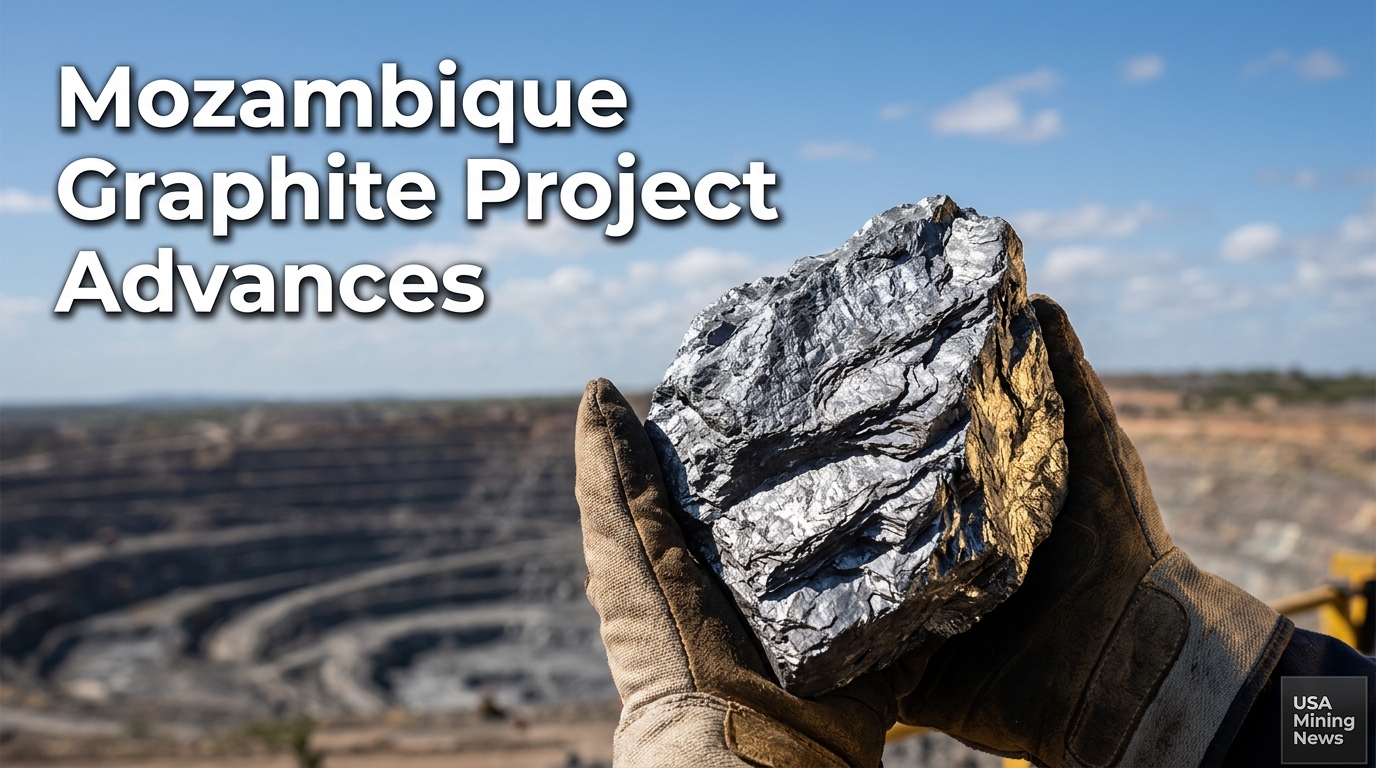
In a strategic move poised to significantly advance a major natural graphite project in Southern Africa, Total Graphite, an emerging force in the global critical minerals sector, has announced the appointment of Lycopodium Minerals Africa. The firm has been tasked with undertaking a comprehensive review and update of the existing feasibility work for Total Graphite’s flagship Montepuez Graphite Project, located in Mozambique. This development, confirmed on September 10, 2026, signals a renewed impetus to bring a substantial graphite resource into production, a crucial step for meeting the burgeoning demand for this essential industrial mineral.
The Montepuez Project: A Strategic Asset
The Montepuez Graphite Project represents a significant deposit within Mozambique's highly prospective Cabo Delgado province, an area increasingly recognized for its substantial graphite endowments. According to current estimates, the Montepuez site boasts an impressive mineral resource of 110.5 million tonnes (mt) at an average grade of 8.2% total graphitic carbon (TGC). This translates to an estimated 9.1 mt of contained graphite, positioning Montepuez as one of the larger undeveloped graphite projects globally.
Crucially, the project already holds a permit allowing for the production of up to 100,000 tonnes per annum (tpa) of graphite concentrate. This pre-existing permitting significantly de-risks the development timeline, as regulatory approvals can often be one of the most time-consuming hurdles for new mining operations. The sheer scale of the Montepuez resource and its permitted production capacity underscore its potential to become a cornerstone asset in the global graphite supply chain, particularly as demand for battery-grade graphite intensifies.
Lycopodium's Mandate: De-risking and Optimization
Lycopodium Minerals Africa, a highly reputable engineering and project management firm with extensive experience in the African mining sector, has been engaged to provide a thorough re-evaluation of the Montepuez project. Under the terms of their appointment, Lycopodium's scope of work is multi-faceted and aims to enhance both the technical robustness and economic viability of the project. Their immediate tasks include:
- Re-examining the Process Design and Flowsheet: A fundamental review of how graphite ore will be processed from run-of-mine to final concentrate. This ensures that the most efficient and cost-effective methods are employed, considering advancements in mineral processing technology since prior studies.
- Considering Alternative Processing Technologies: Evaluating new or different technological approaches that could potentially improve operational performance, reduce processing costs, enhance graphite recovery, or improve concentrate quality, thereby bolstering overall project economics.
- Conducting a Gap Analysis of Detailed Design Elements: Identifying any omissions or areas needing further definition in previously completed detailed engineering work. This ensures that all technical specifications are comprehensive and up-to-date, minimizing potential issues during the construction and operational phases.
- Assessing the Adequacy of Prior Metallurgical Testing: Reviewing the historical metallurgical test work to confirm its robustness and applicability to current processing strategies. This step is critical for validating expected recoveries and product specifications.
- Evaluating Early Site Works: An appraisal of existing infrastructure at the Montepuez site, which includes a base camp, crusher units, and power units. This assessment will determine their suitability for the updated project plan and identify any necessary upgrades or expansions.
This comprehensive review is designed to provide Total Graphite with an optimized, de-risked pathway forward. The initial results from this intensive phase of work are strategically targeted for delivery by November 2026. Following these findings, Total Graphite has indicated that a second phase will be initiated to formally update the feasibility study, a crucial document for securing project finance.
Building on Prior Work: The 2017 VES Framework
A key aspect of Montepuez's development strategy is its foundation on a modular development approach, initially outlined in an October 2017 Value Engineering Study (VES). This approach, which Total Graphite intends to use as its base scenario, proposes a phased expansion rather than a single, large upfront capital expenditure. Modular development is often favored in projects with significant capital requirements, as it allows for a more manageable initial investment, reduces upfront risk, and provides flexibility for expansion based on market conditions and operational performance.
The 2017 VES envisioned a two-stage development plan:
- Stage One: An initial production capacity of approximately 50,000 tpa of graphite concentrate, expected to achieve a purity of 96.7% total graphitic carbon (TGC). The pre-production capital expenditure (capex) for this initial stage was estimated at $42.3 million (approximately £31.2 million).
- Stage Two: An incremental expansion adding nearly 49,000 tpa of production capacity. This second stage was projected to require an additional capital expenditure of $27 million.
Cumulatively, this modular approach would bring the total production capacity close to the permitted 100,000 tpa, with a projected total capital expenditure of $69 million based on 2017 estimates. Total Graphite has acknowledged that these capital expenditure figures will be adjusted for cost inflation given the passage of time and global economic changes. However, the company remains confident that the project's inherent capital efficiency will remain highly competitive within the sector, a critical factor for investor appeal and long-term profitability.
Advantages of a Head Start
Christian Dennis, Chairman of Total Graphite, emphasized the inherent advantages of the Montepuez project's advanced state of development. "The appointment of Lycopodium marks an important step in advancing Montepuez back towards construction and production," Dennis stated. He further highlighted differentiating factors that set Montepuez apart from many other development-stage graphite projects:
- Existing Permitting: The project is already permitted for production of up to 100,000 tpa, bypassing a significant regulatory hurdle.
- Advanced Engineering: Approximately 60% of the detailed engineering work was historically completed, providing a strong foundation for Lycopodium’s review and update.
- Established Site Infrastructure: Initial site infrastructure, including a base camp, crusher units, and power units, has already been established, which will accelerate future construction efforts and reduce initial setup costs.
These pre-existing assets and completed work streams are invaluable, significantly reducing both the timeline and the inherent risks typically associated with greenfield mining projects. They demonstrate Total Graphite’s commitment to disciplined development and position Montepuez for a more rapid transition to construction and eventual production.
Market Context: Graphite's Growing Importance
The timing of Montepuez's advancement is particularly pertinent given the global trajectory of critical minerals demand. Graphite is a key component in the anodes of lithium-ion batteries, which power electric vehicles (EVs), portable electronics, and grid-scale energy storage systems. With the accelerating transition towards a decarbonized global economy, driven by widespread EV adoption and renewable energy infrastructure build-out, the demand for high-quality, sustainably sourced graphite is projected to surge dramatically over the coming decades.
Mozambique has emerged as a significant player in the global graphite market, alongside nations like China and Brazil. The country benefits from extensive high-grade flake graphite deposits, which are crucial for battery applications. Projects like Montepuez are vital for diversifying the global supply chain, reducing reliance on single-source suppliers, and ensuring a stable, ethical supply of this critical material to the burgeoning clean energy sector. The robust resource base and favorable logistics in Mozambique make it an attractive jurisdiction for graphite development.
Roadmap to Production: Financing and Construction
The updated feasibility study, following Lycopodium’s review, will serve as the cornerstone for Total Graphite’s efforts to secure project finance. A meticulously updated and robust feasibility study, reflecting current market conditions and optimized technical parameters, is essential for attracting investment from banks, private equity, and other financial institutions. The company’s stated goal is to leverage this updated study to secure the necessary funding, with a clear objective of resuming construction activities on site in 2027.
A 2027 construction restart would align Montepuez with other significant graphite projects aiming to come online in the latter half of the decade, a period when market analysts predict a substantial supply deficit if new projects do not materialize promptly. Successful financing and construction will allow Montepuez to contribute significantly to global graphite supply precisely when it is most needed.
Beyond Montepuez: The Balama Central Outlook
Total Graphite's strategic vision extends beyond Montepuez. The company also holds the Balama Central project, another promising graphite asset situated in northern Mozambique’s Cabo Delgado province. Recognizing the synergistic potential within its portfolio, Total Graphite has articulated plans to update the pre-feasibility study for Balama Central once the comprehensive review and update of Montepuez are successfully completed. This phased approach demonstrates a pragmatic strategy to optimize capital allocation and technical expertise across its asset base, ensuring a pipeline of future development opportunities within its core operating region.
Conclusion
The appointment of Lycopodium Minerals Africa by Total Graphite for the Montepuez Graphite Project represents a critical inflection point for the company and a significant development for the global graphite industry. With its substantial resource, pre-existing permits, and advanced engineering, Montepuez is well-positioned to capitalize on the rapidly expanding demand for battery-grade graphite. The diligent review and optimization process currently underway, coupled with a clear roadmap towards securing finance and resuming construction by 2027, underscore Total Graphite's commitment to transforming Montepuez into a key player in the supply of this indispensable critical mineral for the energy transition.