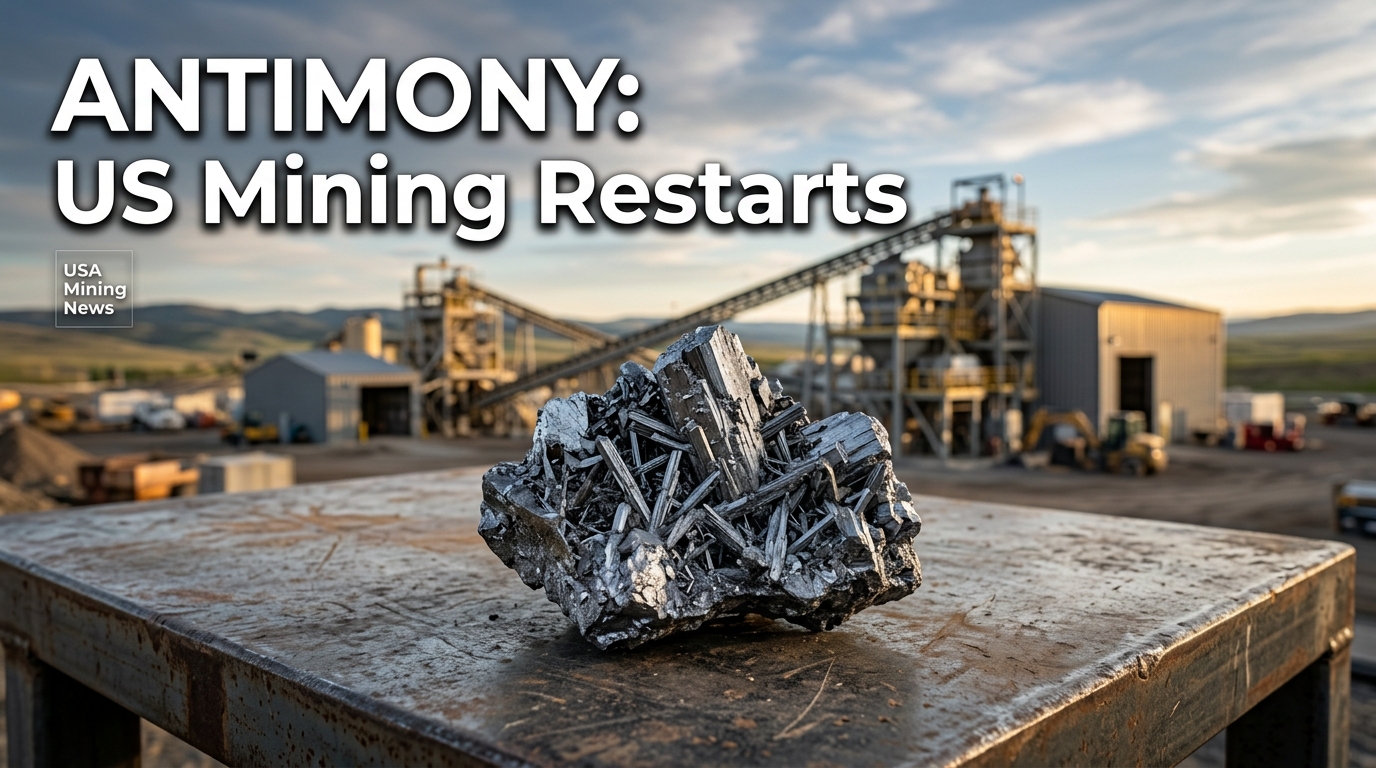
In a move signaling robust progress toward strengthening domestic critical mineral supply chains, United States Antimony Corp. (NYSE: UAMY) announced on Thursday, April 2, 2026, the resumption of mining activities at its Stibnite Hill property in Montana. This restart follows a strategic, near five-month operational halt initiated in November of the preceding year due to challenging weather conditions. The development is particularly significant given the United States' current reliance on foreign suppliers for antimony, a mineral designated as critical due to its indispensable role in national defense and advanced industrial applications.
A Strategic Restart for Domestic Antimony Production
The resumption of activities at Stibnite Hill represents a pivotal moment for United States Antimony and the broader American mining landscape. The company had previously ceased operations at the site in November, just weeks after receiving Montana state approval to commence mining raw ore and transport it for initial sampling at a flotation mill located in Radersburg. The halt was necessitated by the severe weather conditions typical of Montana during the late autumn and winter months, underscoring the seasonal challenges inherent in northern latitude mining operations.
However, an earlier-than-expected return to full-scale mining has been attributed by UAMY to “milder weather conditions” and “minimum snowfall” experienced in Montana, allowing for an expedited restart of operations. This positive environmental turn contrasts sharply with the conditions that typically extend such halts, providing UAMY with additional operational window in 2026. The overarching strategy for the mined ore is comprehensive: material extracted from Stibnite Hill will be processed into antimony concentrates at the Radersburg facility. These concentrates will then be transported to UAMY’s existing smelter in Thompson Falls, Montana, where they will undergo further refinement to produce finished antimony products ready for sale to commercial and defense-sector customers.
The Stibnite Hill property itself holds historical significance, having operated as a productive antimony mine for 15 years, from the late 1960s to the early 1980s. Its reactivation is not merely about restoring past production but about establishing a modern, integrated supply chain. With the restart, United States Antimony aims to position itself as the first fully integrated antimony operation outside of the geopolitical influence of China and Russia, two nations that currently dominate global antimony production and supply.
The Criticality of Antimony: Securing a Vital Supply Chain
Antimony is a specialty mineral with a diverse array of essential industrial applications, many of which are directly tied to national security. Its unique properties make it indispensable across a spectrum of defense technologies and advanced manufacturing processes. Key industrial uses of antimony include:
- Flame Retardants: Antimony compounds are widely used as synergists with halogenated flame retardants in plastics, textiles, and coatings, critical for enhancing safety in defense equipment, communication infrastructure, and public spaces.
- Communication Equipment: Essential components in various electronic devices, including those used in military communication systems.
- Night Vision Goggles: Integral to the intricate electronics and optical coatings required for advanced night vision technologies.
- Ammunition: Used in specialized lead alloys for hardening bullet cores and in primer formulations.
- Laser Sighting: Components for precision targeting systems in military and tactical applications.
The geopolitical significance of antimony cannot be overstated. Currently, the United States has no domestic mined production of antimony, rendering it entirely reliant on foreign suppliers for this critical mineral. This dependency poses significant supply chain vulnerabilities, particularly given that a substantial portion of global antimony supply originates from countries like China and Russia. The absence of a domestic supply chain for a mineral so vital to defense applications presents a strategic imperative for diversification and localization of production.
United States Antimony plays a unique role in addressing this challenge. The company’s Thompson Falls facility is currently the only operational antimony smelter in the United States. Furthermore, UAMY also owns the only other antimony smelter in North America, located in Madero, Mexico. This gives United States Antimony a near-monopoly on smelting capacity in the region, positioning it as a pivotal player in any effort to re-establish a robust, secure domestic antimony supply.
USA Antimony's Integrated Approach: From Mine to Market
The strategic vision underpinning UAMY’s Stibnite Hill project is one of complete vertical integration. By controlling the entire process from raw material extraction to finished product, the company aims to ensure supply security, quality control, and cost efficiency. The Thompson Falls smelter is a cornerstone of this integrated strategy, boasting an impressive production capacity. According to UAMY’s website, the facility is capable of producing approximately 15 million pounds of antimony oxide or 5 million pounds of antimony metal annually. Reflecting an ambitious growth trajectory and aiming to meet anticipated demand, the company has confirmed that an expansion of the Thompson Falls smelter’s production capacity is already underway.
The 2026 mining program at Stibnite Hill builds upon initial successes from the previous year. During last year’s mining period, approximately 800 tons of antimony ore were successfully transported from the mountain to the Radersburg facility for processing. Critically, in October of the previous year, the company had reported early indications that the material extracted from Stibnite Hill could be upgraded to meet stringent military specifications. This potential to produce military-grade antimony is a significant value proposition, directly addressing national defense needs and reinforcing the strategic importance of this domestic resource.
Operational Enhancements and Early Successes
Beyond simply restarting operations, United States Antimony is implementing several key changes to optimize its 2026 mining program, demonstrating a commitment to efficiency, environmental stewardship, and advanced data collection. These enhancements are designed to improve both operational effectiveness and the long-term sustainability of the mining site:
- Concurrent Reclamation Program: A notable environmental initiative for 2026 involves the use of a chipper to process smaller brush and branches generated during mining activities. This organic material will be converted into mulch and directly applied in the concurrent reclamation program. This approach is expected to aid in faster re-vegetation, contributing to quicker environmental recovery of disturbed areas.
- Improved Site Access: The mulching process will also serve a practical purpose by providing better access to existing roads and trails where 2026 mining activities are commencing, enhancing operational logistics and safety.
- Advanced Mapping and Data Collection: To improve geological understanding and resource management, UAMY plans to establish base stations on adjacent mountain tops. These stations will house GPS transmitters that will enable field crews to utilize portable data collectors. This system will facilitate more accurate mapping and recording of antimony vein intercepts, allowing for precise projection of antimony veins both on strike and down dip, thereby optimizing future exploration and mining efforts.
The early indications of the ore's quality, coupled with the technical advancements planned for 2026, suggest a robust operational outlook for Stibnite Hill. The ability to potentially produce material suitable for military specifications could significantly elevate the project's strategic value and market positioning.
Market Reception and Future Outlook
The announcement of the mining restart was met with a positive reaction from the financial markets. Shares of United States Antimony advanced 4.5% following the news, effectively erasing any losses the company's stock had incurred earlier in the week. This market response underscores investor confidence in UAMY’s operational capabilities and its strategic positioning within the critical minerals sector.
Further solidifying its presence on the financial stage, United States Antimony recently uplisted to the New York Stock Exchange (NYSE), a move that typically provides enhanced visibility, liquidity, and access to a broader investor base. The company currently boasts a market capitalization of $1.2 billion, reflecting its significant stature and potential within the North American mining industry.
Looking ahead, United States Antimony’s Stibnite Hill project is poised to deliver tangible benefits for US critical mineral independence. The integrated mine-to-market structure, coupled with the proven smelting capacity at Thompson Falls and ongoing expansion, positions UAMY as a cornerstone in the domestic supply chain for this vital resource. As global geopolitical dynamics continue to shift, the emphasis on securing reliable, localized supplies of critical minerals will only intensify. UAMY’s proactive steps in Montana represent not just a corporate achievement but a strategic national asset in the making, promising to reduce reliance on foreign entities and bolster the resilience of American defense and industrial sectors.