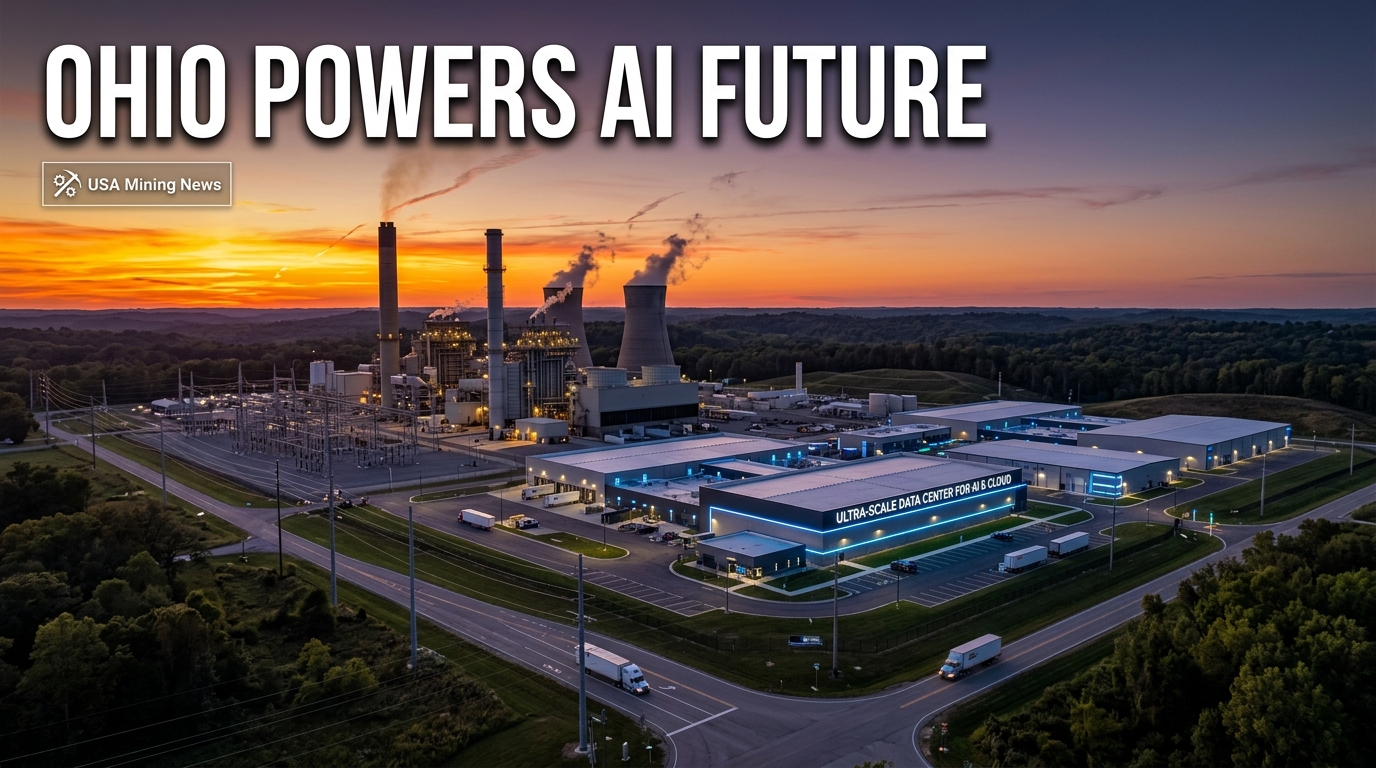
The landscape of American energy and technology is undergoing a significant transformation, driven by strategic public-private partnerships aimed at securing the nation's leadership in the burgeoning field of artificial intelligence (AI). On March 20, 2026, the U.S. Department of Energy (DOE), in concert with the U.S. Department of Commerce (DOC), unveiled a groundbreaking collaboration with SoftBank Group company SB Energy and AEP Ohio. This unique alliance is set to repurpose significant federal land in Southern Ohio, specifically the Portsmouth Site in Pike County, to not only modernize energy infrastructure but also to establish a formidable advanced computing hub.
Driving America’s AI Future: A Multi-Billion-Dollar Infrastructure Push in Southern Ohio
The core of this multi-faceted partnership is the planned development of 10 gigawatts (GW) of new power generation, an overwhelming 9.2 GW of which will be derived from natural gas. This substantial energy output is earmarked to energize an equally ambitious 10 GW data center complex slated for the Portsmouth Site. Notably, all infrastructure improvements and energy generation are designed to be at no direct cost to American ratepayers, a principle underpinning President Trump’s Ratepayer Protection Pledge. This innovative approach reflects a broader strategic directive to leverage federal assets—including land and policy frameworks—to foster economic growth, enhance national security, and solidify the United States' competitive edge in critical technological domains.
U.S. Energy Secretary Chris Wright articulated the administration's vision, stating, “Thanks to President Trump, the U.S. government is leveraging its assets—like our federal lands—to add power generation, create jobs, and ensure the United States wins the AI race.” He underscored the collaborative spirit, adding, “I’m pleased to be working with our partners at SoftBank and AEP Ohio on this important project. By bringing new power online and upgrading our existing infrastructure, this investment supports the AI boom and cutting-edge technologies while strengthening our energy system and helping keep costs down for the American people.”
This initiative is a critical component of broader economic strategies, with portions previously announced as part of President Trump’s U.S.-Japan Strategic Trade and Investment Agreement. U.S. Commerce Secretary Howard Lutnick highlighted the international dimension, noting, “Our Japanese partnership is a direct result of President Trump’s America First trade policies. Japan has committed to invest $550 billion across America. With this historic trade deal we are reindustrializing the country through critical projects like this $33 billion dollar power project in Portsmouth, Ohio.” Secretary Lutnick further indicated the scale of these efforts by referencing recent announcements of "additional mega projects in Alabama, Pennsylvania, Tennessee and Texas."
The Architecture of Power: Generating 10 GW for the Digital Age
The financial commitment to this project is substantial, totaling approximately $37.5 billion. A significant portion, $33.3 billion, comes from Japanese funding, dedicated specifically to the development of the 9.2 GW of natural gas generation facilities. Complementing this, SB Energy is investing an additional $4.2 billion alongside AEP Ohio to upgrade and construct new high-capacity transmission lines across Southern Ohio. This latter investment is crucial, ensuring robust grid connectivity and the efficient distribution of power, with SB Energy committing to making excess transmission and generation capacity available to the broader grid, thereby helping to stabilize and potentially lower local utility rates. AEP Chairman, President, and Chief Executive Officer Bill Fehrman emphasized this aspect, stating, “AEP Ohio is proud that this partnership will bring critical infrastructure to Appalachian Ohio. If it were not for the partnership between all parties – the Administration, SoftBank and our team – this type of investment would not be possible.”
The strategic choice of natural gas for the primary generation capacity reflects its current role as a flexible and relatively low-emission fossil fuel that can rapidly scale to meet demand, complementing intermittent renewable sources. This 10 GW capacity, destined to power a colossal data center development, represents a substantial industrial load, indicative of the burgeoning energy demands of advanced computing and AI. Masayoshi Son, Chairman and CEO of SoftBank Group Corp., captured the essence of this, asserting, “AI will transform every industry, and the PORTS Technology Campus will help deliver the next-generation infrastructure needed to unlock those breakthroughs.”
Strategic Imperatives: AI Leadership, National Security, and Economic Revitalization
This initiative is designed to deliver a broad spectrum of benefits:
- Access to affordable energy: Through significant grid upgrades and the introduction of excess capacity onto the grid, directly contributing to lower consumer electricity prices across the region.
- Job creation and workforce development: The project is expected to create thousands of American jobs, spanning construction, operation, and maintenance, and will contribute to revitalizing the domestic manufacturing base, particularly in the Appalachian Ohio region.
- Innovation and scientific discovery: The establishment of a large-scale data center provides dedicated support for advanced research, including critical fields such as fusion energy, quantum computing, and initiatives vital to national security.
- Environmental cleanup and remediation: The project advances the revitalization of the Portsmouth site, a location that historically played a pivotal, albeit environmentally sensitive, role in U.S. national security. Assistant Secretary of Environmental Management Tim Walsh affirmed, “By capitalizing on investments in America and federal land assets, the partnership will safely advance restoration and revitalization of the Portsmouth site with enormous economic benefit to the region and the country.”
- Community and economic development: Ensuring direct benefits to the residents and businesses of Southern Ohio and the broader regional economy through sustained investment and growth opportunities.
Implications for the Mining Sector: Fueling the Future Grid and Digital Infrastructure
While the immediate focus of this announcement is on power generation and data centers, the implications for the mining sector are profound and multi-layered. The sheer scale of this project, particularly the commitment to 9.2 GW of new natural gas-fired generation, directly translates to a significant, long-term demand for natural gas. This will bolster the upstream natural gas mining and extraction industry, along with associated infrastructure such as pipelines, processing facilities, and storage. For mining companies engaged in natural gas production, this represents a substantial, stable market opportunity, potentially catalyzing further investment in exploration and development across key producing regions in the United States.
Furthermore, the $4.2 billion investment in upgrading and building new transmission lines will drive demand for essential raw materials. Copper, known for its superior electrical conductivity, will be critically important for wires and cables. Aluminum will also see increased demand for high-voltage transmission lines, while steel will be crucial for towers, substations, and other structural components. The specialized nature of modern grid infrastructure also implies requirements for a range of other minerals, from silicon in various electronic components to potentially rare earth elements in advanced power technologies. Similarly, the construction and operation of a 10 GW data center complex will be incredibly mineral-intensive, requiring vast quantities of copper for internal wiring, circuit boards, and cooling systems; silicon for semiconductors; and precious metals like gold, silver, and platinum group metals for connectors and specialized components. The domestic manufacturing base supporting these technologies will, in turn, rely on a robust and secure supply chain of mined raw materials.
From an operational expenditure perspective, the promise of lower electricity costs for businesses across the region, due to grid upgrades and excess capacity, could significantly benefit existing or future mining operations in Ohio and the surrounding Appalachian states. Energy is typically one of the largest operating costs for mining companies, and reliable, affordable power supply can dramatically impact project feasibility, competitiveness, and profitability. The "reindustrialization" theme articulated by Secretary Lutnick hints at a broader resurgence of heavy industry, including potential demand for iron ore, coking coal, and industrial minerals like limestone and aggregates, as these foundational sectors rebuild and expand.
Finally, the project’s linkage to national security and advanced research in areas like fusion and quantum computing underscores the strategic importance of critical minerals. These high-tech sectors rely on a diverse array of specialty metals and rare earth elements, many of which face supply chain vulnerabilities. By fostering an environment of innovation and domestic technological leadership, this Ohio project implicitly reinforces the urgent need for domestic sourcing, processing, and recycling strategies for these strategic minerals, thereby shaping policy and investment in the broader mining industry.
Project Timeline and Future Outlook
Construction on this transformative project is slated to commence within the current year, 2026. The rapid timeline signals an urgency to meet the escalating demands of the AI revolution and to capitalize on the strategic advantage offered by the Portsmouth Site's unique characteristics and the collaborative framework. This partnership between federal agencies and leading private sector entities—SoftBank, a global technology and investment giant, and AEP Ohio, a major utility provider—could serve as a blueprint for future large-scale infrastructure and technology initiatives across the United States. Its success is anticipated to have far-reaching effects, not only in consolidating America’s technological leadership but also in stimulating significant economic growth, enhancing energy resilience, and creating a robust, skilled workforce capable of powering the next generation of industrial and digital innovation.
In essence, the Southern Ohio project is more than just a power plant and a data center; it is a declaration of intent. It signifies a national commitment to harnessing public and private resources to secure a future where affordable energy, advanced computing, economic prosperity, and national security are inextricably linked, with the mining industry playing an indispensable, foundational role in supplying the necessary raw materials.