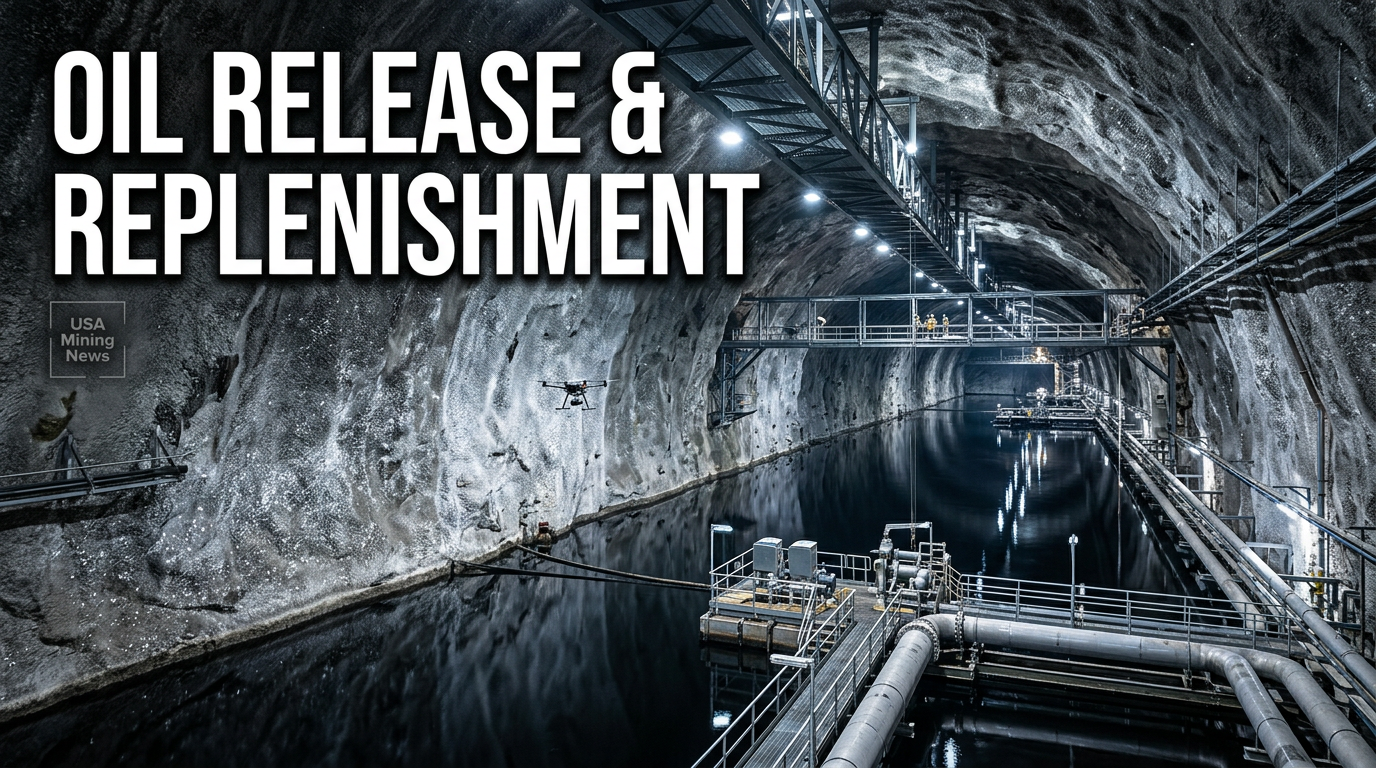
The United States, through the Department of Energy, announced on March 11, 2026, a substantial release of 172 million barrels from its Strategic Petroleum Reserve (SPR). This action, authorized by President Trump and part of a larger 400-million-barrel coordinated global release by 32 International Energy Agency (IEA) member nations, aims to lower energy prices and enhance global energy security. The U.S. plans to fully replenish its reserves with 200 million barrels within the next year at no cost to taxpayers, underscoring a proactive approach to strategic energy management.
U.S. Unveils Major Strategic Petroleum Reserve Release in Coordinated Global Effort to Stabilize Oil Markets
WASHINGTON D.C. – In a decisive move signaling a proactive stance on global energy stability, the United States announced on March 11, 2026, its intention to release 172 million barrels of crude oil from the Strategic Petroleum Reserve (SPR). This significant drawdown is part of a larger, coordinated international effort, with 32 member nations of the International Energy Agency (IEA) agreeing to collectively release 400 million barrels of oil and refined products from their respective strategic reserves. The initiative, championed by President Trump and confirmed by U.S. Secretary of Energy Chris Wright, aims squarely at mitigating rising energy prices and reinforcing national energy security amidst ongoing global complexities.
Immediate Response to Market Pressures: The Coordinated IEA Release
The core of this strategic maneuver is a unanimous agreement among IEA member states to inject a substantial volume of crude and petroleum products into the global market. Secretary Wright's statement, delivered on March 11, 2026, emphasized that this collective action responds directly to President Trump’s request to lower energy prices for consumers and industries worldwide. The impending release represents a significant intervention, designed to calm volatile commodity markets and provide much-needed relief from elevated fuel costs.
The U.S. Department of Energy (DOE), under President Trump’s authorization, will commence its 172-million-barrel release as early as "next week." The process is projected to span approximately 120 days, allowing for a phased and managed discharge of crude oil into the market. This measured pace is crucial for preventing supply chain bottlenecks and ensuring that the market can absorb the additional volume effectively without creating new instabilities. The total IEA release of 400 million barrels, encompassing both crude oil and refined products, highlights the agency’s capacity for rapid, coordinated action in times of perceived supply shortfalls or price spikes. For the mining industry, which relies heavily on diesel and other petroleum products for its extensive fleet of heavy machinery and transportation logistics, such a release could translate into notable reductions in operational expenditure (OPEX) in the coming months.
The Strategic Petroleum Reserve: A Critical Pillar of U.S. Energy Security
The Strategic Petroleum Reserve, established in the aftermath of the 1973-74 Arab oil embargo, serves as the world's largest emergency crude oil supply. Its primary purpose is to protect the U.S. and its allies from severe supply disruptions, acting as a crucial buffer against geopolitical shocks or natural disasters that might imperil the nation’s energy lifeline. The SPR is strategically located in a series of underground salt caverns along the Texas and Louisiana Gulf Coasts, offering secure and economically efficient storage for various grades of crude oil.
Historically, the SPR has been tapped on several occasions, including during the Persian Gulf War in 1991, following Hurricane Katrina in 2005, and as part of IEA-coordinated releases in 2011 (during the Libyan civil war) and more recently in 2022 following Russia's invasion of Ukraine. Each deployment underscores the reserve's vital role not only as a physical stockpile but also as a powerful tool for signaling market confidence and deterring speculative trading. The current planned release of 172 million barrels is among the largest in the SPR’s history, reflecting the administration's assessment of current market conditions and geopolitical risks. The ability to deploy such a massive volume demonstrates the SPR's enduring capacity as the linchpin of American energy resilience. Managing this national asset "responsibly," as President Trump pledged, involves a delicate balance between drawing down reserves to address immediate crises and ensuring rapid, strategic replenishment to maintain long-term security.
Replenishment Plan: A Bold Strategy for Future Security
A key differentiator and an intriguing element of this announcement is the administration’s robust replenishment strategy. Secretary Wright explicitly stated, "the United States has arranged to more than replace these strategic reserves with approximately 200 million barrels within the next year — 20% more barrels than will be drawn down — and at no cost to the taxpayer." This commitment to replenish the SPR within a year, and to exceed the drawdown volume, signifies a calculated effort to strengthen America's energy posture for future contingencies.
The "no cost to the taxpayer" assurance suggests sophisticated financial or procurement mechanisms are being considered. Historically, SPR replenishment has involved open market purchases. Buying back oil when prices are anticipated to be lower than the sale price would effectively make the operation net-neutral or even profitable, thereby fulfilling the "no cost" promise. This strategy could also involve long-term supply agreements or innovative storage contracts. For domestic oil producers, this future demand of 200 million barrels presents a transparent signal of future market absorption, potentially encouraging investment in production capacity over the coming year. It also contrasts sharply with the "previous administration," which Secretary Wright implied "left America’s oil reserves drained and damaged," setting a clear policy differentiator on SPR management and energy independence.
Geopolitical Undercurrents: Energy Security and International Relations
Beyond pure market mechanics, Secretary Wright's statement waded into the choppy waters of international geopolitics, directly addressing the impact of certain state actors on global energy security. "For 47 years," he declared, "Iran and its terrorist proxies have been intent on killing Americans. They have manipulated and threatened the energy security of America and its allies. Under President Trump, those days are coming to an end." This statement positions the SPR release not merely as an economic measure but as part of a broader strategy to counter geopolitical influence on energy markets.
The reference to Iran underscores a long-standing tension point in global energy policy. Geopolitical instability in the Middle East, particularly involving major oil-producing regions and critical shipping lanes, historically sends shockwaves through crude oil futures markets. By explicitly linking the SPR release to a broader strategy of countering such external threats, the administration is emphasizing a comprehensive approach to American energy security. This perspective signals to both allies and adversaries that the U.S. intends to use all tools at its disposal, including its strategic energy reserves, to safeguard its interests and those of its partners. Such a robust stance provides a degree of predictability in an otherwise volatile geopolitical landscape, which is often welcomed by long-term capital-intensive industries like mining.
Implications for the Mining Industry: Beyond Crude Oil
While the headline explicitly concerns oil, the ripple effects of such a significant energy policy decision extend deeply into the mining sector, both domestically and globally. Energy is a fundamental cost input across the entire mining value chain, from exploration and extraction to processing and transportation.
* **Operational Expenditure (OPEX) Reduction:** The most immediate and direct impact for mining companies will likely be on their OPEX. Diesel fuel is the lifeblood of large-scale mining operations, powering haul trucks, excavators, drills, and generators. A sustained period of lower crude oil prices, as intended by this SPR release, will translate into lower fuel costs, improving profit margins and cash flows for mining companies across all commodities. This benefit could be particularly pronounced for companies operating in remote areas with higher transportation costs.
* **Logistics and Supply Chains:** Beyond direct fuel consumption, the cost of transporting mined ore, concentrates, and finished metals is heavily influenced by energy prices. Lower crude costs can reduce shipping fees (for sea, rail, and road freight), easing inflationary pressures on supply chains and potentially making U.S. mined products more competitive in global markets. This applies equally to the inbound logistics of reagents, spare parts, and other critical supplies for mines.
* **Commodity Market Dynamics:** Energy prices often correlate with broader economic activity. While lower oil prices can be a direct cost saving for mining, they also reflect a broader market assessment. If the release successfully dampens inflationary pressures and supports overall economic stability, this could stimulate industrial demand for base metals (copper, nickel, zinc), bulk commodities (iron ore, coal), and industrial minerals. Conversely, if high energy prices were indicative of strong global demand, a rapid drop could signal concerns about future economic growth, which might ultimately depress demand for industrial commodities. However, in this instance, the coordinated release is explicitly aimed at *stabilizing* the market, suggesting a positive economic stimulus.
* **Capital Investment (CAPEX) Decisions:** Sustained lower energy costs can improve the economic viability of new mining projects or expansions. Energy prices are a critical input in discounted cash flow (DCF) models used for capital expenditure (CAPEX) evaluations. A more predictable and potentially lower energy price environment can reduce project risk, enhance internal rates of return (IRR), and free up capital for other investments, including exploration and technology upgrades.
* **Critical Minerals and Energy Transition:** While this release concerns fossil fuels, stable and potentially lower traditional energy prices indirectly affect the energy transition metals. A more stable traditional energy market allows for more measured investment in renewable energy infrastructure and electric vehicles, which in turn drive demand for critical minerals like lithium, cobalt, nickel, and rare earths. However, dramatic fluctuations in traditional energy markets can sometimes divert investment attention or impact the overall economic landscape for energy infrastructure development.
Market Reactions and Future Outlook
The coordinated release of 400 million barrels, with 172 million from the U.S., within the context of a robust replenishment plan, sends a powerful signal to global energy markets. The immediate goal is to temper prices, but the stated intent to rebuild reserves swiftly aims to prevent market participants from viewing the drawdown as a sign of long-term supply weakness.
Secretary Wright's concluding remarks, "Rest assured, America’s energy security is as strong as ever," encapsulate the administration's confidence. This strategy aims to demonstrate that the U.S. possesses both the physical resources and the political will to manage its energy landscape effectively, even in the face of ongoing geopolitical challenges. The phased implementation over 120 days, followed by a year-long replenishment, provides a clear roadmap for market participants. For the mining industry, a period of potentially lower and more stable energy prices offers a welcome respite for operational budgets and an opportunity to strategically plan for future growth and investment in a more predictable cost environment. The coming weeks will reveal how market prices respond to this significant coordinated intervention, and how the intricate dance between supply, demand, and strategic reserves continues to shape the global energy and commodity landscape.