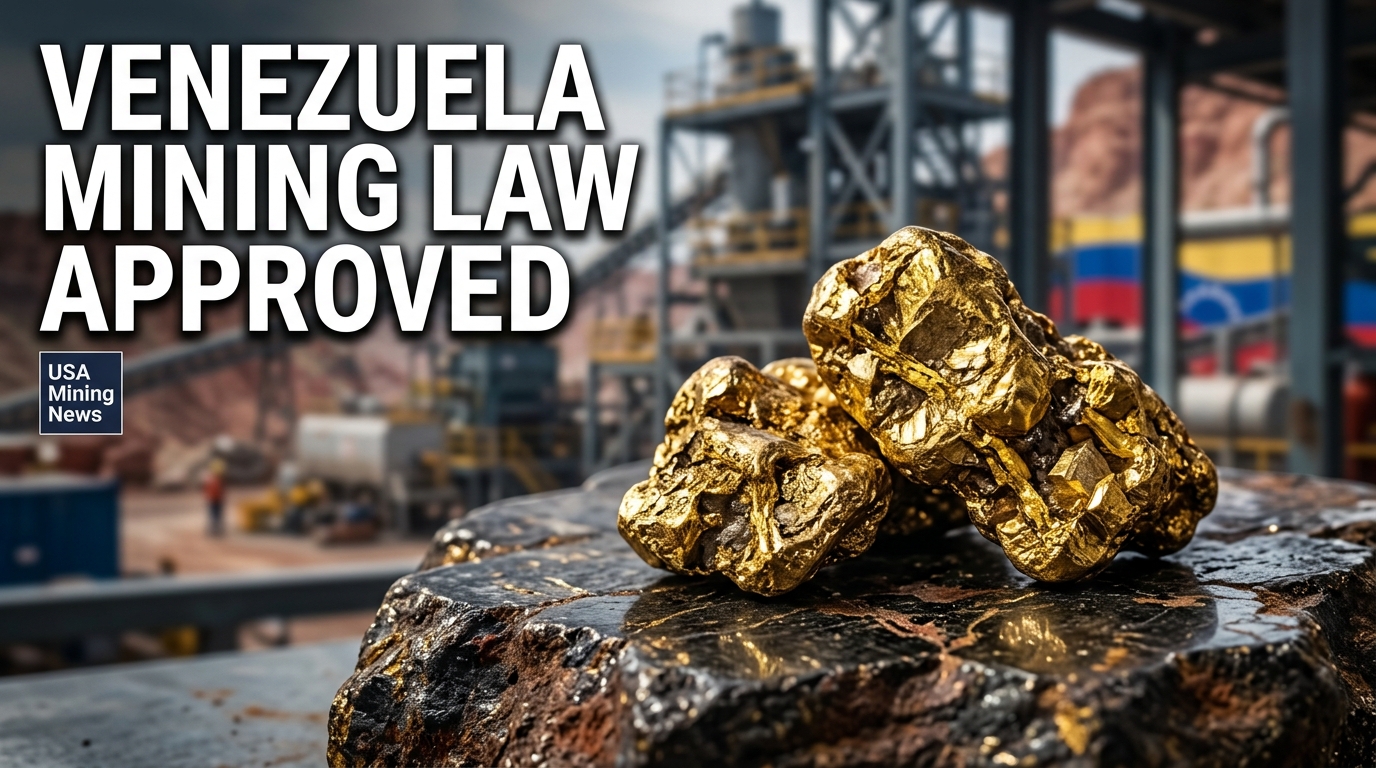
Caracas, Venezuela – On April 10, 2026, Venezuela’s National Assembly ushered in a significant policy shift for its mining sector, unanimously approving a new, comprehensive mining law. This 131-article bill, vigorously advocated by Acting President Delcy Rodríguez, replaces a system that has been in place for nearly three decades, signaling a determined effort by the Venezuelan government to draw substantial foreign capital into its strategic mineral projects.
The legislative action, which followed an initial vote last month, reflects a broader strategic initiative from the Rodríguez administration to enhance legal assurances and offer a more investor-friendly framework. This move is particularly aimed at attracting investment from the United States, a critical pivot given past geopolitical tensions and economic sanctions. The timing aligns with recent diplomatic overtures, including a visit by US Interior Secretary Doug Burgum to Caracas in early March, during which US officials reportedly encouraged Venezuela to advance such reforms. Acting President Rodríguez herself had articulated an aspiration to implement these changes at “Trump speed,” emphasizing the government's intent for rapid and decisive action.
Legislative Overhaul: Key Provisions of the New Law
The newly approved mining law represents a profound departure from the country's previous regulatory environment. Its 131 articles are designed to dismantle barriers to foreign investment that have long complicated operations for international companies. Among its most pivotal features are "economic equilibrium" clauses, which are intended to provide a framework for balancing the interests of both the state and private investors, ensuring that projects remain economically viable over their lifecycle while also securing fair returns for the nation.
Perhaps the most significant change from a legal perspective is the provision for access to international arbitration for dispute resolution. This moves away from a long-standing requirement, established in 1999, that mandated all disputes be resolved exclusively in local Venezuelan courts. For international mining companies, the availability of international arbitration is a critical factor, offering a perceived higher degree of impartiality and legal certainty, which is often a prerequisite for committing significant capital to high-risk jurisdictions.
Furthermore, the legislation introduces a simplified and more predictable tax scheme. It proposes royalties of up to 13% of production and a mining tax of up to 6% on gross revenue. Critically, the law also provides exemptions from several existing levies, streamlining the fiscal burden on mining operations. This simplified structure aims to offer greater clarity and reduce the administrative complexity associated with operating in Venezuela, thereby enhancing its appeal to potential investors who prioritize transparent and stable fiscal regimes.
Concession periods have also been significantly extended under the new law, now reaching a maximum of 30 years, with options for two subsequent ten-year renewals. Such extended tenures are highly valuable to mining companies, as they provide the long-term security necessary to justify the substantial upfront capital investments required for exploration, development, and operational phases of large-scale mining projects. This extended timeframe allows for more comprehensive project planning and execution, reflecting a more mature approach to mineral resource management.
Strategic Minerals and Investor Appeal
Officials from the Venezuelan government have explicitly stated that the new law is designed to attract capital for projects related to bauxite, gold, and other strategic minerals. Venezuela possesses significant, yet largely underexploited, reserves of these commodities. Gold, an invaluable precious metal, continues to be a safe-haven asset and a critical component in various industrial applications. Bauxite, the primary ore for aluminium production, is essential for a broad range of industries, from aerospace and automotive to construction. The term "strategic minerals" typically encompasses a wider array of elements critical for national security, economic growth, and high-tech industries, such as coltan, diamonds, and rare earth elements, all of which Venezuela is known or believed to possess in varying quantities.
The government's focus on these specific minerals underscores a broader economic diversification strategy. Historically, Venezuela's economy has been heavily reliant on oil exports. By opening up its mining sector through a more attractive legal framework, the nation seeks to develop alternative revenue streams and integrate more fully into global commodity supply chains. This strategy not only aims to attract foreign capital but also to stimulate local economic activity, create jobs, and foster technology transfer within the country's mineral-rich regions.
International Relations and Investment Signals
The narrative surrounding the new mining law is intricately linked with Venezuela’s efforts to improve its international standing and re-engage with global economic powers, particularly the United States. The encouragement for these reforms during US Interior Secretary Doug Burgum's visit in early March suggests a potential thawing of relations and a recognition of the mutual economic benefits that could arise from a more stable and legally predictable investment climate in Venezuela.
Further reinforcing this sentiment, the US has already granted a license permitting specific transactions involving gold of Venezuelan origin, as well as dealings with the state-owned mining company Minerven and its subsidiaries. A crucial condition for these transactions is that US law must govern the underlying contracts. This conditional authorization highlights a cautious but pragmatic approach by the US to facilitate certain commercial activities while ensuring that operations adhere to international norms and legal standards. For Minerven, a company that operates several gold mines in Venezuela, this US license could unlock significant opportunities for financing, technology, and market access that have been severely restricted for years.
Addressing Historical Complexities: The Shadow of Nationalizations
The new legal framework cannot be fully understood without acknowledging Venezuela’s complex history with foreign investment. Approximately 20 years ago, following a wave of nationalizations, Venezuela incurred billions of dollars in debt to numerous industrial conglomerates, as well as oil and mining companies. Notable among these were cases involving Crystallex, Gold Reserve, and Rusoro Mining, companies whose assets were seized by the Venezuelan state. These actions created a profound chilling effect on foreign direct investment, leading to prolonged legal battles and a significant loss of investor confidence in Venezuela's commitment to property rights and international legal obligations.
The current administration's emphasis on "legal assurances" and the introduction of international arbitration clauses are direct responses to this challenging legacy. By offering a robust mechanism for dispute resolution outside of domestic courts, the new law attempts to provide a credible guarantee against future unilateral state actions. This is a crucial step towards rebuilding trust among the international investment community, which often views a country’s adherence to rule of law and respect for contractual agreements as paramount before deploying large-scale capital. The success of this new law will largely depend on the consistent application of these provisions and the Venezuelan government's demonstrated commitment to upholding its newfound legal framework.
Industry Implications and Future Outlook
For the global mining industry and prospective investors, Venezuela's new mining law opens a potentially significant, albeit still cautious, window of opportunity. The nation possesses vast mineral wealth that has largely been inaccessible or deemed too risky for major international players in recent decades. Should the legal and fiscal reforms prove effective in practice, Venezuela could re-emerge as a key global supplier of strategic minerals, impacting commodity markets and supply chains, particularly for gold and bauxite.
However, industry professionals and investors will undoubtedly remain watchful regarding several factors. The state's continued authority to identify resources or areas of national importance and apply specific conditions implies that the framework, while more flexible, is not a full liberalization. The implementation and interpretation of the "economic equilibrium" clauses will also be critical. Transparency in the concession granting process, adherence to international arbitration rulings, and consistency in policy application will be paramount in determining whether this legislative reform truly translates into sustained foreign investment and responsible mining development.
The coming months will be crucial for observing how these new regulations are put into practice and how the Venezuelan government navigates the intricate balance between attracting foreign capital, maintaining national sovereignty over its resources, and addressing its historical financial obligations. The unanimous approval of this law represents a bold declaration of intent, but the ultimate success will hinge on its practical execution and the evolving dynamics of international relations and investor confidence.