Pivotal Air Permit Granted for ReElement's Indiana Rare Earth Refinery
In a significant development for the burgeoning domestic critical minerals sector, ReElement Technologies announced on August 20, 2026, the granting of a Minor Source air permit for its rare earth element and critical mineral refinery located in Marion, Indiana, United States. This crucial regulatory approval, reported by Shree Mishra, covers all four planned production lines at the facility, marking a substantial step forward for the company in its journey towards commercial operation. The permit explicitly allows for the installation, commissioning, and subsequent operation of these production lines, provided they adhere to specific emission limits and operating conditions meticulously outlined by regulatory bodies.
For any industrial facility, particularly one involved in chemical processing and refining, obtaining environmental permits is a foundational milestone. For ReElement Technologies, an entity in which American Resources holds a minority interest, this air permit is more than just a bureaucratic checkbox; it represents the culmination of extensive technical reviews and collaborative efforts with state and local authorities. It signals a transition from the intensive regulatory phase to the tangible processes of equipment installation and the critical path towards commercial commissioning at what the company refers to as the Marion Supersite. The strategic importance of such a permit cannot be overstated, as it provides the necessary environmental clearance for a facility designed to produce materials vital to modern technology and national security.
Strategic Location and Diverse Product Portfolio
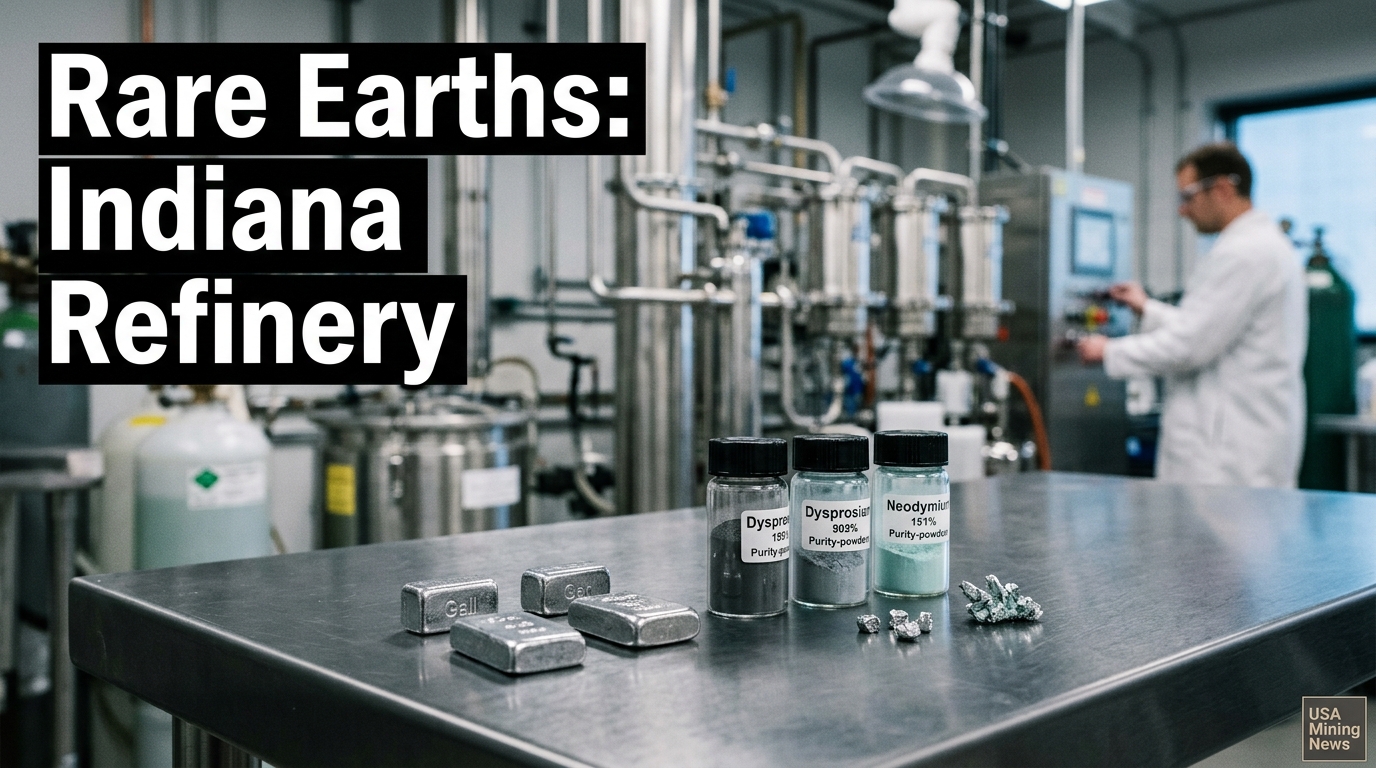
The Marion, Indiana, location for ReElement's refinery is strategically positioned within the industrial heartland of the United States. Once fully operational, the facility is slated to produce an array of high-purity separated products that are indispensable across numerous advanced industrial applications. These include:
- Dysprosium: A heavy rare earth element crucial for high-strength permanent magnets, particularly in electric vehicles and wind turbines.
- Gadolinium: Used in medical imaging (MRI contrast agents), nuclear reactors, and specific alloys.
- Gallium: A critical minor metal for semiconductors, light-emitting diodes (LEDs), and high-frequency electronics.
- Germanium: Essential for fiber optics, infrared optics, and solar cells. The company notes germanium as a significant component of its current order book.
- Neodymium: A light rare earth element, fundamental for powerful permanent magnets used in electric motors and generators.
- Neodymium-Praseodymium (NdPr): A blended rare earth oxide commonly used directly in magnet manufacturing.
- Samarium: Used in specialized magnets, neutron absorbers in nuclear reactors, and medical applications.
- Terbium: A heavy rare earth element that enhances magnetic properties and is used in solid-state devices.
- Yttrium: Utilized in phosphors for displays, specialized ceramics, and superconductors.
The facility is designed to process both recycled and virgin feedstocks, offering flexibility and contributing to a circular economy model for critical minerals. This dual-source approach helps mitigate supply risks and leverages existing material streams. ReElement Technologies has already reported that its current order book shows a significant demand for germanium and heavy rare earth elements, indicating a strong market pull from both commercial and defence sector customers. This demand underscores the immediate relevance and necessity of the Marion facility’s output for strategic US industries.
Innovative Separation Technology and Modular Design
A distinctive feature of ReElement Technologies' Marion plant is its reliance on a chromatography-based separation and purification process for refining critical minerals. This advanced chemical separation technique, which isolates individual elements from a mixed solution based on their differential affinities for a stationary phase, offers advantages over more traditional, often larger-scale, and chemically intensive methods. Chromatography allows for precise control over the separation process, enabling the production of high-purity materials critical for demanding applications in electronics and defense.
Furthermore, ReElement has adopted a modular approach to its production lines. This design philosophy facilitates expansion by adding standardized production capacity units that can share common infrastructure and resources. This contrasts sharply with conventional mineral processing facilities, which typically demand extensive, custom-built infrastructure and often involve the handling of larger volumes of chemicals. The modularity of ReElement’s approach offers several strategic benefits:
- Scalability: The ability to incrementally increase capacity based on market demand and feedstock availability, reducing initial capital expenditure risks.
- Flexibility: Allows for easier adaptation to different feedstocks or product mixes in the future.
- Efficiency: Potentially lower environmental footprint due to reduced overall chemical volumes and a more contained process.
- Speed to Market: Standardized modules can accelerate deployment and commissioning timelines.
This innovative processing method and plant design position ReElement Technologies as a forward-thinking player in the critical minerals space, aiming to create a more agile and environmentally responsible refining pathway.
Navigating the Regulatory Landscape
The air permitting process for the Marion facility involved intricate coordination among various governmental bodies, including state and local authorities, in addition to federal oversight. This multi-jurisdictional collaboration was coupled with detailed technical reviews, a necessity given the facility’s sophisticated refining methods and the nature of the materials being processed. ReElement Technologies stated that the review process was meticulously designed to ensure compliance with stringent environmental, health, and safety (EHS) standards, while simultaneously maintaining a commercially practical schedule. This balance between environmental stewardship and economic viability is crucial for the successful execution of large-scale industrial projects.
Mark Jensen, Chairman and CEO of ReElement Technologies, emphasized the collaborative spirit behind this achievement. “Receiving the principal approvals necessary to operate the production lines represents a significant milestone in ReElement’s commercialization,” Jensen stated. He further lauded the cooperative efforts, noting, “The speed, diligence and professionalism demonstrated by the State of Indiana, the City of Marion, Grant County, federal authorities and the permitting authorities show what is possible when government and industry work together with urgency, transparency and a shared commitment to rebuilding critical-mineral supply chains in the US.” His remarks underscore the importance of public-private partnerships in addressing complex challenges like securing domestic critical mineral supplies.
Rebuilding Domestic Critical Mineral Supply Chains
The establishment and successful permitting of facilities like ReElement’s Marion refinery are paramount to the broader US strategy of de-risking and strengthening critical mineral supply chains. For decades, the United States has become increasingly reliant on foreign sources, particularly China, for the processing and separation of rare earth elements and other critical minerals. This dependency poses significant economic and national security vulnerabilities, especially in an era of heightened geopolitical competition and supply chain disruptions.
The Marion facility is explicitly intended to support critical mineral supply chains for a diverse range of high-priority sectors within the United States. These include:
- Domestic Defence: Ensuring a secure supply of materials for advanced military technologies, from precision-guided munitions to radar systems.
- Energy: Providing essential components for renewable energy technologies, such as wind turbines and electric vehicle batteries, critical for the clean energy transition.
- Automotive: Supplying rare earth magnets for electric vehicle motors and other advanced automotive components.
- Semiconductors: Delivering high-purity gallium and germanium, fundamental to advanced microelectronics.
- Advanced Manufacturing: Supporting a wide array of high-tech industries that rely on specialized materials for innovation and production.
By bringing refining capacity back onshore, the US aims to reduce its strategic vulnerabilities, foster domestic innovation, and create high-value manufacturing jobs. The involvement of American Resources, a US-based company, holding a minority interest in ReElement, further aligns with national objectives to promote domestic ownership and control over critical mineral assets.
Outlook: From Commissioning to Commercial Operation
With the critical air permits now secured for phase one production, ReElement Technologies is poised to accelerate its operational readiness. The immediate focus shifts towards completing the installation and commissioning of the production lines, followed by rigorous validation of operational performance. This phase is crucial for demonstrating the efficacy and reliability of ReElement’s proprietary chromatography-based process on a commercial scale.
Once operational, the Marion facility will not only contribute a vital supply of high-purity critical minerals but also serve as a model for future domestic refining projects. The modular design inherently allows for future expansion, providing flexibility to scale production as demand grows or as new feedstock sources become available. This forward-looking approach ensures that ReElement can adapt to evolving market dynamics and continue to play a significant role in securing America’s critical mineral future. The successful commissioning and ongoing operation of this refinery will represent a tangible step towards establishing a robust, resilient, and domestically controlled critical mineral supply chain, ultimately strengthening the US industrial base and national security.