Alamos Gold Faces Q2 Output Dips Amid Young-Davidson Disruptions; Diversified Portfolio Expected to Anchor H2 Recovery
Toronto, Ontario – Alamos Gold (TSX, NYSE: AGI), a prominent Canadian gold producer, has announced a downward revision to its second-quarter production outlook, attributing the change to a series of unforeseen operational challenges at its flagship Young-Davidson mine located in northern Ontario. The disruptions, including seismic activity and a significant power outage, are expected to temper output for the current quarter, although the company maintains a positive long-term outlook for the year, banking on the robust performance of its other Canadian assets.
Operational Challenges at Young-Davidson
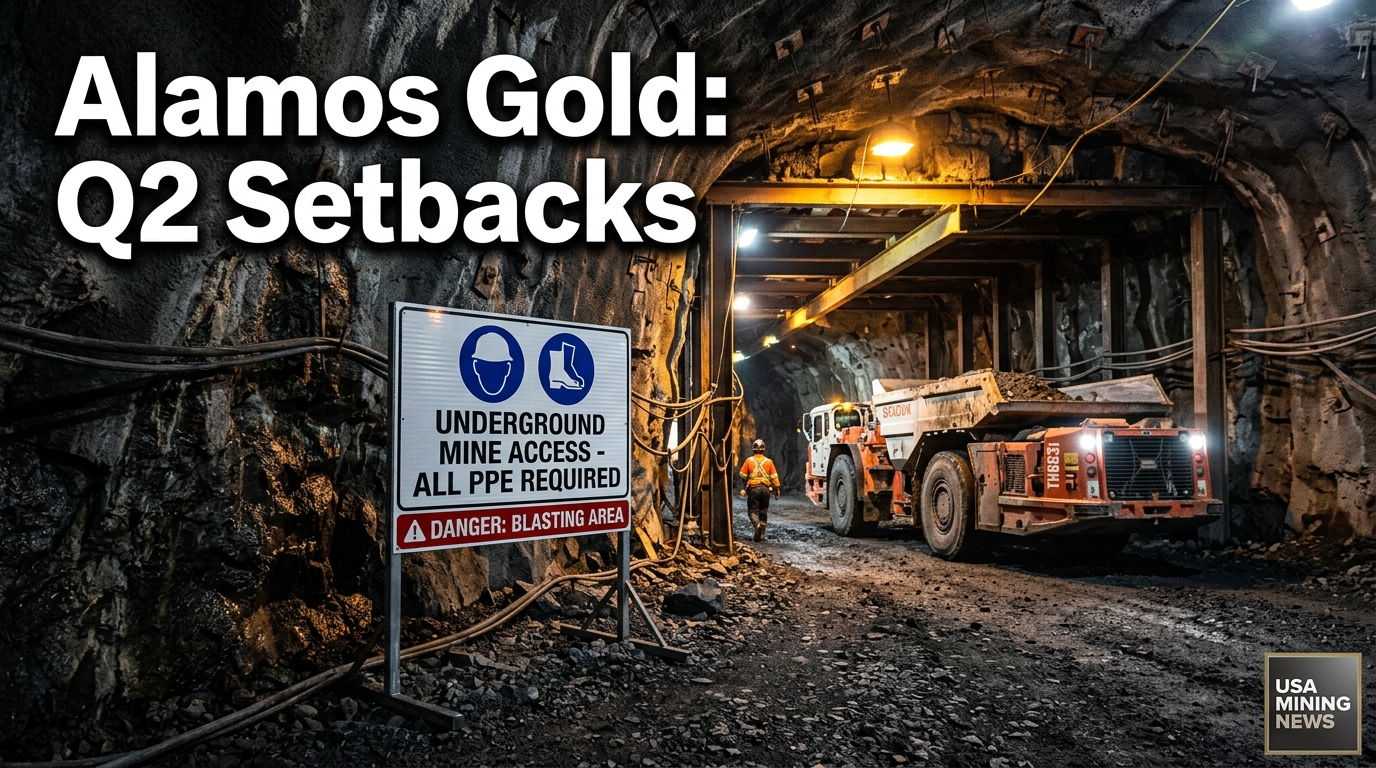
In an update issued on Thursday, June 18, 2026, Alamos Gold detailed the specific difficulties encountered at the Young-Davidson underground mine. The operation was impacted by two separate seismic events last week, a common geological occurrence in deep underground mining environments. One of these events unfortunately occurred “at an active mining front,” prompting immediate safety protocols and structural assessments. While the company confirmed that no injuries were reported, a testament to its safety systems, the mine’s infrastructure sustained damage. This damage has subsequently limited access to two crucial higher-grade stopes, areas specifically scheduled for mining during the second quarter to contribute to the quarter’s production targets.
Further exacerbating the operational challenges, the Young-Davidson mine also experienced a three-day power outage in late May. This disruption stemmed from storm-related damage to the regional power line, a common vulnerability for remote mining operations reliant on extensive regional infrastructure. Such power interruptions can severely impact all facets of an underground mine, from hoisting and ventilation to dewatering and processing, invariably leading to reduced mining rates and, consequently, lower production volumes.
John McCluskey, Chief Executive Officer of Alamos Gold, acknowledged the setbacks in a press release, stating, “We are disappointed with the operational challenges at Young-Davidson, and are working diligently to review and optimize the mining sequence to support higher mining rates going forward. The first half has been challenging, but we expect stronger production into the second half of this year.” His comments underscore the company’s proactive approach to mitigating the impacts and optimizing future operational efficiency.
Revised Production and Cost Expectations
As a direct consequence of these disruptions, Alamos Gold now anticipates Young-Davidson’s second-quarter production to be lower than initially forecast, aligning instead with the output levels seen in the first quarter. Overall, the company’s consolidated quarterly production guidance has been revised down to a range of 130,000-135,000 ounces of gold. This new forecast represents a significant 12% drop from the midpoint of Alamos’s previous guidance range for the quarter. Furthermore, the operational inefficiencies and additional rectification work are expected to lead to an increase in production costs.
The implications extend beyond the current quarter. Alamos Gold has also indicated that its consolidated gold production for the full year 2026 will likely fall below its previous guidance, with associated costs exceeding earlier forecasts. The company plans to provide a comprehensive revised guidance in July, coinciding with the release of its second-quarter financial results. Following the announcement, shares of Alamos Gold experienced a 2.5% decline in the trading session, closing with a market capitalization of C$21.6 billion (approximately $15.3 billion USD), reflecting immediate investor reaction to the revised outlook.
Young-Davidson: A Historical and Strategic Asset
The Young-Davidson mine, situated approximately 60 kilometers west of Kirkland Lake in northern Ontario, holds a storied place in Canada’s mining landscape. Its rich production history dates back to the 1930s, underscoring the region's enduring geological potential for gold mineralization. Modern mining operations at Young-Davidson recommenced in 2013 under the ownership of AuRico Gold, which subsequently merged with Alamos Gold, integrating the mine into Alamos’s portfolio. Young-Davidson is one of two major gold mines Alamos operates in northern Ontario, making it a critical component of the company’s Canadian asset base and a consistent contributor to its overall production profile. Its long history also points to a complex orebody and established infrastructure, which requires continuous management and investment to sustain modern, safe, and efficient operations.
Anchoring Growth: Island Gold and Magino Progress
Despite the temporary challenges at Young-Davidson, Alamos Gold’s operational resilience is significantly bolstered by its other key assets. For the remainder of 2026, the company expects production to be "anchored" by its other prominent Canadian operation, the Island Gold District. This underground mine, renowned for being one of the highest-grade gold mines in Canada, has been performing exceptionally well and is projected to remain a primary driver of production growth throughout the year. Alamos plans to further increase the mining rate at Island Gold from its current 1,500 tonnes per day to an impressive 2,000 tonnes per day by the end of 2026, reflecting the district’s strong potential and ongoing expansion efforts.
In addition to Island Gold, the Company’s Magino open pit mine is also progressing according to plan. The mill ramp-up at Magino is proceeding without issues and is anticipated to achieve an average throughput of 10,000 tonnes per day by the third quarter of 2026. This systematic increase in processing capacity at Magino is crucial for developing its full production potential and diversifying Alamos’s operational footprint.
The strategic importance of these assets cannot be overstated. Last year, the Island Gold District alone contributed nearly half of Alamos’s total gold output, effectively matching the combined production from Young-Davidson and the Mulatos operations in Mexico. This strong performance from Island Gold and the ongoing ramp-up at Magino provide crucial operational diversification, helping to mitigate the impact of site-specific disruptions like those currently affecting Young-Davidson.
Broader Industry Implications
The situation at Young-Davidson highlights several inherent challenges of the global mining industry, particularly for deep underground operations. Seismic events, while often minor, underscore the complex geotechnical environments miners navigate. Enhanced monitoring, ground support, and rapid response protocols are paramount for worker safety and operational continuity. Furthermore, the power outage serves as a reminder of the critical importance of reliable energy infrastructure for remote mining sites and the need for robust contingency planning against acts of nature. Both scenarios can lead to significant unplanned downtime and increased costs, impacting financial forecasts and investor confidence.
For the wider gold market, while Alamos Gold is a significant producer, a short-term reduction from one mine is unlikely to move global gold prices directly. However, it does emphasize the supply-side risks inherent in mining, where geological, technical, and logistical factors can quickly alter output forecasts. Investors in the mining sector continually evaluate companies not just on their resource base but also on their operational resilience, management’s ability to navigate unforeseen challenges, and the strength of their diversified asset portfolios.
Outlook and Investor Confidence
Alamos Gold’s proactive communication regarding the Young-Davidson disruptions and its reiteration of stronger anticipated performance in the second half of the year are critical for maintaining investor confidence. The company’s focus on optimizing the mining sequence at Young-Davidson, alongside the continued strong performance and ramp-up at Island Gold and Magino, offers a clear pathway to recovery. The upcoming release of revised full-year guidance in July will be closely watched by analysts and investors, providing a clearer picture of the overall impact and Alamos Gold’s adjusted strategic priorities for 2026 and beyond.
Ultimately, while the current quarter presents headwinds for Young-Davidson, Alamos Gold’s diversified portfolio, particularly its high-grade Canadian assets, is positioned to support its overall production goals. The industry will be observing how quickly the company can overcome these temporary setbacks and leverage its other operations to achieve its ambitious growth targets.