In a significant development for the global mining industry, diversified resources major BHP has forged a comprehensive global framework agreement with Wuxi BOTON Technology, a prominent Chinese manufacturer of conveyor belt systems. Announced on June 11, 2026, the agreement, formally signed last month at BOTON’s Innovation Centre in Wuxi, China, heralds a new phase of collaboration designed to revolutionize conveyor operations through advanced automation and robust sustainability initiatives.
This strategic alliance represents a substantial evolution of the existing relationship between the two companies. Moving beyond a conventional buyer-supplier dynamic, the new terms outline an expansive partnership that will encompass joint technology initiatives, life cycle services, dedicated sustainability projects, and an enhanced global support network. For an industry increasingly focused on operational efficiency, safety, and environmental stewardship, this agreement between a leading miner and a key technology provider signals a clear direction towards integrated, intelligent solutions.
A Strategic Alliance for Next-Generation Conveyors
The core of this renewed partnership lies in its commitment to innovation and shared development. While BOTON has long been a supplier of critical conveyor components to BHP, the global framework agreement fundamentally shifts the nature of their engagement. This collaboration is now poised to become a crucible for advanced research and development, aiming to deliver cutting-edge solutions specifically tailored for the demanding environments of modern mining operations.
The decision by BHP, one of the world's largest mining companies, to deepen its ties with BOTON underscores the strategic importance of conveyor systems in the overall mining value chain. Conveyors are the arteries of any large-scale mining operation, responsible for the efficient transportation of vast quantities of ore and waste material. Interruptions or inefficiencies in these systems can lead to significant production losses and increased operational costs. By elevating the relationship to include joint technology development and lifecycle management, BHP is strategically investing in the reliability and future-proofing of its critical material handling infrastructure.
Pioneering Automation in Conveyor Operations
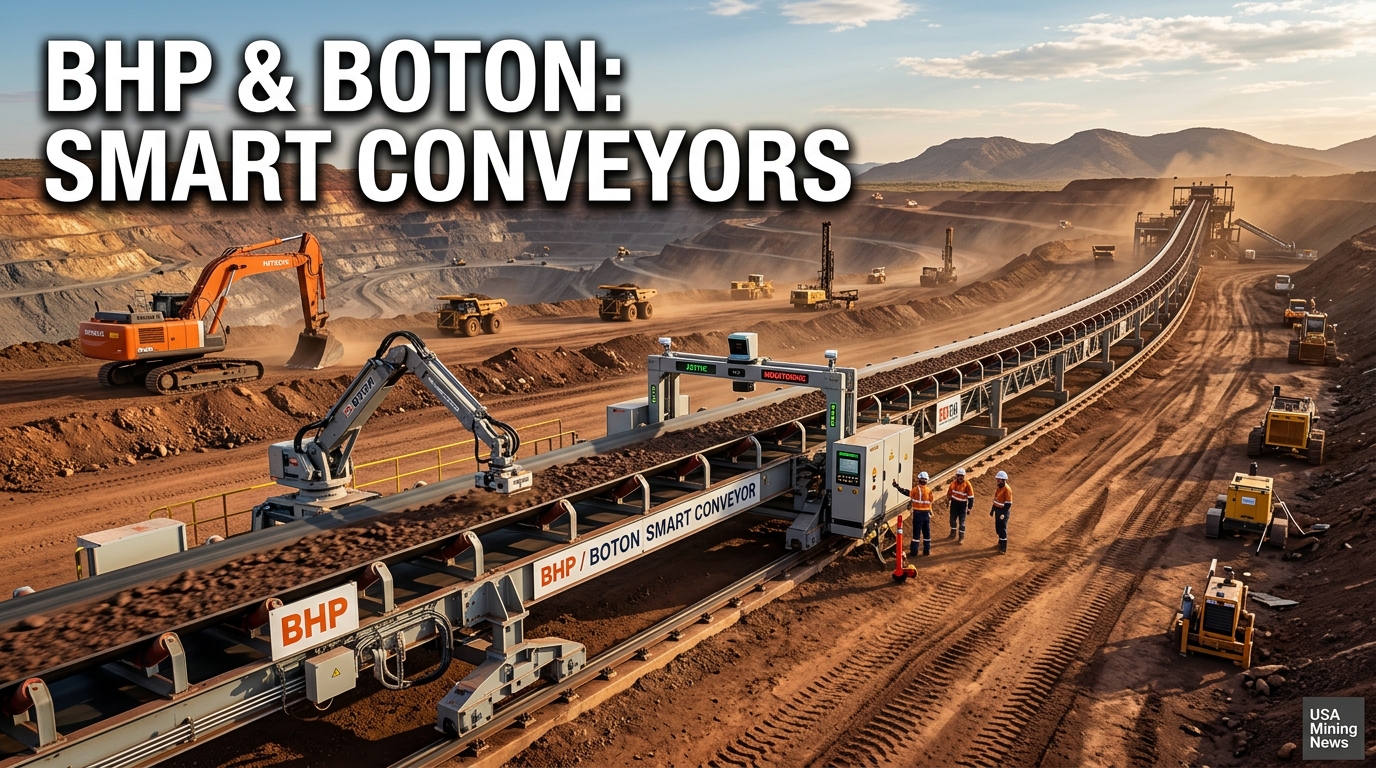
A key pillar of the new agreement is the joint development of technologies aimed at significantly advancing automation in conveyor operations. This initiative builds directly on successful previous projects undertaken at BHP’s massive Escondida copper mine in Chile, providing a proven foundation for future innovations. The scope of planned technological advancements is ambitious and comprehensive, targeting critical areas of maintenance, safety, and operational intelligence.
The specified intelligent systems under investigation highlight a move towards predictive maintenance and real-time operational optimization. These include:
- Longitudinal Rip Detection: A critical safety and asset integrity feature, designed to identify and alert operators to rips or tears in conveyor belts, preventing catastrophic failures and extensive downtime.
- Digital X-ray Scanning: Deploying advanced imaging for internal belt inspection, allowing for early detection of wear, splice issues, or embedded foreign objects that could compromise belt integrity. This could dramatically reduce manual inspection requirements and improve diagnostic accuracy.
- AI-based Belt Alignment: Utilizing artificial intelligence to continuously monitor and adjust belt alignment, minimizing wear on belts and components, reducing spillage, and improving operational stability. Misaligned belts are a common cause of operational inefficiency and premature wear.
- Robotic Inspection Tools: Introducing autonomous or semi-autonomous robots to conduct routine inspections of conveyor systems in potentially hazardous or difficult-to-access areas, enhancing safety for human personnel and providing more frequent and consistent data.
These innovations are poised to transform conveyor maintenance from reactive to predictive, improving operational uptime and significantly enhancing safety. For mining companies, minimizing unplanned downtime of core equipment like conveyors is paramount to maintaining production targets and profitability. Automation and intelligent systems offer the promise of operations that are not only more efficient but also inherently safer, reducing human exposure to moving machinery and harsh environments.
Driving Decarbonization and Circularity
Beyond operational efficiency and safety, the collaboration places a strong emphasis on sustainability, addressing growing environmental concerns within the mining sector. BHP and BOTON intend to introduce a comprehensive Supply Chain Partner Programme focused on monitoring the carbon footprint throughout the entire life cycle of mining operations. This reflects a broader industry trend towards understanding and mitigating Scope 3 emissions – those generated indirectly across the value chain, from raw material extraction to product end-of-life.
The programme will track emissions across several critical stages:
- Sourcing of Raw Materials: Evaluating the environmental impact originating from the extraction and processing of materials used in conveyor manufacturing.
- Manufacturing Processes: Assessing carbon emissions from BOTON's production facilities.
- Operations: Monitoring the energy consumption and associated emissions during the operational life of conveyor systems at BHP’s mines.
- Recycling of Conveyor Belts: Developing and implementing solutions for the effective recycling and responsible disposal of end-of-life conveyor belts, aiming to increase circularity and reduce waste sent to landfills.
This holistic approach to carbon footprint monitoring is a direct response to global climate targets and increasing investor scrutiny on environmental, social, and governance (ESG) performance. BHP Chief Commercial Officer Rag Udd highlighted this aspect, stating, "By working more closely together, we are advancing the next generation of mining conveyor solutions to improve productivity, support our decarbonisation ambitions and deliver long-term value across our global operations." This initiative aims not only to track but also to improve methods for managing emulsions and developing innovative recycling solutions, further lessening environmental impacts and contributing to a more circular economy in mining.
Strengthening Global Support and Service Infrastructure
A vital component of the framework agreement is BOTON’s commitment to significantly strengthen its service operations in BHP’s core mining markets. This expansion will leverage BOTON’s existing international facilities, particularly those located in strategically important regions such as Australia and Thailand. Furthermore, plans include the establishment of dedicated service stations to provide faster and more localized support directly to BHP’s operations.
For large-scale, geographically dispersed mining companies like BHP, access to rapid and reliable local technical support is crucial. Downtime in remote mining locations can be exceptionally costly, making proximity of maintenance services a key factor in operational resilience. By enhancing its service footprint, BOTON aims to ensure that BHP’s advanced conveyor systems are maintained at peak performance with minimal interruption, reinforcing the partnership’s focus on long-term value and operational continuity.
BHP’s Broader Strategic Vision
This partnership with BOTON is consistent with BHP’s overarching strategic vision, which prioritizes innovation, safety, and sustainability as fundamental drivers of long-term value. Rag Udd’s remarks underscore the alignment of this agreement with BHP’s broader corporate goals to enhance productivity and achieve decarbonization targets. In an industry facing escalating challenges from resource depletion, volatile commodity prices, and stringent environmental regulations, technological innovation and strategic partnerships are becoming increasingly critical.
BHP’s commitment to advancing its operational capabilities through technology is not an isolated incident. The company consistently explores avenues to optimize its portfolio and operations. For instance, in February of this year, BHP demonstrated its strategic financial acumen by signing a long-term streaming agreement with Wheaton Precious Metals. This deal included a substantial $4.3 billion upfront payment for silver from BHP’s production share at the Antamina mine in Peru. While distinct from the BOTON agreement, such high-value, long-term arrangements highlight BHP's proactive approach to securing its financial future and enhancing value across its diverse asset base, often leveraging innovative financing and operational models.
The Road Ahead: Implications for the Mining Sector
The global framework agreement between BHP and Wuxi BOTON Technology sets a compelling precedent for the mining industry. It exemplifies how major resource producers are moving beyond traditional procurement models to embrace deeper, collaborative partnerships with technology providers. This shift is driven by the imperative to unlock new levels of efficiency, elevate safety standards, and meet increasingly ambitious environmental targets.
The joint development of intelligent conveyor systems, encompassing advanced rip detection, X-ray scanning, AI-based alignment, and robotic inspection, promises to deliver tangible benefits in terms of operational reliability and reduced costs. More profoundly, the Supply Chain Partner Programme for carbon footprint monitoring and enhanced recycling initiatives provides a template for how miners can address Scope 3 emissions and contribute to a more circular economy. As the industry continues its evolution towards "Mining 4.0," characterized by digitalization, automation, and sustainability, collaborations like that between BHP and BOTON will be instrumental in shaping the future landscape of global mining.
The success of these initiatives at BHP’s global operations could lead to wider adoption across the industry, potentially establishing new benchmarks for conveyor technology and sustainable practices. The long-term implications are clear: safer, more productive, and environmentally conscious mining operations that are better equipped to meet the demands of a resource-hungry world, while simultaneously addressing the critical challenges of carbon reduction and resource stewardship.