In a pivotal development for the nascent deep-sea mining sector, American Ocean Minerals Corporation (AOMC) has announced the successful completion of Expedition 7, its inaugural offshore exploration mission within the Cook Islands. This approximately three-week campaign, focused on critical environmental baseline studies and resource assessment, marks a significant step forward in preparing for the responsible development of strategic polymetallic nodule resources.
The successful execution of Expedition 7, reported on June 25, 2026, underscores AOMC's methodical approach to leveraging deep-sea mineral endowments, which are increasingly vital for the global clean energy transition. With a portfolio that includes interests in the Cook Islands’ exclusive economic zone and US-regulated international waters, AOMC is positioning itself as a key player in securing a diversified supply of critical minerals such as cobalt, manganese, and nickel.
A New Frontier: Advancing Deep-Sea Exploration in the Cook Islands
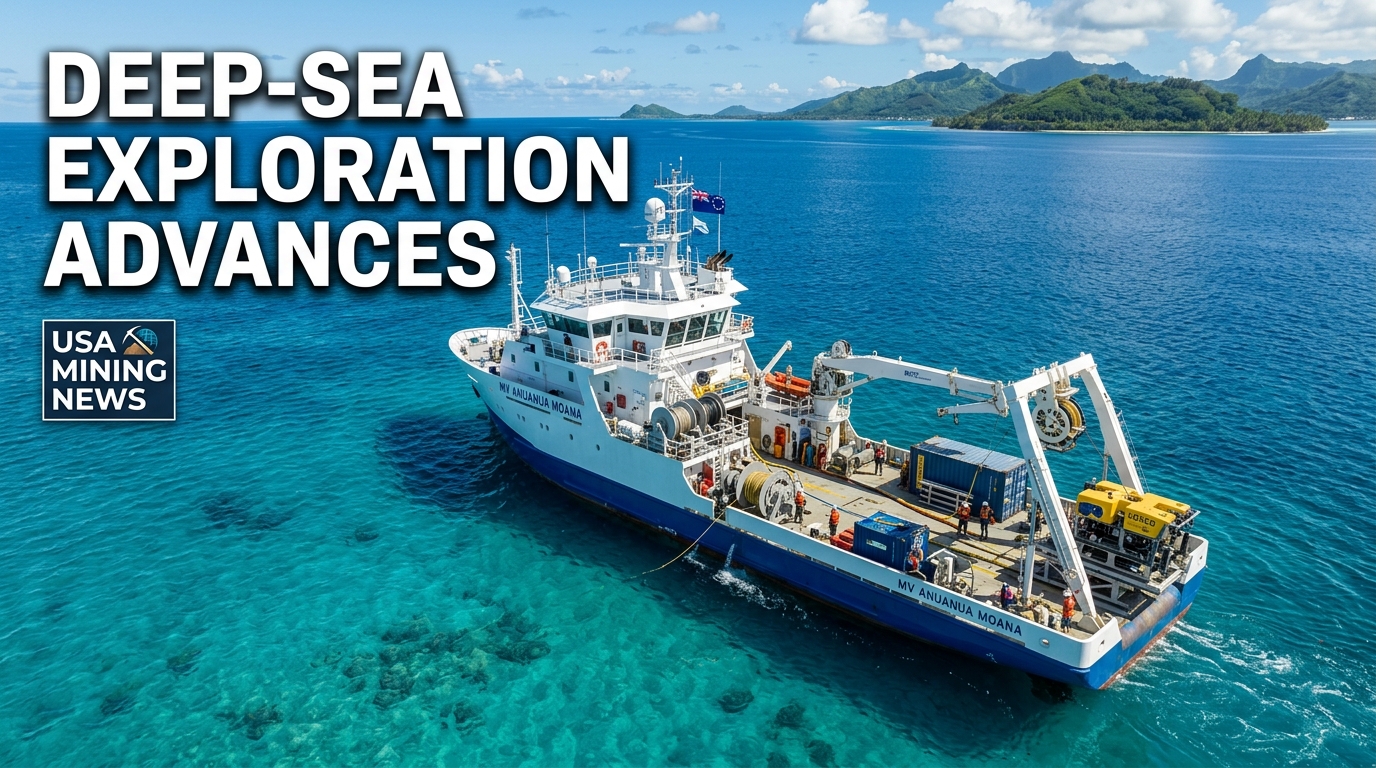
Expedition 7 was conducted aboard the MV Anuanua Moana, a 196-foot research vessel that serves as AOMC’s central offshore platform for exploration and environmental monitoring. Originally constructed in 2007, the vessel was acquired by AOMC in 2022 and has since undergone extensive refurbishment to meet the rigorous demands of deep-sea operations. Its deployment for Expedition 7 highlights AOMC's strategic investment in proprietary infrastructure, aimed at reducing reliance on third-party vessel availability and ensuring consistent, high-quality data collection.
The primary area of focus for this campaign was the Moana Minerals’ EL3 licensed area, located within the Cook Islands’ exclusive economic zone. This exploration license is held by OML, presumably Odyssey Marine Exploration, through its subsidiary Moana Minerals Ltd. The expedition's core objective was to gather comprehensive data to support multi-year environmental baselining and refine the existing polymetallic nodule resource estimate within this specific license area, which is crucial for advancing toward an Environmental Impact Statement (EIS) and a Pre-Feasibility Study (PFS).
Beyond its Cook Islands activities, AOMC is also building a substantial portfolio in US-regulated international waters, including highly significant regions such as the Clarion-Clipperton Zone and the Penrhyn Basin. The company has already demonstrated its compliance with requirements for two exploration applications under the Deep Seabed Hard Mineral Resources Act, covering inferred resources estimated to exceed 1.4 billion tonnes. This dual focus illustrates AOMC's expansive vision to explore and potentially develop deep-sea critical mineral assets under various jurisdictional frameworks.
Strategic Mergers and Key Players Shaping the Sector
The successful completion of Expedition 7 follows closely on the heels of a significant corporate development for AOMC. In April, the company signed a definitive merger agreement with Odyssey Marine Exploration, a transaction anticipated to create a US-controlled deep-sea critical minerals company with a valuation of approximately $1 billion. This merger is a clear indicator of the growing consolidation and strategic investment within the deep-sea mining industry, as companies seek to pool resources, expertise, and licensed areas to optimize their path to commercial viability.
Leadership in this emerging sector is pivotal, and AOMC benefits from formidable industry experience. Tom Albanese, Chairman of AOMC and former CEO of mining giant Rio Tinto, articulated the company's foundational approach: “AOMC is building a platform founded on disciplined execution, rigorous environmental standards, and dedicated infrastructure.” His statement underscores a commitment to integrating robust scientific practice with operational efficiency, a critical balance for an industry keenly scrutinized for its potential environmental footprint.
Hans Smit, CEO of Ocean Minerals, also lauded the expedition's accomplishments, stating, “This was an exceptional campaign that reflects the capability and discipline of the entire team.” His comments highlight the technical prowess and collaborative effort required to operate effectively in the challenging deep-sea environment. The synergy between AOMC and Odyssey, particularly through subsidiaries like Moana Minerals Ltd., is designed to facilitate a streamlined process from exploration to potential commercialization, underpinned by extensive scientific investigation.
Technical Rigor: Unpacking Expedition 7's Scientific Endeavor
The technical achievements of Expedition 7 are notable, demonstrating a comprehensive and highly integrated scientific endeavor. Over three weeks, the team aboard the Anuanua Moana completed operations at 53 distinct sites. This involved the successful deployment and recovery of 60 box cores and 62 multicores, which are specialized devices used to collect undisturbed samples of the seabed and underlying sediments. From these operations, a substantial total of 4,059 physical samples were retrieved for detailed laboratory analysis.
The nature of the collected data is particularly advanced, integrating multiple scientific disciplines to establish robust environmental baselines. The expedition focused on sediment physico-chemistry, which provides insights into the physical and chemical properties of the seafloor. Simultaneously, quantitative assessments of macrofaunal, meiofaunal, and foraminiferal communities were conducted. These studies analyze the diversity and abundance of various organisms – from larger invertebrates to microscopic life forms and single-celled organisms – that inhabit the deep-sea ecosystem. Furthermore, molecular environmental DNA (eDNA) data was collected, offering a cutting-edge method to detect the presence of species through genetic material shed into the environment, thereby providing a broad ecological snapshot without direct observation.
Beyond these core biological and chemical datasets, additional information was gathered where feasible, including bathymetry (detailed mapping of the seafloor terrain), water-column biomass (the total mass of living organisms in the water column), and surface marine observations. This holistic approach is crucial for establishing baseline ecological conditions and understanding natural variability across representative deep-sea habitats. As Mr. Smit noted, “The combination of biological, chemical, physical, and geological sampling is exactly the kind of integrated science required to assess natural variability, understand ecosystem structure, and support evidence-based environmental management.” The refined data is expected to significantly strengthen the existing polymetallic nodule resource estimate within the EL3 license area, moving AOMC closer to a clearer understanding of the economic potential.
The Regulatory Labyrinth and Environmental Stewardship
Transitioning deep-sea mineral assets from initial exploration to potential commercial harvesting is a multi-year process, demanding meticulous attention to environmental stewardship and regulatory compliance. The data collected during Expedition 7 is not merely for scientific curiosity; it is a direct input into Moana Minerals’ ongoing Environmental Impact Statement (EIS), which is planned for completion in the first half of 2027. An EIS is a rigorous process to predict and assess the environmental consequences of a proposed project, suggesting mitigation measures and forming a critical component for regulatory approval.
Concurrently, a Pre-Feasibility Study (PFS) for the MML’s license area is on track for completion in the second half of this year, 2026. The PFS evaluates the project’s technical viability and economic potential, building upon the resource definition work and considering the environmental and social impacts. Both the EIS and PFS are indispensable for future engagement with Cook Islands regulators, providing the scientific and technical basis for necessary permits and licenses to proceed.
AOMC’s commitment to “rigorous environmental standards” and the view that “responsible development requires environmental science and resource assessment to advance in parallel” signals an understanding of the intense global scrutiny surrounding deep-sea mining. The industry faces criticism regarding potential irreversible damage to unique deep-sea ecosystems. By investing heavily in comprehensive environmental baselining studies, AOMC aims to build a foundation of evidence-based environmental management, striving to demonstrate that mineral extraction can proceed in an environmentally responsible manner.
Market Implications and Future Outlook for Critical Minerals
The drive to develop deep-sea mineral resources is fundamentally linked to the escalating global demand for critical minerals. Polymetallic nodules are rich in manganese, cobalt, and nickel, all essential components for modern technologies, particularly in the rapidly expanding electric vehicle (EV) battery sector and renewable energy infrastructure. As terrestrial deposits become more challenging to access and geopolitical considerations highlight the need for diversified supply chains, deep-sea sources offer a tempting alternative.
The Cook Islands, with its vast exclusive economic zone, represents a significant potential future source for these minerals. AOMC's forward momentum through disciplined execution and dedicated infrastructure, exemplified by the Anuanua Moana, underscores its long-term vision. By reducing dependence on external service providers and consistently gathering high-quality data, AOMC aims to control its operational timelines and costs, crucial factors in a capital-intensive industry.
The successful completion of Expedition 7 is more than just a logistical triumph; it is a critical step in de-risking future project development. With key studies like the EIS and PFS nearing completion, AOMC and its partners will be in a stronger position to make informed investment decisions and secure the necessary regulatory approvals for a potential transition toward commercial harvesting. The broader industry will be watching these developments closely, as they may set precedents for regulatory frameworks and operational best practices in this frontier mining domain.
Conclusion: Paving the Way for a New Era
American Ocean Minerals Corporation's successful Expedition 7 in the Cook Islands represents a tangible advancement in the deep-sea critical minerals sector. By systematically conducting extensive environmental baseline studies and resource definition work, AOMC is methodically addressing the technical and regulatory challenges inherent in this emerging industry. The integration of cutting-edge scientific methodologies with strategic corporate development, notably the merger with Odyssey Marine Exploration, positions the company at the forefront of deep-sea resource exploration.
As the world grapples with the imperative to secure vital minerals for a sustainable future, projects like AOMC’s ventures in the Cook Islands and US-regulated waters offer a glimpse into potential new supply sources. The ongoing efforts to complete the EIS and PFS signify a commitment to balancing the promise of critical mineral extraction with the paramount responsibility of environmental stewardship. AOMC’s disciplined approach, demonstrated through Expedition 7, is not only paving the way for its own operational future but also contributing significantly to defining the future trajectory of deep-sea mining on a global scale.