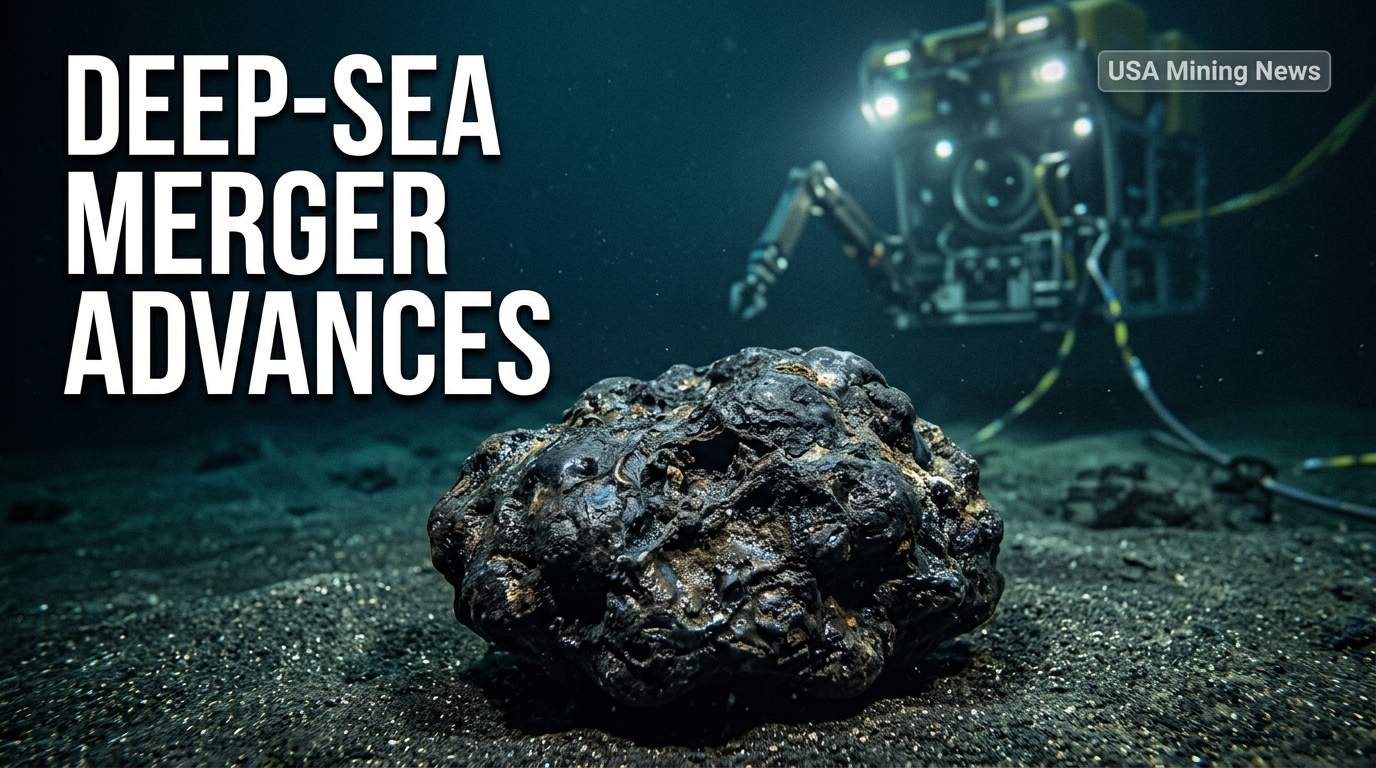
In a significant development for the burgeoning deep-sea mining sector, American Ocean Minerals Corporation (AOMC) and Odyssey Marine Exploration have officially advanced their planned merger by filing a registration statement on Form S-4 with the U.S. Securities and Exchange Commission (SEC) on May 12, 2026. This pivotal step solidifies the intent to form a major critical minerals platform, specifically targeting deep-sea polymetallic nodule exploration and development. The proposed all-stock transaction, which will involve the exchange of AOMC’s existing common stock and warrants for those of Odyssey, values the combined entity at approximately $1 billion in equity, signaling high confidence in the future of marine mineral resources.
Pioneering Deep-Sea Critical Minerals: The Rationale Behind the Merger
The strategic alliance between AOMC and Odyssey Marine Exploration is designed to establish a formidable presence in the nascent, yet critically important, field of deep-sea mining. The merger’s primary objective is to create a robust platform dedicated to the exploration and development of critical minerals and rare earths found in polymetallic nodules on the deep seabed. This initiative comes at a time when global demand for these essential elements is soaring, driven by the rapid expansion of electric vehicles (EVs), renewable energy technologies, and advanced electronics. Terrestrial mineral deposits are becoming increasingly scarce or politically complex, compelling the industry to explore alternative sources.
The synergy underlying this transaction is clear: Odyssey Marine Exploration brings decades of operational expertise in deep-sea exploration, recovery, and a well-established public company framework. This complements AOMC’s substantial financial resources and its strategic investments in a diverse marine mineral portfolio. Mark Justh, CEO of AOMC, underscored this strategic alignment, stating, “As we move through the SEC review process, our focus remains on disciplined execution across the technical, environmental, permitting and commercial work streams required to build this responsible critical mineral platform.” He further elaborated that the filing provides Odyssey shareholders a comprehensive understanding of the merged company’s assets, regulatory pathways, capital structure, technical work streams, and business plan, thereby demonstrating the financial and strategic merits of the proposed transaction.
Financial Fortification and Operational Outlook
A key aspect of AOMC’s readiness for this merger is its significant financial positioning prior to the transaction. The company successfully secured over $230 million from a consortium of institutional and strategic investors. This funding includes approximately $156 million derived from private placement activities and an additional $75.6 million in pre-public funding. This substantial capital infusion is crucial for mitigating the inherent costs and risks associated with pioneering deep-sea exploration and development projects.
Post-merger, the combined entity anticipates having $175 million in cash available, which will be strategically allocated to further its ambitious exploration projects. This capital will provide a strong foundation for the detailed technical, environmental impact assessments, and preliminary development work required for deep-sea resource extraction. Upon the completion of the merger, the new company will officially operate under the name American Ocean Minerals Corporation and is slated to trade on the Nasdaq stock exchange under the ticker symbol ‘AOMC’. This public listing will offer investors a unique opportunity to participate in the growth of a company at the forefront of a new frontier in resource extraction.
A Multi-Jurisdictional Asset Base for Strategic Advantage
AOMC’s strategic differentiation lies in its multi-jurisdictional asset base, which is underpinned by a phased commercialization strategy designed to navigate the complexities of both international and national regulatory frameworks. This diverse portfolio includes:
- Cook Islands Exploration Licences: The merged entity will hold interests tied to exploration licenses in the Cook Islands, which are managed by CIC and Ocean Minerals’ subsidiary, Moana Minerals. This establishes a footprint in international waters, where regulatory oversight is typically governed by evolving international conventions and treaties, requiring careful adherence to established and emerging guidelines.
- U.S. Project Areas: In parallel, the company is developing U.S. project areas, specifically AOM Area-1 and AOM Area-2. These projects fall under the purview of the Deep Seabed Hard Mineral Resources Act and are overseen by the National Oceanic and Atmospheric Administration (NOAA). Developing assets within U.S. jurisdiction can potentially offer strategic advantages by contributing to domestic critical mineral supply chains, enhancing national security, and potentially streamlining certain aspects of environmental permitting and compliance under federal law.
These polymetallic nodules, which are the primary target of these operations, are naturally occurring concretions on the seabed, rich in a suite of valuable metals including copper, nickel, cobalt, manganese, and increasingly important, rare earth elements. These minerals are indispensable components in a wide array of high-tech and green technologies, making them critical for the global energy transition and digital economy.
Navigating the Regulatory and Environmental Landscape
The deep-sea mining industry operates in an environment of intense scrutiny, particularly regarding its potential environmental impacts. As AOMC CEO Mark Justh emphasized, a “disciplined execution across the technical, environmental, permitting and commercial work streams” is paramount. The filing of the Form S-4 registration statement with the SEC is not merely a procedural step; it serves as a critical document providing transparent and detailed information to investors and stakeholders regarding the company’s assets, its proposed regulatory pathways, capital structure, and overarching business plan.
The regulatory framework for deep-sea mining is complex and still evolving. While international waters are broadly governed by the United Nations Convention on the Law of the Sea (UNCLOS) and the International Seabed Authority (ISA), national jurisdictions, like the U.S. projects, operate under specific domestic legislation such as the Deep Seabed Hard Mineral Resources Act. Successfully obtaining and maintaining permits requires demonstrating rigorous environmental stewardship, advanced technological capabilities for minimizing seabed disturbance, and robust post-extraction rehabilitation plans. The commitment to building a “responsible critical mineral platform” is therefore not just a corporate philosophy but a fundamental necessity for gaining public acceptance and operational licenses in this environmentally sensitive domain.
Path to Completion: Milestones and Contingencies
The journey towards the finalization of this merger is contingent upon several critical milestones and conditions. Both the boards of directors of AOMC and Odyssey Marine Exploration, along with Odyssey’s special transaction committee, have unanimously approved the merger agreement, indicating strong internal consensus on the strategic direction. The transaction is projected to be completed in the late second quarter (Q2) or early third quarter (Q3) of 2026.
However, several standard closing conditions must be met:
- The effectiveness of the registration statement filed with the SEC.
- Obtaining requisite stockholder approvals from both Odyssey and AOMC.
- Securing all necessary regulatory consents from relevant governmental bodies.
- Successful application for the listing of the merged company’s shares on Nasdaq.
- Other customary closing conditions typically associated with transactions of this scale.
Each of these steps represents a significant hurdle that must be cleared to ensure a smooth transition and the legal establishment of the new merged entity. The anticipation of completion within the next few months suggests that both companies are confident in addressing these requirements efficiently.
Broader Implications for the Mining Industry
This merger carries profound implications for the broader mining industry and the global supply chain of critical minerals. It represents a significant vote of confidence in the commercial viability and technological feasibility of deep-sea mineral extraction. By consolidating financial resources, operational expertise, and a diversified asset portfolio, the combined AOMC entity aims to accelerate the commercialization of deep-sea minerals, potentially offering a new, diversified supply source for metals essential for modern technologies.
The move could also serve as a catalyst for increased investment in deep-sea mining technologies and research, spurring innovation in exploration, extraction, and environmental mitigation techniques. For countries like the United States, which are actively seeking to secure domestic and diversified critical mineral supply chains to reduce reliance on geopolitical rivals, projects under U.S. jurisdiction are particularly significant. Furthermore, the emphasis on a “responsible critical mineral platform” will set important precedents for environmental standards and social license to operate in this nascent sector, influencing how future deep-sea ventures are viewed and regulated globally. The industry will be closely watching how the new AOMC navigates these challenges, balancing resource extraction with ecological stewardship.
Conclusion: A New Horizon for Critical Mineral Supply
The advancement of the merger between American Ocean Minerals Corporation and Odyssey Marine Exploration marks a pivotal moment in the quest for critical minerals. With a robust financial backing, a multi-jurisdictional asset strategy, and a clear vision for deep-sea polymetallic nodule development, the newly formed AOMC is poised to become a significant player in addressing the global demand for essential raw materials. As the transaction progresses through its final stages, the mining industry will be keenly observing how this new entity charts its course, potentially opening a new, critical frontier in sustainable resource supply and reshaping the future of mineral extraction.