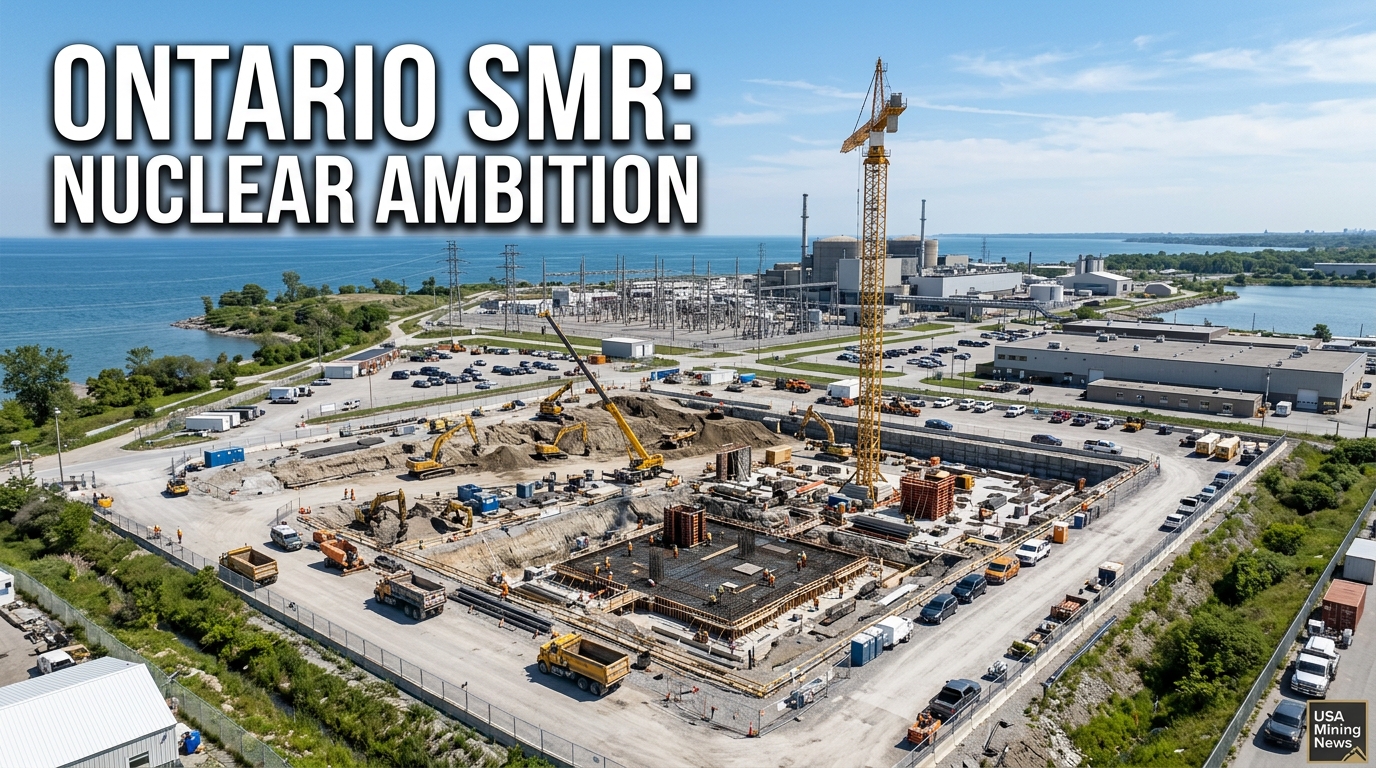
In a significant development for global energy security and advanced nuclear technology, Ontario has commenced construction on the first small modular reactor (SMR) within the G7 group of nations. This undertaking, situated at the Darlington site just east of Toronto, positions Canada at the forefront of a burgeoning energy transition, one increasingly shaped by rising power demands, ambitious electrification goals, and the imperative for resilient, low-carbon electricity generation. The project’s inception comes as tightening fuel markets globally underscore the critical need for new, scalable nuclear power solutions.
A Landmark Project: Ontario's Darlington SMR
The Darlington SMR project, spearheaded by Ontario Power Generation (OPG), is set to be a cornerstone of Canada’s future energy landscape. On
May 8, 2026
, construction officially began on the first of four planned reactors. Each unit is engineered to generate a substantial300 megawatts (MW)
of electricity, collectively aiming for a total capacity of1,200 MW
upon full completion. This comprehensive output is projected to be sufficient to power approximately1.2 million homes
in Ontario, providing a substantial boost to the provincial grid.The inaugural unit, a
GE Hitachi BWRX-300 reactor
, represents a critical step in de-risking advanced nuclear technology deployment. This specific reactor design is considered a mature SMR, benefiting from established operational experience and a strong foundation in conventional boiling water reactor technology. The first unit is optimistically projected to come online by the end of the current decade, a timeline that, if met, would showcase rapid development in the SMR sector. Erveina Gosalci, founder and CEO of the Canadian Association of Small Modular Reactors and the SMR Forum, underscored the project's broader implications, telling The Northern Miner that it “strengthens Canada’s role as a trusted partner in a world increasingly focused on energy security and resilient supply chains.”Driving Domestic Industrial Capacity and Supply Chains
Beyond its direct impact on electricity generation, the Darlington SMR project is anticipated to act as a powerful catalyst for the Canadian industrial and mining sectors. The development of advanced nuclear infrastructure inherently requires a robust supply chain, from raw material extraction to advanced manufacturing. For the mining industry, this translates into intensified demand for a range of critical minerals and materials essential for reactor construction and operation.
Notably, the project is expected to drive demand for
uranium
, the primary fuel source for nuclear reactors. While the specifics of fuel for the BWRX-300 units present a new challenge for Canada's largely domestic nuclear fuel cycle, the overall expansion of nuclear capacity reinforces uranium's strategic importance. Furthermore, the construction of these advanced reactors will require specific metallic inputs such aszirconium
, known for its excellent corrosion resistance and low neutron absorption cross-section in nuclear environments;niobium
, an alloying agent used to enhance the strength and stability of high-temperature steels; and variousspecialty steels
engineered to withstand the extreme conditions within a reactor core. This demand could stimulate investment in exploration, extraction, and processing within Canada, fostering domestic economic growth and enhancing the nation's resource resilience.Navigating a Global Competitive Landscape
Canada's bold move into SMR deployment unfolds within an increasingly competitive international arena. Nations like the
United States
, theUnited Kingdom
, andFrance
are vigorously advancing their own SMR programs, each aiming to establish leadership in this nascent, high-potential sector. The global emphasis, as Gosalci highlighted in an email from London, UK, is on "standardized designs and repeat builds that can anchor domestic supply chains and create export opportunities."The race for SMR dominance is not merely about launching a single project but about achieving "scale and speed." This necessitates frameworks that support faster, more standardized licensing, predictable permitting, and regulatory treatment that allows subsequent projects to benefit from prior experience. Canada's ability to transition from a "project-by-project model to a design-and-program model" will be critical for maintaining its competitive edge and establishing itself as an exporter of SMR technology, much like its historical success with
CANDU
reactors.Reframing Ontario's Energy Strategy
The timing of the Darlington SMR project reflects a fundamental shift in Ontario’s long-term energy outlook. Following years of relatively stagnant demand, the province is now experiencing a significant upswing in electricity consumption. This surge is being driven by a confluence of factors, including the widespread adoption of
electrification
across various sectors, robustindustrial growth
, and the burgeoning demands ofdata centers
. These trends have unequivocally pushed nuclear power back to the epicenter of Ontario’s long-term supply planning.For decades, Ontario’s nuclear strategy primarily revolved around major refurbishment programs for its existing fleet of CANDU reactors. The Darlington SMR represents a pivotal departure from this approach, signaling the first new nuclear build in the province in decades. This marks a strategic transition from merely extending the operational life of existing facilities to actively expanding the province's nuclear generation capacity, a move vital for meeting future energy needs reliably and sustainably.
Financial Backing and the Shift to a Program Model
The strategic importance of the Darlington project is underscored by the substantial financial commitments it has garnered. The Canadian government views this as a vital long-term investment in energy infrastructure. This commitment includes an allocation of up to
C$2 billion
from theCanada Growth Fund
, a furtherC$1 billion
channeled through theBuilding Ontario Fund
, and a significantC$970 million loan
from theCanada Infrastructure Bank
. Such robust federal and provincial backing aligns with the ambitious goal of deploying SMR technology at scale.However, the key challenge, as articulated by Gosalci, lies in translating this initial flagship project into a sustainable, multi-unit build program. This transition demands more than just financial capital; it requires fundamental shifts in operational and regulatory paradigms. "In practical terms," Gosalci explained, "that means clearer timelines, stronger pathways for standard design approval, more predictable permitting, and regulatory treatment that allows repeat projects to benefit from prior experience." The ability to industrialize the deployment of SMRs, moving beyond bespoke project management to a repeatable, program-based approach, will be crucial for cost-effectiveness and timely delivery.
The Evolving Nuclear Fuel Cycle: A New Dependence?
The introduction of the Darlington SMRs into Canada’s nuclear ecosystem also heralds a significant shift in the nation’s fuel requirements, with profound implications for the uranium mining sector and global supply chains. Canada has historically prided itself on a largely domestic nuclear fuel cycle for its existing CANDU reactors. These reactors operate on
natural uranium fuel
, primarily supplied byCameco
(TSX: CCO
;NYSE: CCJ
), one of the world’s largest uranium producers.Ore extracted from northern Saskatchewan mines is processed into
uranium oxide (U3O8)
, commonly known as yellowcake. This yellowcake is then shipped to Cameco’sPort Hope facility in Ontario
, where it is converted intouranium dioxide (UO2) powder
and subsequently fabricated into fuel bundles specifically designed for CANDU reactors. A distinguishing feature of CANDU units is that theydo not require enrichment
, allowing Canada to maintain a high degree of energy independence from the more constrained and geopolitically sensitive global conversion and enrichment markets.However, the new Darlington SMRs, utilizing the BWRX-300 design,
do require enriched uranium
. This technical difference introduces a new complexity into Canada’s energy security equation. David Novog, director of the McMaster Institute for Energy Studies and an expert on nuclear reactors, stated this directly: “In Canada, we don’t enrich. So part of the decision to build those reactors is essentially becoming dependent on a foreign fuel source.” While some of the uranium can still undergo conversion at Cameco’s Port Hope facility, the crucial enrichment step will need to be performed abroad by specialized players such asUrenco in the US
orFrance’s Orano
. Novog emphasized that this shift ties Canada into a global enrichment supply chain that is currently undergoing significant rebuilding and rebalancing in response to geopolitical pressures and evolving market dynamics.Maturing SMR Technology and Future Scale-Up
Within the broad category of SMRs, the
BWRX reactor
being built at Darlington is considered a relativelymature technology
, mitigating some of the risks associated with novel designs. Megan Moore, technical director with the advanced reactors division at Canadian Nuclear Laboratories (CNL), a federal research organization, explained that "Some SMR technologies are much closer to what we already know how to build and operate," while others "introduce new materials or operating conditions that require additional validation before you can really scale them up."The critical factor for widespread deployment, Moore noted, is proving performance over time, which "ultimately determines whether something is ready to scale, or still needs more validation." Given the current market demand for reliable, carbon-free energy, Moore sees potential for Ontario to accelerate SMR deployment more rapidly than it did with the initial rollout of CANDU technology. Historically, the province powered up the first CANDU at
Douglas Point near Kincardine, Ontario, in 1968
. It took until the1990s
for Ontario to install18 CANDU reactors
across the province. The modularity and advanced design principles of SMRs could significantly shorten this deployment curve.Canada's SMR Action Plan and Geopolitical Context
Canada’s commitment to SMRs has been formally outlined since the release of its
SMR Action Plan in 2020
. This plan laid out ambitious goals, including building robust domestic capacity for SMR development and manufacturing, and leveraging this expertise to become an exporter of the technology, much as it successfully did with CANDU reactors. Despite the initial fervor, public updates to the plan have been somewhat limited since2022
, save for the federal government's significantC$2 billion investment package
announced last year.The strategic value of SMRs extends beyond domestic energy needs, playing a crucial role in enhancing global energy security, particularly in a period of heightened geopolitical instability. The ongoing
US's war with Iran
andRussia's invasion of Ukraine
have acutely highlighted the vulnerabilities of traditional energy supply chains and underscored the need for diversified, resilient, and secure energy sources. In this context, SMRs are increasingly promoted as strategic infrastructure capable of providing stable, dispatchable, and carbon-free power, contributing significantly to national and international energy resilience.The Darlington SMR project stands as a pivotal moment for Canada, signaling a renewed commitment to nuclear energy and a strategic embrace of advanced reactor technology. It not only addresses Ontario's surging energy demands but also positions Canada as a leader in a globally competitive SMR market. While challenges remain, particularly concerning the shift to enriched uranium fuel and the need for a scalable deployment model, the project represents a bold step towards a more secure, sustainable, and technologically advanced energy future, with tangible benefits for the Canadian mining, manufacturing, and energy sectors.