BHP Taps Worley for Expansive South Australian Copper Growth Initiatives
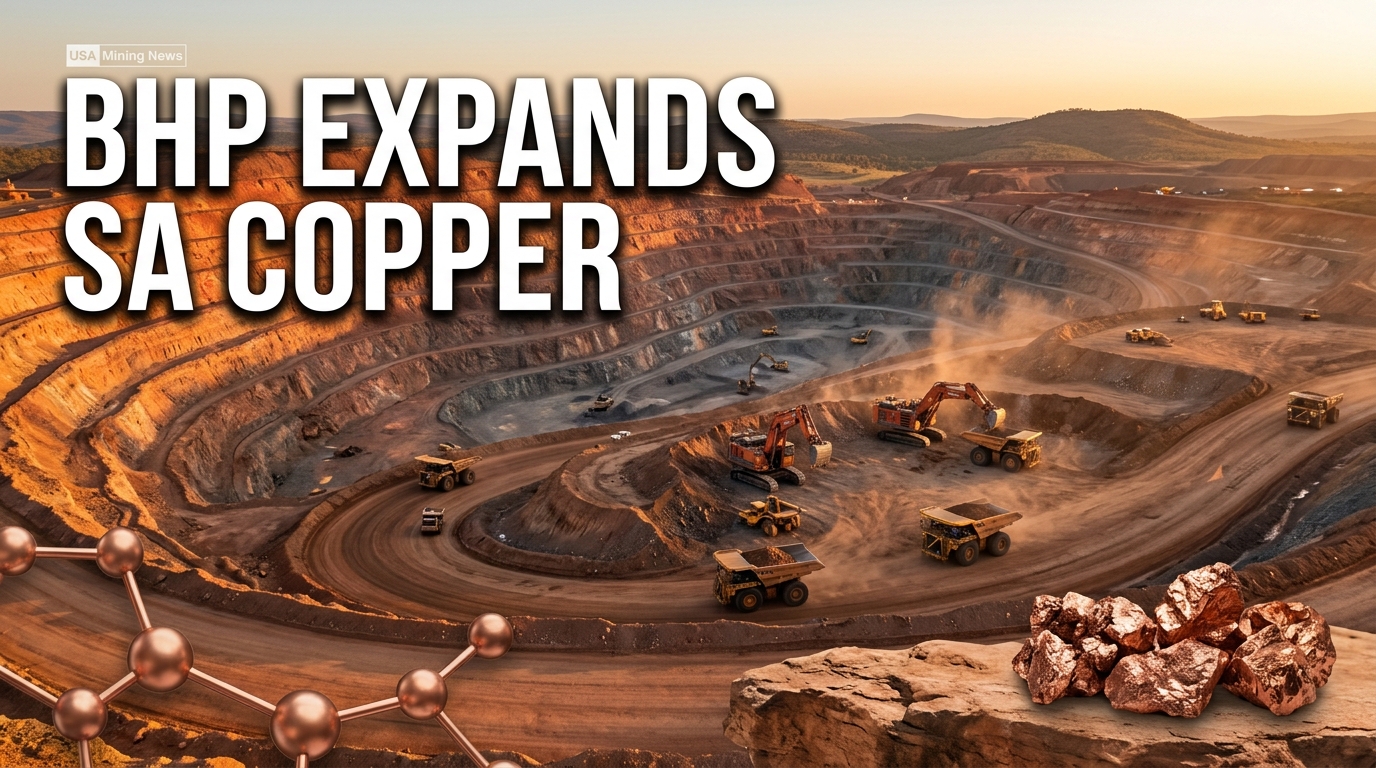
In a strategic move signaling its commitment to significant copper growth, global mining major BHP has officially appointed Worley to provide comprehensive study and engineering, procurement, and construction management (EPCM) services for potential expansion projects at its prominent Olympic Dam and Carrapateena operations in South Australia. Announced on September 8, 2026, these ambitious expansion plans represent a pivotal component of BHP’s overarching Copper SA strategy, designed to materially increase its output of this critical energy transition metal. While early phase EPCM activities are already underway, the progression of these extensive projects remains contingent upon a final investment decision (FID) by BHP’s board, a standard yet critical gateway for large-scale capital endeavors in the mining sector.
The selection of Worley, a global leader in professional services for the energy, chemicals, and resources sectors, underscores the complex and specialized nature of these undertakings. The agreements outline a multi-phased approach, covering a broad spectrum of technical and operational elements from the initial study stages through to detailed EPCM execution. This collaboration highlights a strategic alignment between BHP’s long-term vision for copper dominance and Worley’s proven capabilities in delivering complex mining infrastructure and processing solutions, particularly within the underground mining domain and for projects targeting energy transition materials.
Driving the Copper SA Growth Strategy
BHP’s Copper SA initiative represents a cornerstone of the company’s forward-looking portfolio strategy, focusing on expanding its exposure to commodities vital for decarbonization and sustainable development. South Australia hosts some of the world’s most significant copper deposits, with Olympic Dam being one of the largest known polymetallic ore bodies globally, producing copper, uranium, gold, and silver. Carrapateena, a newer and highly prospective operation, commenced production in late 2019, quickly establishing itself as a key asset within BHP's portfolio. The decision to pursue substantial expansions at both sites reflects BHP’s confidence in the long-term market fundamentals for copper and its strategic intent to solidify its position as a leading global producer.
The imperative behind this growth strategy is clear: global demand for copper is projected to escalate dramatically over the coming decades, primarily fueled by the accelerating global energy transition. Electrification of transport, the expansion of renewable energy infrastructure such as wind and solar farms, and the broad adoption of energy-efficient technologies all rely heavily on copper due to its exceptional electrical conductivity and corrosion resistance. By investing in these expansions, BHP is positioning itself to capitalize on these enduring demand trends, ensuring its operational footprint aligns with the evolving requirements of a decarbonizing world economy.
Deep Dive into the Scope: Olympic Dam and Carrapateena
The scope of services entrusted to Worley is comprehensive, covering potential enhancements across both operations, with distinct but complementary objectives:
- Olympic Dam Mine: The plans at Olympic Dam include possible block cave development and associated infrastructure. Block caving is a highly efficient, high-volume underground mining method particularly suited for large, deep ore bodies. It involves undercutting a large section of ore, allowing it to progressively collapse under its own weight, creating a continuous flow of broken ore that can be extracted. This method typically requires significant upfront capital investment but offers lower operating costs per tonne once operational, enabling access to vast ore reserves that would otherwise be uneconomical to extract. The associated infrastructure would encompass new shafts, ventilation systems, crushing and conveying systems, and potentially expanded power and water utilities to support the increased throughput from a new block cave.
- Carrapateena Operation: At Carrapateena, the focus is on the potential expansion of both underground operations and processing facilities. This could entail extending existing underground mine development, introducing additional mining fronts, or optimizing mining methods to increase ore extraction rates. Simultaneously, enhancements to the processing plant would be crucial to handle the increased ore volumes. This might involve adding new crushing circuits, grinding mills, flotation cells, or refining capacity to maintain or improve metallurgical recoveries and concentrate quality.
Worley’s mandate covers the full spectrum of activities required for these expansions, described as a "cave to concentrate" program. This holistic approach signifies that Worley will be involved in every stage, from the extraction of ore deep underground (the "cave" aspect) through to its beneficiation and the production of a high-grade copper concentrate ready for smelting (the "concentrate" aspect). Such a comprehensive scope demands deep expertise in underground mine design, materials handling, mineral processing, and large-scale project integration, ensuring seamless transitions between different project phases and operational areas.
Worley’s Mandate and Expertise
Worley’s appointment builds upon a strong history of collaboration with BHP, particularly in the realm of copper expansion planning. Over the past two years, Worley’s consulting teams in the Asia-Pacific region have already contributed significantly to BHP’s strategic copper initiatives. Their prior work included conducting development option studies, performing techno-economic analyses, assessing logistical requirements, and providing crucial assistance with overall project planning. This foundational knowledge positions Worley uniquely to transition seamlessly into the current study and EPCM phases.
Chris Ashton, CEO of Worley, articulated the strategic significance of this contract, stating, “This contract reflects Worley’s continued focus on energy transition materials, such as copper, as a priority growth market. We are pleased to provide ongoing support for BHP’s ambition to grow its copper production in South Australia. Our team brings experience in underground mining, processing and major project delivery, and we look forward to working with BHP and the local businesses in South Australia to progress these megaprojects.” This statement underscores Worley’s strategic alignment with the global shift towards green technologies and its commitment to leveraging its specialized expertise in complex mining environments.
The work for these projects will be predominantly conducted by Worley’s Australian team, leveraging deep local knowledge and engineering capabilities. This core team will be further bolstered by specialist engineering partners, ensuring access to cutting-edge technical solutions, and supported by Worley’s Globally Integrated Delivery team, which includes valuable resources from key mining hubs such as China and Chile. This global-local hybrid model allows for optimal resource allocation, leveraging diverse expertise and maintaining cost efficiency while ensuring robust project delivery standards.
The Critical Role of a Final Investment Decision (FID)
While the commencement of early phase EPCM activities signals considerable momentum, it is crucial to reiterate that the full-scale expansions are still subject to a final investment decision (FID) by BHP. An FID is a critical checkpoint in the lifecycle of any major capital project, signifying a formal commitment of significant financial resources. Before an FID is granted, BHP’s board will meticulously evaluate a range of factors, including:
- Economic Viability: Detailed financial modeling, sensitivity analysis to commodity price fluctuations, capital expenditure estimates, and projected operating costs.
- Technical Readiness: Assurance that engineering designs are robust, technical risks are mitigated, and operational plans are sound.
- Regulatory Approvals: Confirmation of all necessary environmental, social, and governmental permits.
- Market Conditions: Reassessment of long-term copper demand forecasts, supply-side dynamics, and competitive landscape.
- Risk Assessment: Comprehensive evaluation of geological, operational, social, environmental, and geopolitical risks.
The progression to these detailed study and EPCM phases indicates that BHP is sufficiently confident in the preliminary assessments and market outlook to invest further in project definition. A positive FID would unlock billions of dollars in investment, setting the stage for one of the most significant copper capacity expansions globally in the latter half of the 2020s, with implications extending well into the 2030s and beyond.
Market Context: The Electrification Imperative and Copper Demand
The increasing global demand for copper, particularly from the electrification and energy transition sectors, is a major driver behind BHP's investment strategy. Copper is an indispensable component in electric vehicles (EVs), charging infrastructure, battery storage systems, and renewable energy generation technologies like solar panels and wind turbines. For instance, an average EV can contain three to four times more copper than a conventional internal combustion engine vehicle, while offshore wind farms require significantly more copper per megawatt of capacity than fossil fuel power plants.
Industry analysts project a widening supply-demand gap for copper in the coming years, primarily due to insufficient new supply coming online to meet the exponential growth in demand. The development of new large-scale copper mines is notoriously capital-intensive and time-consuming, often taking over a decade from discovery to full production. Consequently, major miners like BHP are strategically focusing on expanding existing operations and de-risking brownfield projects to bring new volumes to market more efficiently. These expansions at Olympic Dam and Carrapateena are perfectly aligned with addressing this anticipated supply deficit, positioning BHP as a critical supplier for the future green economy.
Operational Synergies and Strategic Alignment
BHP's decision to concentrate its copper growth efforts in South Australia also leverages established operational synergies and regulatory frameworks. The region has a well-developed mining ecosystem, including skilled labor, infrastructure, and a supportive government keen on fostering resource development. Expanding existing operations allows BHP to capitalize on existing infrastructure, operational expertise, and community relationships, potentially reducing project risks and execution timelines compared to entirely new greenfield developments.
Furthermore, these investments reinforce South Australia’s standing as a globally significant copper province, attracting further investment and talent to the region. The economic benefits for local businesses and communities, through job creation, procurement opportunities, and infrastructure development, will be substantial should these projects proceed to full execution. For BHP, these expansions represent a reinforcement of its commitment to its "future-facing commodities" strategy, which prioritizes assets like copper, nickel, and potash that are essential for global decarbonization and food security.
Future Outlook and Industry Implications
As Worley progresses with the study and EPCM services, the mining industry will be closely watching for updates on BHP's FID for these South Australian copper expansions. A positive decision would signal a strong vote of confidence in the long-term copper market and could galvanize other major miners to accelerate their own copper growth initiatives. These projects, if fully realized, would represent a significant injection of new copper supply into the global market, potentially influencing price dynamics and contributing to the stability of the supply chain for critical technologies.
The scale and technical complexity of the planned block cave at Olympic Dam and the comprehensive expansions at Carrapateena underscore the long-term vision required for modern mining. It reflects an industry grappling with deeper, lower-grade ore bodies, demanding innovative technical solutions and substantial capital commitments. BHP's partnership with Worley on these "megaprojects" in South Australia serves as a bellwether for the broader mining sector, highlighting the strategic importance of copper and the collaborative efforts required to unlock its future potential for a sustainable global economy.