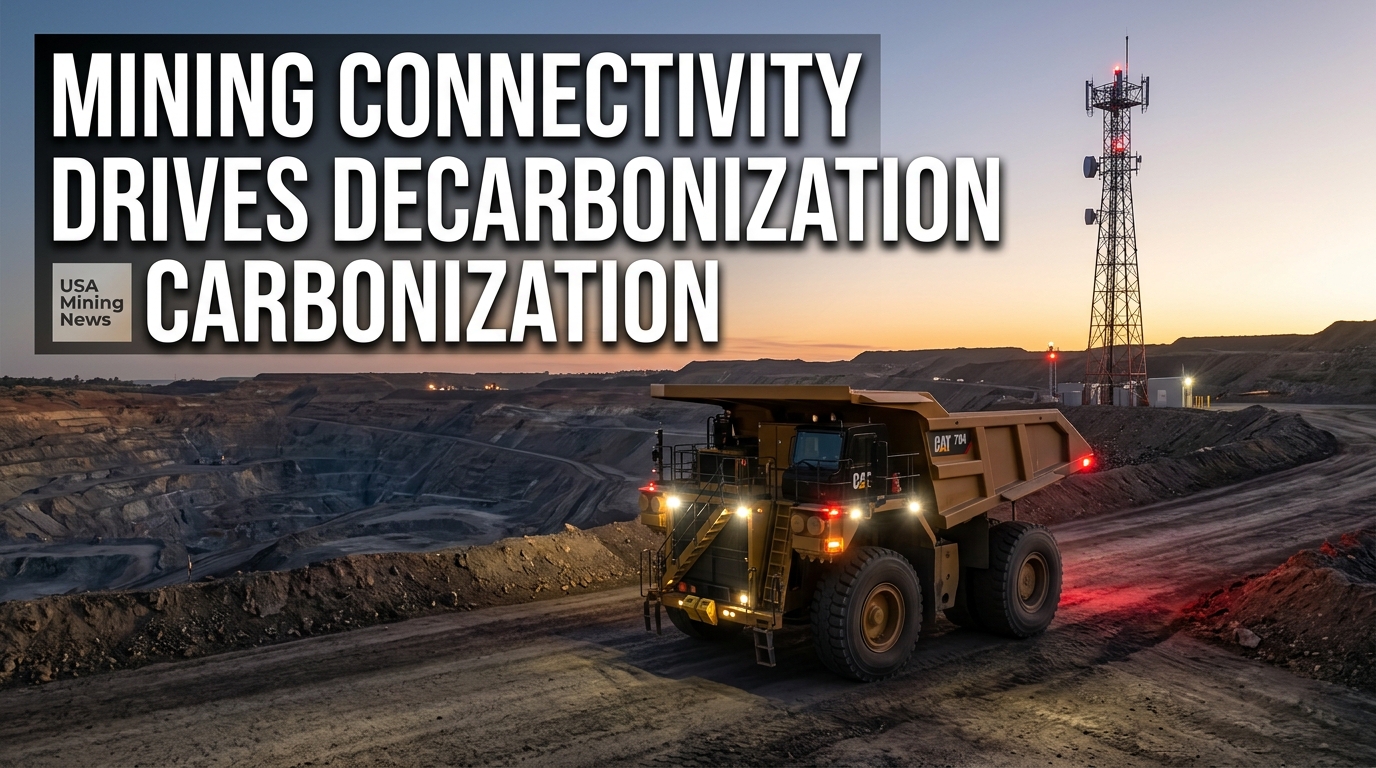
As the global mining sector navigates the complex path toward achieving net-zero operational emissions by 2050, a critical, often-overlooked enabling technology is coming to the forefront: reliable connectivity. While the industry justifiably focuses on transformative solutions like fleet electrification, advanced automation, and sophisticated emissions monitoring, all these pivotal initiatives share a common dependency on the ability to move vast quantities of data seamlessly and reliably across expansive mine sites. This insight, underscored by industry observations as of August 12, 2026, positions connectivity not as an optional upgrade, but as essential decarbonization infrastructure.
The imperative for decarbonization within mining is driven by a confluence of factors, including stringent environmental regulations, increasing investor scrutiny over Environmental, Social, and Governance (ESG) performance, and a corporate commitment to sustainability. Most major mining companies have already articulated ambitious emissions-reduction targets, signaling a profound shift in operational philosophy. However, the path to these targets is fraught with challenges, requiring more than simply deploying new technologies. It demands the intelligent integration and optimization of these innovations, a process fundamentally reliant on robust data flow.
Whether the goal is to reduce the substantial fuel consumption of haul trucks, optimize energy-intensive processing plants, or scale autonomous operations, operators require real-time, actionable operational data. This data enables them to swiftly identify inefficiencies, respond to changing conditions, and make informed decisions that directly impact energy use and emissions. In this high-stakes environment, reliable connectivity is increasingly recognized as the indispensable operational foundation that allows every major decarbonization investment to deliver tangible, measurable results.
The Pivotal Role of Connected Fleet Management in Reducing Diesel Waste
One of the most significant contributors to operational emissions in mining remains diesel-powered mobile equipment. Gigantic haul trucks, loaders, and auxiliary vehicles consume vast amounts of fuel, making their optimization a priority for any decarbonization strategy. While a complete transition to fleet electrification is a long-term strategic priority for many operations—and a capital-intensive undertaking—substantial and immediate reductions in emissions can be achieved by refining how existing diesel equipment is dispatched, routed, and maintained today.
Fuel consumption in large-scale mining operations is heavily influenced by inefficiencies such as queuing at loading or dumping points, congestion on haul roads, excessive idling, and suboptimal routing. These issues not only waste fuel but also reduce overall productivity and increase wear and tear on equipment. This is where reliable connectivity, serving as the backbone for advanced fleet-management systems (FMS), demonstrates its immediate value. By enabling these systems to collect and share real-time information from every truck, loader, and piece of processing equipment across the site, operators gain unprecedented visibility and control.
This continuous data stream allows dispatch systems to dynamically optimize movements across the entire mine site. Algorithms can calculate the most efficient routes, minimize unnecessary travel distances, and precisely coordinate arrivals at loading and processing points. The reduction in wasted energy from reduced idling time and more efficient travel directly translates into lower fuel burn and, consequently, reduced greenhouse gas emissions. Furthermore, by improving the coordination of assets, operations can significantly enhance asset utilization, meaning more material moved per unit of energy consumed.
Enabling Automation and Enhancing Operational Efficiency: The Boliden Aitik Case Study
Beyond optimizing traditional diesel fleets, reliable connectivity is also the lifeblood of autonomous and remote-operated equipment. These advanced systems promise not only significant gains in efficiency but also enhanced safety by removing human operators from hazardous environments. However, their successful deployment hinges on continuous, predictable, and low-latency communications across the entire mine site. Any interruption or delay in data transmission can compromise safety protocols, disrupt operations, and negate the benefits of automation.
The operational advantages of such connectivity are not merely theoretical; they are being demonstrated in leading mines globally. Boliden’s Aitik copper mine in Sweden provides a compelling practical example of how robust connectivity can support automation, improve asset utilization, and significantly reduce operational inefficiencies. According to reports from Ericsson, a key technology provider, the Aitik mine has achieved remarkable results by leveraging reliable network infrastructure.
Specifically, the mine has reported saving approximately two hours each day on a typical 20-hour operating schedule. This seemingly modest daily saving translates into a substantial cumulative gain over weeks and months, directly contributing to a reported 10% increase in production. Moreover, the mine has experienced an impressive 50% improvement in overall operational efficiency. These figures highlight the profound impact that better equipment utilization, enabled by precise automation and reduced idle time, can have on both productivity and the energy required per unit of output. Consistent acceleration, braking, and adherence to optimized routes by autonomous vehicles inherently improve fuel efficiency compared to the irregular patterns often associated with human driving.
Real-Time Mine Data for Broader Energy Efficiency
While mobile equipment is a significant energy consumer, it is by no means the only one. Fixed infrastructure and processes such as ventilation systems in underground mines, dewatering pumps, crushing and grinding circuits, and materials handling systems also consume substantial energy. In many conventional setups, these systems are controlled by fixed schedules or operate based on incomplete information, often running at full capacity even when demand has fallen or conditions do not warrant such intensity.
The integration of reliable connectivity facilitates a paradigm shift through connected environmental monitoring. For instance, in underground operations, ventilation systems can move away from fixed schedules to "ventilation on demand" (VoD), responding in real-time to actual air quality conditions, the precise locations of workers, and the operational status of equipment. This prevents unnecessary ventilation of unoccupied areas, leading to significant energy savings.
Similarly, pumps, processing equipment, and utilities can be continuously monitored. This real-time data allows operators to identify abnormal consumption patterns, optimize utilization based on demand, and proactively reduce waste. The true power emerges when these disparate applications share a single, unified operational picture, allowing for comprehensive optimization across the entire mine ecosystem.
Advanced systems, such as Ericsson Private 5G combined with Becker/LASEC’s Smartflow platform, are designed to gather data from a multitude of sensors, machinery, and operational systems. This aggregated data creates a live, digital representation of the mine, enabling a suite of interconnected applications. These include, but are not limited to:
- Ventilation on Demand (VoD): Dynamic adjustment of airflow based on real-time needs.
- Continuous Environmental Monitoring: Real-time tracking of air quality, temperature, and other critical environmental parameters.
- Predictive Maintenance: Monitoring equipment health to predict failures and schedule maintenance proactively, minimizing downtime and energy spikes from stressed machinery.
- Dynamic Fleet Dispatch: Real-time optimization of vehicle movements, as discussed previously.
- Collision Avoidance Systems: Enhancing safety by preventing incidents involving personnel and equipment.
- Man-Down Detection and Evacuation Guidance: Rapid response capabilities in emergency situations, ensuring worker safety.
By connecting these formerly siloed systems, operators can achieve better coordination of equipment, continuously monitor and manage air quality, precisely identify maintenance needs, respond more effectively to emergencies, and, crucially, operate all energy-consuming systems according to real-time operational performance rather than static schedules. This continuous visibility into energy, emissions, water, and equipment use also provides a robust foundation for strengthening reporting and audit capabilities, enabling sustainability teams to track progress against emission targets with unprecedented accuracy and transparency.
Building a Scalable Business Case for Mine Connectivity
In the current global economic landscape, characterized by persistent cost pressures and often volatile commodity markets, any significant technology investment in mining must be underpinned by a clear and measurable business case. Connectivity, traditionally viewed as a supporting utility, is often easier to justify when approached as a shared operational infrastructure rather than a discrete project tied to a single machine or a narrow application.
Private 5G networks, for instance, offer a versatile and robust platform capable of simultaneously supporting a diverse array of critical operational functions. These include emissions monitoring, energy tracking, fleet optimization, remote operations, predictive maintenance, environmental monitoring, and worker safety applications. Crucially, they also lay the groundwork for future AI-driven applications and advanced analytics. This multi-faceted utility allows the benefits of connectivity to be evaluated across a broad spectrum of key performance indicators, encompassing production outcomes, reductions in operating costs, improvements in safety, and the achievement of sustainability targets.
Furthermore, advances in radio technology have significantly improved the energy efficiency of private 5G networks themselves. This means that mines can expand their digital operations and integrate more connected devices without a proportional increase in the power required to operate the communications infrastructure, reinforcing the sustainable aspect of the investment. Establishing this reusable digital foundation eliminates the need to rebuild communications infrastructure for every new digital initiative, offering long-term value and scalability.
The Future of Connected Mining: A Digital Decarbonized Frontier
The journey to net-zero is complex, but reliable connectivity acts as the central nervous system for the modern mine, integrating disparate technologies into a cohesive, intelligent whole. It is the conduit through which real-time data flows, enabling the precision and agility required to optimize operations for both productivity and environmental stewardship.
As the mining industry continues to innovate, the strategic importance of a robust, ubiquitous, and low-latency network infrastructure will only grow. It will serve as the launchpad for future advancements in artificial intelligence, machine learning, and advanced robotics, all contributing to a more efficient, safer, and ultimately, a more sustainable mining sector. For mining executives and investors, understanding the foundational role of connectivity is paramount to accurately assessing the viability and long-term success of decarbonization strategies in the years leading up to 2050 and beyond.