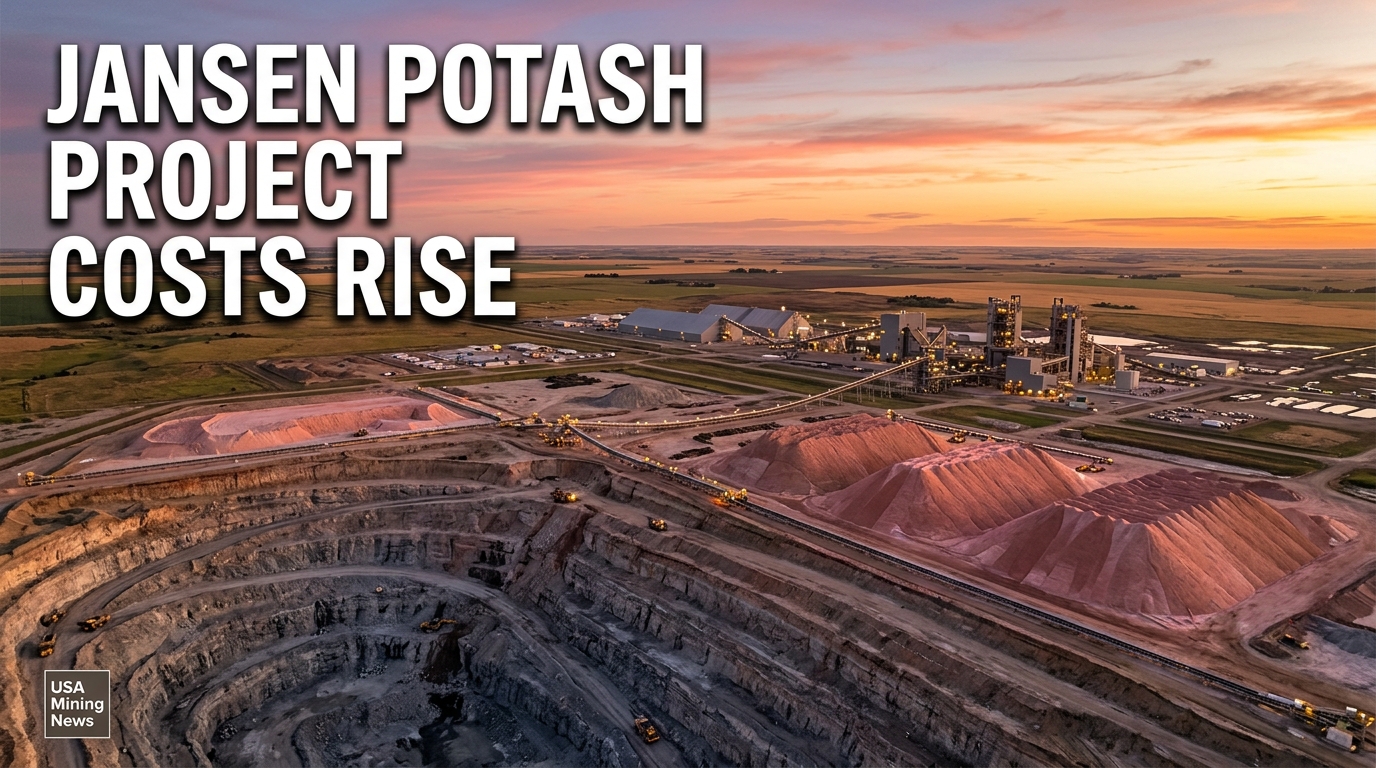
BHP Rerates Jansen Stage Two: Escalating Costs and Extended Timelines for Crucial Potash Project
In a significant announcement impacting its long-term growth strategy, global mining giant BHP has revised its total investment estimate for Stage Two of the Jansen potash project in Saskatchewan, Canada, by a substantial $2 billion. The projected cost for this critical development has climbed from the originally approved $4.9 billion to a new figure of $6.9 billion, following a comprehensive review of cost drivers and schedule forecasts. This reassessment also indicates a two-year delay in the project's timeline, with first production from Stage Two now anticipated in late financial year 2031 (FY31), pushing back from the previously planned commencement in FY29.
The Jansen project is a cornerstone of BHP's strategic pivot towards agricultural commodities, aiming to diversify its portfolio beyond its traditional strength in iron ore, copper, and metallurgical coal. With global food security concerns and the increasing need for enhanced crop yields, potash, an essential agricultural nutrient, is considered a 'future-facing' commodity with robust long-term demand fundamentals. This latest update, released on June 19, 2026, highlights the inherent complexities and challenges associated with developing large-scale, world-class mining assets in the current global economic climate.
Analysis of Cost Drivers and Project Dynamics
The decision to increase the capital expenditure and extend the timeline for Jansen Stage Two stems from an exhaustive review initiated by BHP following an earlier signal of potential adjustments. Recall that approval for Jansen Stage Two was granted in October 2023, with an initial investment cost estimate of $4.9 billion. Subsequently, in August 2025, BHP announced a two-year extension to the project’s timeline, moving the expected production start to FY31, and concurrently confirmed its intention to provide an updated capital expenditure (capex) estimate in the second half of FY26. The current announcement fulfills that commitment.
BHP attributed the majority of the $2 billion increase to several key factors identified during this extensive review process. These include:
- Additional Construction Hours: A deeper understanding of the project's intricacies and the scale of the required work has necessitated a greater allocation of labor hours than initially modelled. This can arise from unforeseen geological conditions, design optimizations, or more conservative safety protocols.
- Higher Material Quantities: The review indicated that larger volumes of construction materials, specialized components, and infrastructure elements will be required to complete Stage Two to specifications. This often reflects a more detailed engineering design and a fuller scope of work.
- Cost Escalation: General inflationary pressures, particularly in the energy, labor, and specialized equipment sectors, have continued to impact capital projects globally. While BHP is a seasoned operator, even the most meticulous planning can be susceptible to broader economic trends that drive up the cost of goods and services over extended development timelines.
Despite these upward revisions, BHP clarified that the project is making tangible progress. As of the end of May 2026, Jansen Stage Two was reported to be 16% complete in terms of overall physical construction. Critically, engineering progress for this stage stands at an impressive 83%. This high level of engineering completion is significant, as it typically reduces the intrinsic risks associated with the remaining construction and execution phases by providing a more definitive blueprint for the work ahead. It signals that while the costs and timeline have been adjusted, the technical understanding and planning are robust, setting a clearer path for future development.
Strategic Importance and Market Outlook for Potash
Jansen is not merely a revenue diversification play; it is a strategic long-term investment in a commodity vital for global agriculture. Potash fertilizers are indispensable for maximizing crop yields and ensuring food security for a growing global population. As demographics shift and dietary preferences evolve, demand for food is expected to intensify, underpinning the long-term fundamentals for potash.
Brandon Craig, BHP Americas president and CEO-elect, underscored this strategic imperative, stating, "BHP continues to invest in its long-term growth strategy. Jansen is an important pillar of BHP’s strategy and will deliver exposure to a future-facing commodity with strong demand fundamentals and portfolio diversification benefits."
BHP maintains its forecast for Jansen Stage Two output at approximately 4.36 million tonnes per annum (mtpa) of potash. With Stage One expected to produce a similar volume, and a planned two-year ramp-up period for both stages, the company forecasts that combined Jansen production will eventually reach an impressive 8.5 mtpa. This volume is projected to represent approximately 10% of the world's total potash output, positioning BHP as a major player in the global potash market and Canada as a continued dominant force in supply.
Financial Implications and Shareholder Value
The revised investment figures naturally prompt a re-evaluation of the project's financial attractiveness. At consensus potash prices, the updated internal rate of return (IRR) for Jansen Stage Two is now estimated at 11%, with an expected payback period of eight years. While lower than initial projections might have been, these metrics still indicate a solid return profile for a large-scale, long-life asset in the mining sector. Importantly, the company reported that underlying earnings before interest, taxes, depreciation and amortisation (EBITDA) margins are expected to remain above 65% once the project reaches maturity, highlighting the robust profitability of potash operations.
Paradoxically, despite the increased capital intensity, BHP remains confident in Jansen’s operational efficiency. The company stated that once Stage Two has reached full ramp-up, the combined Jansen mine is set to be the lowest-unit-cost Canadian potash mine, with an estimated operating cost range of $114–130 per tonne. This range is consistent with the initial estimate at the time of project approval, underscoring BHP's belief in the long-term cost competitive advantage of the operation. Achieving a low unit cost is a significant strategic advantage, providing resilience against commodity price fluctuations and ensuring strong margins throughout market cycles.
In light of the higher projected capital intensity for Jansen, BHP expects to recognize an impairment charge of roughly $2.3 billion, both before and after tax, in its financial results for 2026. This non-cash accounting adjustment relates to its investment in the project to date and reflects a re-evaluation of the asset's carrying value based on the updated cost and schedule forecasts. While it impacts reported earnings, it is a standard accounting practice for reviewing the economic viability of large capital assets.
Despite these significant adjustments to the Jansen project, it is pertinent to note that BHP does not expect to change its group capital expenditure guidance for FY27, which remains approximately $11 billion. This indicates that while Jansen's costs have shifted, BHP's overall capital allocation strategy and financial discipline across its diverse portfolio remain on track for the immediate future.
The Path Forward: Stage One Progress and Future Milestones
Crucially, the update from BHP reaffirms that Jansen Stage One remains on track for first production by mid-calendar year 2027. This timeline is in line with the updated cost and schedule that was set in January 2026, suggesting that lessons learned and reviews undertaken have already been incorporated into Stage One’s execution. The continued progress on Stage One provides a critical short-term milestone for the project, demonstrating BHP's capability in bringing portions of this massive development online.
The staggered commissioning of Jansen is a calculated risk mitigation strategy, allowing for operational insights from Stage One to potentially inform later stages. With Stage One ramping up and Stage Two targeting first production in late FY31, the full potential of Jansen will be realized over the next decade. The successful integration and ramp-up of both stages will solidify BHP's position in the global potash market, contributing significantly to its long-term commodity mix and financial performance.
For mining industry professionals and investors, BHP's latest update on Jansen Stage Two serves as a pertinent reminder of the escalating costs and extended timelines often inherent in large-scale, complex resource development projects. While the revisions are substantial, BHP's continued commitment, robust financial outlook for the project, and the strategic importance of potash underscore the company's long-term vision for this ambitious Canadian venture. The industry will closely watch Jansen's continued development, not just for its operational success, but also as a bellwether for capital project execution in an increasingly complex and inflationary global environment.